







Question: 9. Name at least five important things to keep in mind if you want to work successfully with vendors in direct marketing. Discuss each concept
9. Name at least five important things to keep in mind if you want to work successfully with vendors in direct marketing. Discuss each concept briefly.
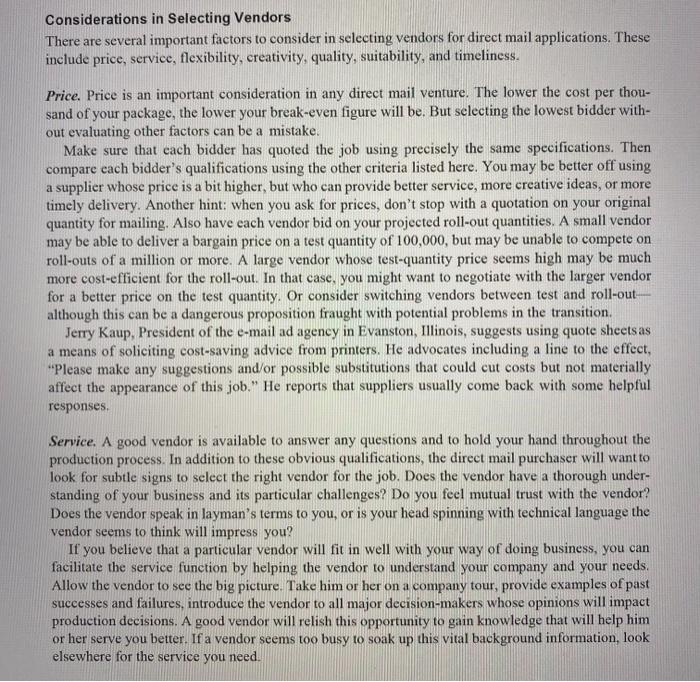
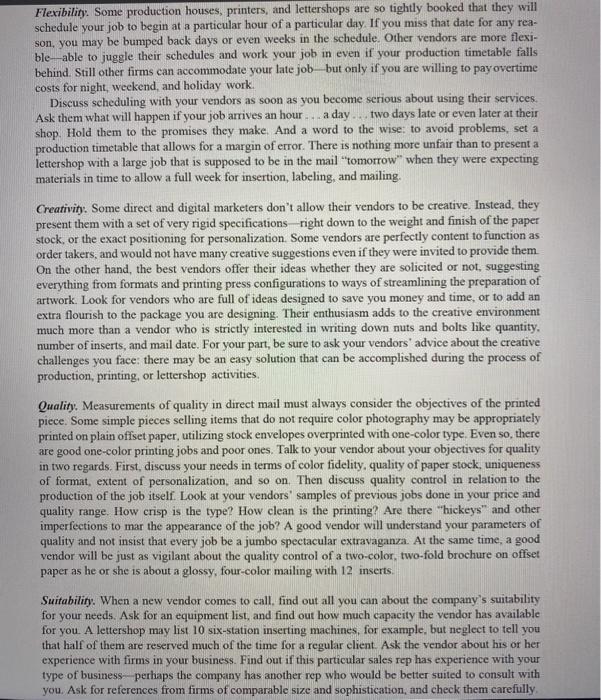
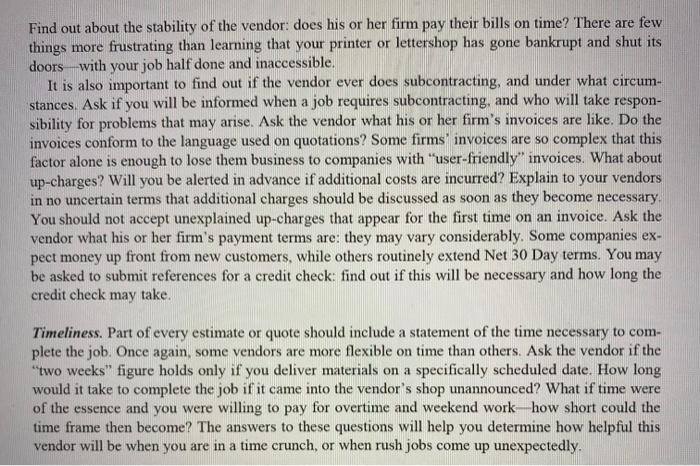
Considerations in Selecting Vendors There are several important factors to consider in selecting vendors for direct mail applications. These include price, service, flexibility, creativity, quality, suitability, and timeliness. Price. Price is an important consideration in any direct mail venture. The lower the cost per thou-sand of your package, the lower your break-even figure will be. But selecting the lowest bidder with-out evaluating other factors can be a mistake. Make sure that each bidder has quoted the job using precisely the same specifications. Then compare each bidder's qualifications using the other criteria listed here. You may be better off using a supplier whose price is a bit higher, but who can provide better service, more creative ideas, or more timely delivery. Another hint: when you ask for prices, don't stop with a quotation on your original quantity for mailing. Also have each vendor bid on your projected roll-out quantities. A small vendor may be able to deliver a bargain price on a test quantity of 100,000 , but may be unable to compete on roll-outs of a million or more. A large vendor whose test-quantity price seems high may be much more cost-efficient for the roll-out. In that case, you might want to negotiate with the larger vendor for a better price on the test quantity. Or consider switching vendors between test and roll-out-although this can be a dangerous proposition fraught with potential problems in the transition. Jerry Kaup, President of the e-mail ad agency in Evanston, Illinois, suggests using quote sheetsas a means of soliciting cost-saving advice from printers. He advocates including a line to the effect, "Please make any suggestions and/or possible substitutions that could cut costs but not materially affect the appearance of this job." He reports that suppliers usually come back with some helpful responses. Service. A good vendor is available to answer any questions and to hold your hand throughout the production process. In addition to these obvious qualifications, the direct mail purchaser will want to look for subtle signs to select the right vendor for the job. Does the vendor have a thorough under-standing of your business and its particular challenges? Do you feel mutual trust with the vendor? Does the vendor speak in layman's terms to you, or is your head spinning with technical language the vendor seems to think will impress you? If you believe that a particular vendor will fit in well with your way of doing business, you can facilitate the service function by helping the vendor to understand your company and your needs. Allow the vendor to see the big picture. Take him or her on a company tour, provide examples of past successes and failures, introduce the vendor to all major decision-makers whose opinions will impact production decisions. A good vendor will relish this opportunity to gain knowledge that will help him or her serve you better. If a vendor seems too busy to soak up this vital background information, look elsewhere for the service you need. Find out about the stability of the vendor: does his or her firm pay their bills on time? There are few things more frustrating than learning that your printer or lettershop has gone bankrupt and shut its doors with your job half done and inaccessible. It is also important to find out if the vendor ever does subcontracting, and under what circum-stances. Ask if you will be informed when a job requires subcontracting, and who will take respon-sibility for problems that may arise. Ask the vendor what his or her firm's invoices are like. Do the invoices conform to the language used on quotations? Some firms' invoices are so complex that this factor alone is enough to lose them business to companies with "user-friendly" invoices. What about up-charges? Will you be alerted in advance if additional costs are incurred? Explain to your vendors in no uncertain terms that additional charges should be discussed as soon as they become necessary. You should not accept unexplained up-charges that appear for the first time on an invoice. Ask the vendor what his or her firm's payment terms are: they may vary considerably. Some companies ex-pect money up front from new customers, while others routinely extend Net 30 Day terms. You may be asked to submit references for a credit check: find out if this will be necessary and how long the credit check may take. Timeliness. Part of every estimate or quote should include a statement of the time necessary to com-plete the job. Once again, some vendors are more flexible on time than others. Ask the vendor if the "two weeks" figure holds only if you deliver materials on a specifically scheduled date. How long would it take to complete the job if it came into the vendor's shop unannounced? What if time were of the essence and you were willing to pay for overtime and weekend work-how short could the time frame then become? The answers to these questions will help you determine how helpful this vendor will be when you are in a time crunch, or when rush jobs come up unexpectedly. Flexibility. Some production houses, printers, and lettershops are so tightly booked that they will schedule your job to begin at a particular hour of a particular day. If you miss that date for any rea-son, you may be bumped back days or even weeks in the schedule. Other vendors are more flexi-ble-able to juggle their schedules and work your job in even if your production timetable falls behind. Still other firms can accommodate your late job - but only if you are willing to payovertime costs for night, weekend, and holiday work. Discuss scheduling with your vendors as soon as you become serious about using their services. Ask them what will happen if your job arrives an hour . . . a day ... two days late or even later at their shop. Hold them to the promises they make. And a word to the wise: to avoid problems, set a production timetable that allows for a margin of error. There is nothing more unfair than to present a lettershop with a large job that is supposed to be in the mail "tomorrow" when they were expecting materials in time to allow a full week for insertion, labeling, and mailing. Creativity: Some direct and digital marketers don't allow their vendors to be creative. Instead, they present them with a set of very rigid specifications - right down to the weight and finish of the paper stock, or the exact positioning for personalization. Some vendors are perfectly content to function as order takers, and would not have many creative suggestions even if they were invited to provide them On the other hand, the best vendors offer their ideas whether they are solicited or not, suggesting everything from formats and printing press configurations to ways of streamlining the preparation of artwork. Look for vendors who are full of ideas designed to save you money and time, or to add an extra flourish to the package you are designing. Their enthusiasm adds to the creative environment much more than a vendor who is strictly interested in writing down nuts and bolts like quantity, number of inserts, and mail date. For your part, be sure to ask your vendors' advice about the creative challenges you face: there may be an easy solution that can be accomplished during the process of production, printing, or lettershop activities. Quality. Measurements of quality in direct mail must always consider the objectives of the printed piece. Some simple pieces selling items that do not require color photography may be appropriately printed on plain offset paper, utilizing stock envelopes overprinted with one-color type. Even so, there are good one-color printing jobs and poor ones. Talk to your vendor about your objectives for quality in two regards. First, discuss your needs in terms of color fidelity. quality of paper stock, uniqueness of format, extent of personalization, and so on. Then discuss quality control in relation to the production of the job itself. Look at your vendors' samples of previous jobs done in your price and quality range. How crisp is the type? How clean is the printing? Are there "hickeys" and other imperfections to mar the appearance of the job? A good vendor will understand your parameters of quality and not insist that every job be a jumbo spectacular extravaganza. At the same time, a good vendor will be just as vigilant about the quality control of a two-color, two-fold brochure on offset paper as he or she is about a glossy, four-color mailing with 12 inserts. Suitability. When a new vendor comes to call, find out all you can about the company's suitability for your needs. Ask for an equipment list, and find out how much capacity the vendor has available for you. A lettershop may list 10 six-station inserting machines, for example, but neglect to tell you that half of them are reserved much of the time for a regular elient. Ask the vendor about his or her experience with firms in your business. Find out if this particular sales rep has experience with your type of business-perhaps the company has another rep who would be better suited to consult with you. Ask for references from firms of comparable size and sophistication, and check them carefully
Step by Step Solution
There are 3 Steps involved in it

Get step-by-step solutions from verified subject matter experts
 Study Help