Question: 9. On Pages 719-722 of the Walsh text, the author presents the 2013 case of Barnett v PA Consulting Group. In this case a 57-year
9. On Pages 719-722 of the Walsh text, the author presents the 2013 case of Barnett v PA Consulting Group. In this case a 57-year old woman (Judith Barnett) alleged she was the victim of sexual and age discrimination when she was fired by her employer. The trial court entered a summary judgment in favor of the employer. Did the federal appellate court agree with the trial court or did it rule that summary judgment was not proper? Explain.
10. The court notes that it does not wish to act as a super personnel (human resources) office. It states the employer was free to restructure its business as it wishes, etc. and that would be legal. The employer alleged that Ms. Barnett was simply not a good fit for the newly restructured business. Why didn't the court respect the wishes of the employer? Explain.
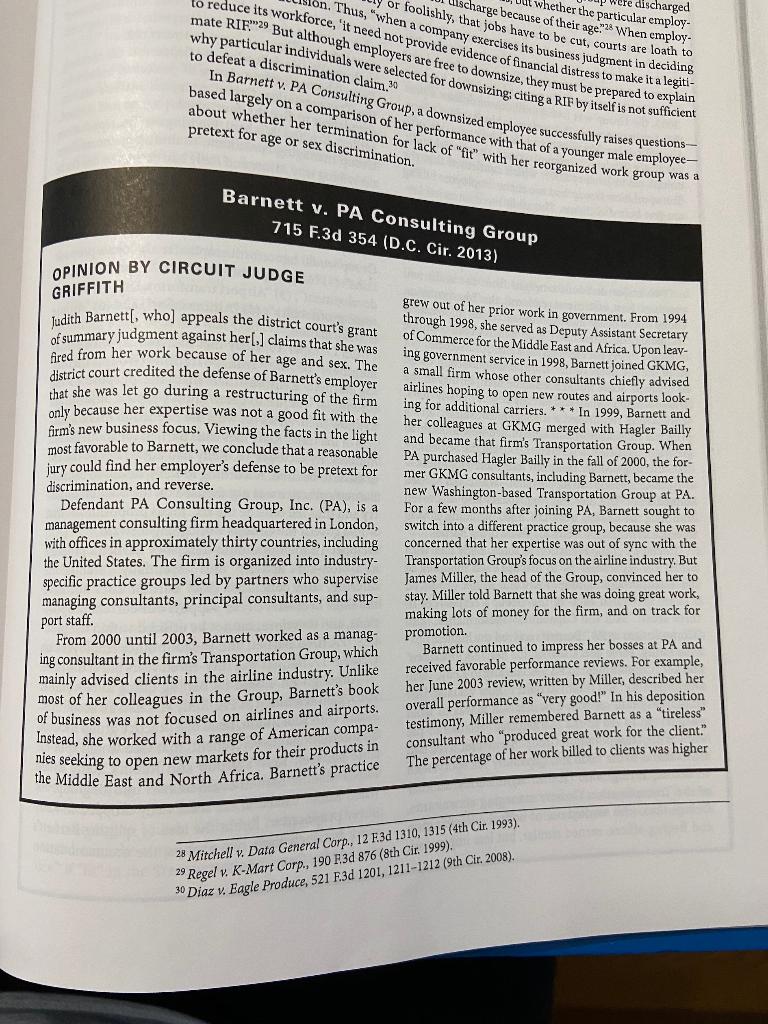
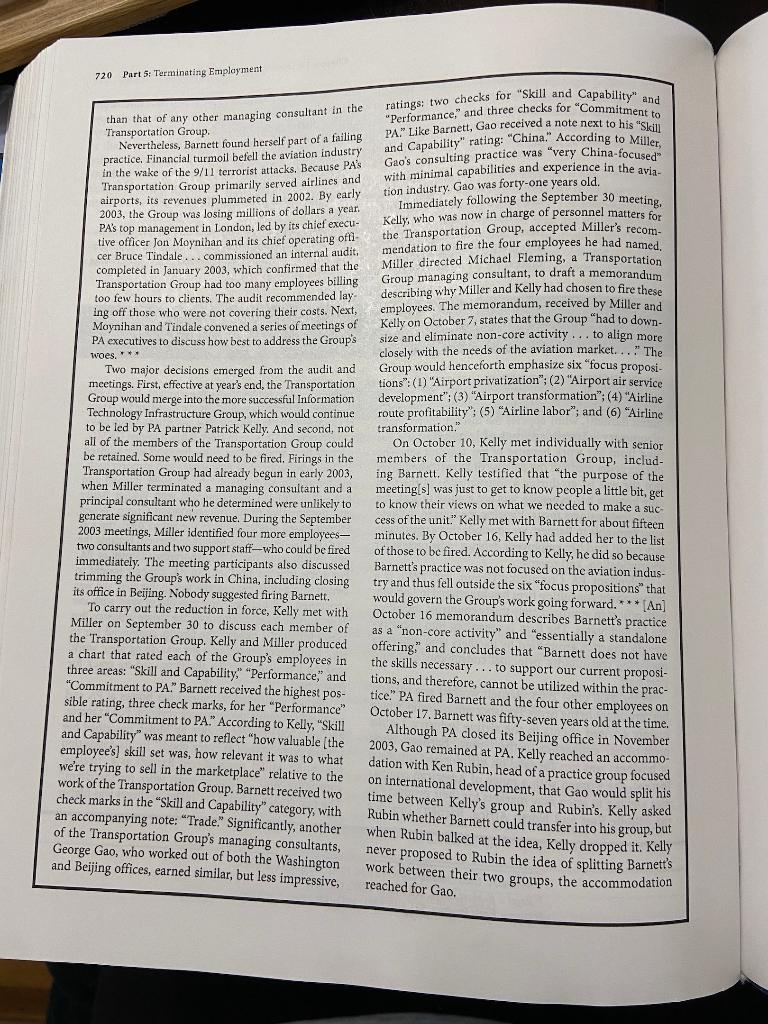
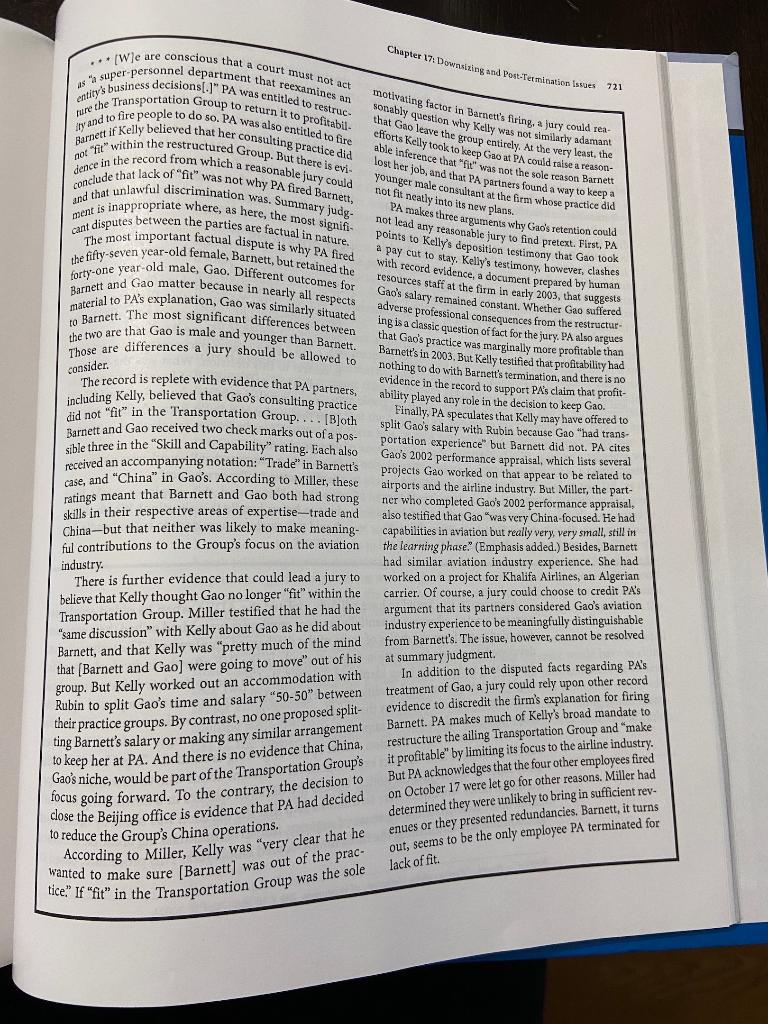
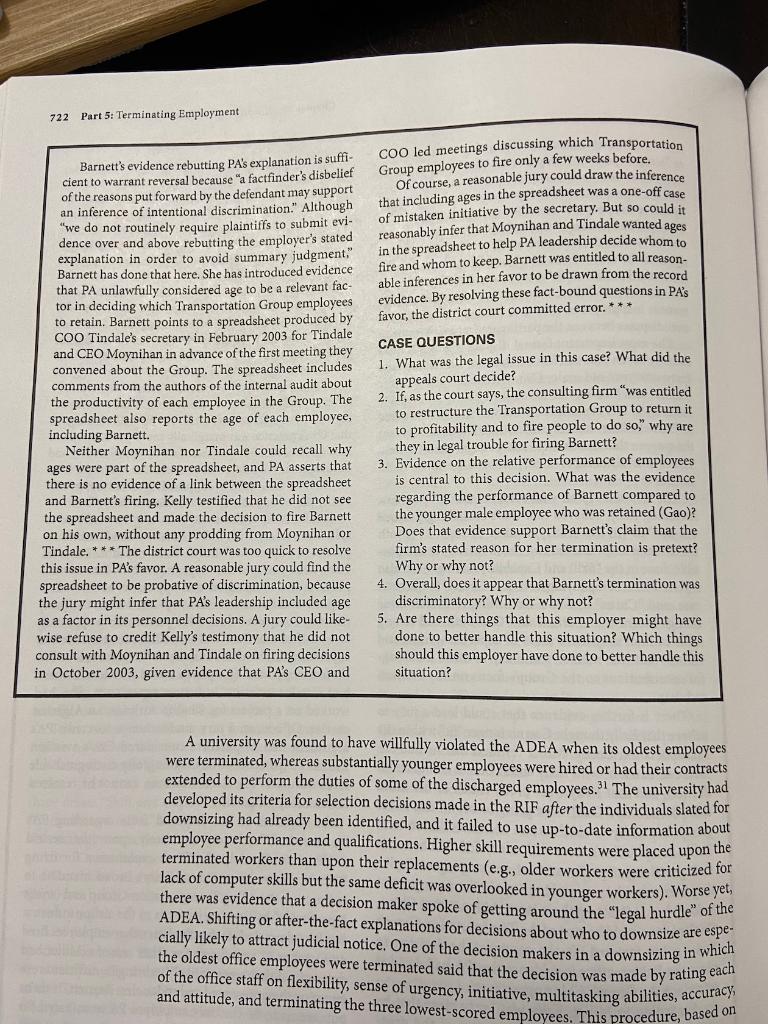
reduce its workforce, 'it need not provide evidence of financial distress to make it a legiti- Thus, "when a company exercises its business judgment in deciding mate RIF29 But although employers are free to downsize, they must be prepared to explain why particular individuals were selected for downsizing: citing a RIF by itself is not sufficient Judith Barnett, who] appeals the district court's grant of summary judgment against her[] claims that she was foolishly, that jobs have to be cut, courts are loath to In Barnett v. PA Consulting Group, a downsized employee successfully raises questions OPINION BY CIRCUIT JUDGE whether the particular employ- scharge because of their age 2 When employ- Wefe discharged to defeat a discrimination claim. about whether her termination for lack of "fit" with her reorganized work group was a pretext for age or sex discrimination. Barnett v. PA Consulting Group 715 F.3d 354 (D.C. Cir. 2013) GRIFFITH Bailly fired from her work because of her age and sex. The district court credited the defense of Barnett's employer that she was let go during a restructuring of the firm only because her expertise was not a good fit with the firm's new business focus. Viewing the facts in the light most favorable to Barnett, we conclude that a reasonable jury could find her employer's defense to be pretext for discrimination, and reverse. Defendant PA Consulting Group, Inc. (PA), is a management consulting firm headquartered in London, with offices in approximately thirty countries, including the United States. The firm is organized into industry- specific practice groups led by partners who supervise managing consultants, principal consultants, and sup- port staff. From 2000 until 2003, Barnett worked as a manag- ing consultant in the firm's Transportation Group, which mainly advised clients in the airline industry. Unlike most of her colleagues in the Group, Barnett's book of business was not focused on airlines and airports. Instead, she worked with a range of American compa- nies seeking to open new markets for their products in the Middle East and North Africa. Barnett's practice grew out of her prior work in government. From 1994 through 1998, she served as Deputy Assistant Secretary of Commerce for the Middle East and Africa. Upon leav- ing government service in 1998, Barnett joined GKMG, a small firm whose other consultants chiefly advised airlines hoping to open new routes and airports look ing for additional carriers. * * * In 1999, Barnett and her colleagues at GKMG merged with Hagler and became that firm's Transportation Group. When PA purchased Hagler Bailly in the fall of 2000, the for- mer GKMG consultants, including Barnett, became the new Washington-based Transportation Group at PA. For a few months after joining PA, Barnett sought to switch into a different practice group, because she was concerned that her expertise was out of sync with the Transportation Group's focus on the airline industry. But James Miller, the head of the Group, convinced her to stay. Miller told Barnett that she was doing great work, making lots of money for the firm, and on track for promotion Barnett continued to impress her bosses at PA and received favorable performance reviews. For example, her June 2003 review, written by Miller, described her overall performance as "very good!" In his deposition testimony, Miller remembered Barnett as a "tireless" consultant who "produced great work for the client." The percentage of her work billed to clients was higher 28 Mitchell v. Data General Corp., 12 E3d 1310, 1315 (4th Cir. 1993). 2 Regel v. K-Mart Corp., 190 F.3d 876 (8th Cir. 1999). 30 Diaz v. Eagle Produce, 521 E3d 1201, 1211-1212 (9th Cir. 2008). PA." Like Barnett, Gao received a note next to his "Skill to align more "Performance," and three checks for "Commitment to ratings: two checks for "Skill and Capability and and Capability rating: "China." According to Miller, Kelly, who was now in charge of personnel matters for 720 Part 5: Terminating Employment than that of any other managing consultant in the Transportation Group, Nevertheless, Barnett found herself part of a failing practice. Financial turmoil befell the aviation industry Gao's consulting practice was "very China-focused in the wake of the 9/11 terrorist attacks. Because PA's with minimal capabilities and experience in the avia Transportation Group primarily served airlines and tion industry. Gao was forty-one years old. airports, its revenues plummeted in 2002. By carly Immediately following the September 30 meeting, 2003, the Group was losing millions of dollars a year. PA's top management in London, led by its chief execu- the Transportation Group, accepted Miller's recom- tive officer Jon Moynihan and its chief operating offi mendation to fire the four employees he had named cer Bruce Tindale... commissioned an internal audit, Miller directed Michael Fleming, a Transportation completed in January 2003, which confirmed that the Group managing consultant, to draft a memorandum Transportation Group had too many employees billing too few hours to clients. The audit recommended lay describing why Miller and Kelly had chosen to fire these ing off those who were not covering their costs. Next, employees. The memorandum, received by Miller and Moynihan and Tindale convened a series of meetings of Kelly on October 7, states that the Group had to down- PA executives to discuss how best to address the Group's size and eliminate non-core activity woes." closely with the needs of the aviation market...." The Two major decisions emerged from the audit and Group would henceforth emphasize six "focus proposi- meetings. First, effective at year's end, the Transportation tions":(1) "Airport privatization; (2) "Airport air service Group would merge into the more successful Information development"; (3) "Airport transformation"; (4) "Airline Technology Infrastructure Group, which would continue route profitability": (5) "Airline labor"; and (6) "Airline to be led by PA partner Patrick Kelly. And second, not transformation all of the members of the Transportation Group could On October 10, Kelly met individually with senior be retained. Some would need to be fired. Firings in the members of the Transportation Group, includ- Transportation Group had already begun in early 2003, ing Barnett. Kelly testified that the purpose of the when Miller terminated a managing consultant and a meeting(s) was just to get to know people a little bit, get principal consultant who he determined were unlikely to to know their views on what we needed to make a suc generate significant new revenue. During the September cess of the unit." Kelly met with Barnett for about fifteen 2003 meetings, Miller identified four more employees, minutes. By October 16, Kelly had added her to the list two consultants and two support staff-who could be fired immediately. The meeting participants also discussed Barnett's practice was not focused on the aviation indus- of those to be fired. According to Kelly, he did so because trimming the Groups work in China, including closing try and thus fell outside the six"focus propositions that its office in Beijing. Nobody suggested firing Barnett. would govern the Group's work going forward. *** (An] To carry out the reduction in force, Kelly met with October 16 memorandum describes Barnett's practice Miller on September 30 to discuss each member of as a "non-core activity" and "essentially a standalone a chart that rated Group. Kelly and Miller produced offering." and concludes that "Barnett does not have three areas: "Skill and e Group's employees in the skills necessary ... to support our current proposi- "Commitment to PA." Barnett received the highest pos- Capability "Performance, and tions, and therefore, cannot be utilized within the prac- tice." PA fired Barnett and the four other employees on sible rating, three check marks, for her "Performance" and her "Commitment to PA According to Kelly, "Skill October 17. Barnett was fifty-seven years old at the time. and Capability was meant to reflect "how valuable (the Although PA closed its Beijing office in November employee's] skill set was, how relevant it was to what 2003, Gao remained at PA. Kelly reached an accommo- we're trying to sell in the marketplace" relative to the work of the Transportation Group. Barnett received two on international development, that Gao would split his check marks in the "Skill and Capability category, with an accompanying note: "Trade." Significantly, another of the Transportation Group's managing consultants, never proposed to Rubin the idea of splitting Barnett's dation with Ken Rubin, head of a practice group focused time between Kelly's group and Rubin's. Kelly asked Rubin whether Barnett could transfer into his group, but when Rubin balked at the idea, Kelly dropped it. Kelly work between their two groups, the accommodation reached for Gao. George Gao, who worked out of both the Washington and Beijing offices, earned similar, but less impressive, that Geo leave the group entirely. At the very least, the Chapter 17: Downsizing and Post Termination issues 721 conclude e that motivating factor in Barrett's firing a jury could rea- sonably question why Kelly was not similarly adamant efforts Kelly took to keep Gao at PA could raise a reason- able inference that "fix" was not the sole reason Barnett lost her job, and that PA partners found a way to keep a younger male consultant at the firm whose practice did of "fit" was not why PA fired , not fit neatly into its new plans. PA makes three arguments why Gao's retention could not lead any reasonable jury to find pretext. First, PA points to Kelly's deposition testimony that Gao took a pay cut to stay. Kelly's testimony, however, clashes with record evidence, a document prepared by human resources staff at the firm in early 2003, that suggests Gao's salary remained constant. Whether Gao suffered adverse professional consequences from the restructur- ing is a classic question of fact for the jury. PA also argues that Gao's practice was marginally more profitable than Barnett's in 2003. But Kelly testified that profitability had differences a jury should be allowed to nothing to do with Barnett's termination, and there is no evidence in the record to support PAs claim that profit- forty-one year nos are ..* We are conscious that a court must not act as "super personnel department that reexamines an wure the Transportation Group to return it to profitabil entity's business decisions[.]" PA was entitled to restrue. Ihy and to fire people to do so. PA was also entitled to fire not "lit" within the restructured Group. But there is evi. Barnett if Kelly believed that her consulting practice did dence in the record from which a reasonable jury could and that unlawful discrimination was. Summary judg. ment is inappropriate where, as here, the most signifi- cant disputes between the parties are factual in nature. The most important factual dispute is why PA fired the fifty-seven year-old female, Barnett, but retained the old male, Gao. Different outcomes for Barnett and Gao matter because in nearly all respects material to PA's explanation, Gao was similarly situated to Barnett. The most significant differences between the two are that Gao is male and younger than Barnett. consider cord is replete with evidence that PA partners, including Kelly, believed that Gao's consulting practice did not "fit" in the Transportation Group.... Bloth Barnett and Gao received two check marks out of a pos- tice." If "fit" in the Transportation Group was the sole sible three in the "Skill and Capability rating. Each also received accompanying notation: "Trade" in Barnett's case, and "China" in Gao's. According to Miller, these ratings meant that Barnett and Gao both had strong skills in their respective areas of expertise-trade and Chinabut that neither was likely to make meaning- ful contributions to the Group's focus on the aviation industry. There is further evidence that could lead a jury to believe that Kelly thought Gao no longer "fit" within the Transportation Group. Miller testified that he had the "same discussion" with Kelly about Gao as he did about Barnett, and that Kelly was "pretty much of the mind that (Barnett and Gao) were going to move out of his group. But Kelly worked out an accommodation with Rubin to split Gao's time and salary "50-50" between their practice groups. By contrast, no one proposed split- ting Barnett's salary or making any similar arrangement to keep her at PA. And there is no evidence that China, Gao's niche, would be part of the Transportation Group's focus going forward. To the contrary, the decision to to reduce the Group's China operations. Wanted ability played any role in the decision to keep Gao. Finally, PA speculates that Kelly may have offered to split Gad's salary with Rubin because Gao "had trans- portation experience" but Barnett did not. PA cites Gao's 2002 performance appraisal, which lists several projects Gao worked on that appear to be related to airports and the airline industry. But Miller, the part- ner who completed Gao's 2002 performance appraisal, also testified that Gao 'was very China-focused. He had capabilities in aviation but really very, very small, still in the learning phase." (Emphasis added.) Besides, Barnett had similar aviation industry experience. She had worked on carrier. Of course, a jury could choose to credit PA's on a project for Khalifa Airlines, an Algerian ... argument that its partners considered Gao's aviation industry experience to be meaningfully distinguishable from Barnett's. The issue, however, cannot be resolved at summary judgment. In addition to the disputed facts regarding PA's treatment of Gao a jury could rely upon other record evidence to discredit the firm's explanation for firing Barnett. PA makes much of Kelly's broad mandate to restructure the ailing Transportation Group and "make it profitable" by limiting its focus to the airline industry. But PA acknowledges that the four other employees fired on October 17 were let go for other reasons . Miller had determined they were unlikely to bring in sufficient rev- enues or they presented redundancies. Barnett, it turns out, seems to be the only employee PA terminated for dose the Beijing office is evidence that PA had decided According to Miller, Kelly was "very clear that he make sure (Barnett) was out of the prac- lack of fit. 722 Part 5: Terminating Employment that including agestive by the secretary. But so could it coo led meetings discussing which Transportation Group employees to fire only a few weeks before Of course, a reasonable jury could draw the inference the spreadsheet was a one-off case of mistaken initiative reasonably infer that Moynihan and Tindale wanted ages in the spreadsheet to help PA leadership decide whom to fire and whom to keep. Barnett was entitled to all reason- able inferences in her favor to be drawn from the record evidence. By resolving these fact-bound questions in PA's favor, the district court committed error. *** Barnett's evidence rebutting PA's explanation is suffi- cient to warrant reversal because "a factfinder's disbelief of the reasons as put forward by the defendant may support an inference of intentional discrimination." Although "we do not routinely require plaintiffs to submit evi- dence over and above rebutting the employer's stated sation in order to avoid summary Barnett has done that here. She has introduced evidence that PA unlawfully considered age to be a relevant fac tor in deciding which Transportation Group to retain. Barnett points to a spreadsheet produced by Tindale's etary in February 2003 for Tindale and CEO Moynihan in advance of the first meeting they convened about the Group. The spreadsheet includes comments from the authors of the internal audit about the productivity of each employee in the Group. The spreadsheet also reports the age of each employee, including Barnett. Neither Moynihan nor Tindale could recall why ages were part of the spreadsheet, and PA asserts that there is no evidence of a link between the spreadsheet and Barnett's firing. Kelly testified that he did not see the spreadsheet and made the decision to fire Barnett on his own, without any prodding from Moynihan or Tindale. *** The district court was too quick to resolve this issue in PA's favor. A reasonable jury could find the spreadsheet to be probative of discrimination, because the jury might infer that PA's leadership included age as a factor in its personnel decisions. A jury could like- wise refuse to credit Kelly's testimony that he did not consult with Moynihan and Tindale on firing decisions in October 2003, given evidence that PA's CEO and CASE QUESTIONS 1. What was the legal issue in this case? What did the appeals court decide? 2. If, as the court says, the consulting firm "was entitled to restructure the Transportation Group to return it to profitability and to fire people to do so." why are they in legal trouble for firing Barnett? 3. Evidence the relative performance of employees is central to this decision. What was the evidence regarding the performance of Barnett compared to the younger male employee who was retained (Gao)? Does that evidence support Barnett's claim that the firm's stated reason for her termination is pretext? Why or why not? 4. Overall, does it appear that Barnett's termination was discriminatory? Why or why not? 5. Are there things that this employer might have done to better handle this situation? Which things should this employer have done to better handle this situation? A university was found to have willfully violated the ADEA when its oldest employees were terminated, whereas substantially younger employees were hired or had their contracts extended to perform the duties of some of the discharged employees. 31 The university had developed its criteria for selection decisions made in the RIF after the individuals slated for downsizing had already been identified, and it failed to use up-to-date information about employee performance and qualifications. Higher skill requirements were placed upon the terminated workers than upon their replacements (e.g., older workers were criticized for lack of computer skills but the same deficit was overlooked in younger workers). Worse yet. there was evidence that a decision maker spoke of getting around the legal hurdle of the ADEA. Shifting or after-the-fact explanations for decisions about who to downsize are espe- cially likely to attract judicial notice. One of the decision makers in a downsizing in which the oldest office employees were terminated said that the decision was made by rating each of the office staff on flexibility, sense of urgency, initiative, multitasking abilities , accuracy and attitude, and terminating the three lowest-scored employees. This procedure, based on reduce its workforce, 'it need not provide evidence of financial distress to make it a legiti- Thus, "when a company exercises its business judgment in deciding mate RIF29 But although employers are free to downsize, they must be prepared to explain why particular individuals were selected for downsizing: citing a RIF by itself is not sufficient Judith Barnett, who] appeals the district court's grant of summary judgment against her[] claims that she was foolishly, that jobs have to be cut, courts are loath to In Barnett v. PA Consulting Group, a downsized employee successfully raises questions OPINION BY CIRCUIT JUDGE whether the particular employ- scharge because of their age 2 When employ- Wefe discharged to defeat a discrimination claim. about whether her termination for lack of "fit" with her reorganized work group was a pretext for age or sex discrimination. Barnett v. PA Consulting Group 715 F.3d 354 (D.C. Cir. 2013) GRIFFITH Bailly fired from her work because of her age and sex. The district court credited the defense of Barnett's employer that she was let go during a restructuring of the firm only because her expertise was not a good fit with the firm's new business focus. Viewing the facts in the light most favorable to Barnett, we conclude that a reasonable jury could find her employer's defense to be pretext for discrimination, and reverse. Defendant PA Consulting Group, Inc. (PA), is a management consulting firm headquartered in London, with offices in approximately thirty countries, including the United States. The firm is organized into industry- specific practice groups led by partners who supervise managing consultants, principal consultants, and sup- port staff. From 2000 until 2003, Barnett worked as a manag- ing consultant in the firm's Transportation Group, which mainly advised clients in the airline industry. Unlike most of her colleagues in the Group, Barnett's book of business was not focused on airlines and airports. Instead, she worked with a range of American compa- nies seeking to open new markets for their products in the Middle East and North Africa. Barnett's practice grew out of her prior work in government. From 1994 through 1998, she served as Deputy Assistant Secretary of Commerce for the Middle East and Africa. Upon leav- ing government service in 1998, Barnett joined GKMG, a small firm whose other consultants chiefly advised airlines hoping to open new routes and airports look ing for additional carriers. * * * In 1999, Barnett and her colleagues at GKMG merged with Hagler and became that firm's Transportation Group. When PA purchased Hagler Bailly in the fall of 2000, the for- mer GKMG consultants, including Barnett, became the new Washington-based Transportation Group at PA. For a few months after joining PA, Barnett sought to switch into a different practice group, because she was concerned that her expertise was out of sync with the Transportation Group's focus on the airline industry. But James Miller, the head of the Group, convinced her to stay. Miller told Barnett that she was doing great work, making lots of money for the firm, and on track for promotion Barnett continued to impress her bosses at PA and received favorable performance reviews. For example, her June 2003 review, written by Miller, described her overall performance as "very good!" In his deposition testimony, Miller remembered Barnett as a "tireless" consultant who "produced great work for the client." The percentage of her work billed to clients was higher 28 Mitchell v. Data General Corp., 12 E3d 1310, 1315 (4th Cir. 1993). 2 Regel v. K-Mart Corp., 190 F.3d 876 (8th Cir. 1999). 30 Diaz v. Eagle Produce, 521 E3d 1201, 1211-1212 (9th Cir. 2008). PA." Like Barnett, Gao received a note next to his "Skill to align more "Performance," and three checks for "Commitment to ratings: two checks for "Skill and Capability and and Capability rating: "China." According to Miller, Kelly, who was now in charge of personnel matters for 720 Part 5: Terminating Employment than that of any other managing consultant in the Transportation Group, Nevertheless, Barnett found herself part of a failing practice. Financial turmoil befell the aviation industry Gao's consulting practice was "very China-focused in the wake of the 9/11 terrorist attacks. Because PA's with minimal capabilities and experience in the avia Transportation Group primarily served airlines and tion industry. Gao was forty-one years old. airports, its revenues plummeted in 2002. By carly Immediately following the September 30 meeting, 2003, the Group was losing millions of dollars a year. PA's top management in London, led by its chief execu- the Transportation Group, accepted Miller's recom- tive officer Jon Moynihan and its chief operating offi mendation to fire the four employees he had named cer Bruce Tindale... commissioned an internal audit, Miller directed Michael Fleming, a Transportation completed in January 2003, which confirmed that the Group managing consultant, to draft a memorandum Transportation Group had too many employees billing too few hours to clients. The audit recommended lay describing why Miller and Kelly had chosen to fire these ing off those who were not covering their costs. Next, employees. The memorandum, received by Miller and Moynihan and Tindale convened a series of meetings of Kelly on October 7, states that the Group had to down- PA executives to discuss how best to address the Group's size and eliminate non-core activity woes." closely with the needs of the aviation market...." The Two major decisions emerged from the audit and Group would henceforth emphasize six "focus proposi- meetings. First, effective at year's end, the Transportation tions":(1) "Airport privatization; (2) "Airport air service Group would merge into the more successful Information development"; (3) "Airport transformation"; (4) "Airline Technology Infrastructure Group, which would continue route profitability": (5) "Airline labor"; and (6) "Airline to be led by PA partner Patrick Kelly. And second, not transformation all of the members of the Transportation Group could On October 10, Kelly met individually with senior be retained. Some would need to be fired. Firings in the members of the Transportation Group, includ- Transportation Group had already begun in early 2003, ing Barnett. Kelly testified that the purpose of the when Miller terminated a managing consultant and a meeting(s) was just to get to know people a little bit, get principal consultant who he determined were unlikely to to know their views on what we needed to make a suc generate significant new revenue. During the September cess of the unit." Kelly met with Barnett for about fifteen 2003 meetings, Miller identified four more employees, minutes. By October 16, Kelly had added her to the list two consultants and two support staff-who could be fired immediately. The meeting participants also discussed Barnett's practice was not focused on the aviation indus- of those to be fired. According to Kelly, he did so because trimming the Groups work in China, including closing try and thus fell outside the six"focus propositions that its office in Beijing. Nobody suggested firing Barnett. would govern the Group's work going forward. *** (An] To carry out the reduction in force, Kelly met with October 16 memorandum describes Barnett's practice Miller on September 30 to discuss each member of as a "non-core activity" and "essentially a standalone a chart that rated Group. Kelly and Miller produced offering." and concludes that "Barnett does not have three areas: "Skill and e Group's employees in the skills necessary ... to support our current proposi- "Commitment to PA." Barnett received the highest pos- Capability "Performance, and tions, and therefore, cannot be utilized within the prac- tice." PA fired Barnett and the four other employees on sible rating, three check marks, for her "Performance" and her "Commitment to PA According to Kelly, "Skill October 17. Barnett was fifty-seven years old at the time. and Capability was meant to reflect "how valuable (the Although PA closed its Beijing office in November employee's] skill set was, how relevant it was to what 2003, Gao remained at PA. Kelly reached an accommo- we're trying to sell in the marketplace" relative to the work of the Transportation Group. Barnett received two on international development, that Gao would split his check marks in the "Skill and Capability category, with an accompanying note: "Trade." Significantly, another of the Transportation Group's managing consultants, never proposed to Rubin the idea of splitting Barnett's dation with Ken Rubin, head of a practice group focused time between Kelly's group and Rubin's. Kelly asked Rubin whether Barnett could transfer into his group, but when Rubin balked at the idea, Kelly dropped it. Kelly work between their two groups, the accommodation reached for Gao. George Gao, who worked out of both the Washington and Beijing offices, earned similar, but less impressive, that Geo leave the group entirely. At the very least, the Chapter 17: Downsizing and Post Termination issues 721 conclude e that motivating factor in Barrett's firing a jury could rea- sonably question why Kelly was not similarly adamant efforts Kelly took to keep Gao at PA could raise a reason- able inference that "fix" was not the sole reason Barnett lost her job, and that PA partners found a way to keep a younger male consultant at the firm whose practice did of "fit" was not why PA fired , not fit neatly into its new plans. PA makes three arguments why Gao's retention could not lead any reasonable jury to find pretext. First, PA points to Kelly's deposition testimony that Gao took a pay cut to stay. Kelly's testimony, however, clashes with record evidence, a document prepared by human resources staff at the firm in early 2003, that suggests Gao's salary remained constant. Whether Gao suffered adverse professional consequences from the restructur- ing is a classic question of fact for the jury. PA also argues that Gao's practice was marginally more profitable than Barnett's in 2003. But Kelly testified that profitability had differences a jury should be allowed to nothing to do with Barnett's termination, and there is no evidence in the record to support PAs claim that profit- forty-one year nos are ..* We are conscious that a court must not act as "super personnel department that reexamines an wure the Transportation Group to return it to profitabil entity's business decisions[.]" PA was entitled to restrue. Ihy and to fire people to do so. PA was also entitled to fire not "lit" within the restructured Group. But there is evi. Barnett if Kelly believed that her consulting practice did dence in the record from which a reasonable jury could and that unlawful discrimination was. Summary judg. ment is inappropriate where, as here, the most signifi- cant disputes between the parties are factual in nature. The most important factual dispute is why PA fired the fifty-seven year-old female, Barnett, but retained the old male, Gao. Different outcomes for Barnett and Gao matter because in nearly all respects material to PA's explanation, Gao was similarly situated to Barnett. The most significant differences between the two are that Gao is male and younger than Barnett. consider cord is replete with evidence that PA partners, including Kelly, believed that Gao's consulting practice did not "fit" in the Transportation Group.... Bloth Barnett and Gao received two check marks out of a pos- tice." If "fit" in the Transportation Group was the sole sible three in the "Skill and Capability rating. Each also received accompanying notation: "Trade" in Barnett's case, and "China" in Gao's. According to Miller, these ratings meant that Barnett and Gao both had strong skills in their respective areas of expertise-trade and Chinabut that neither was likely to make meaning- ful contributions to the Group's focus on the aviation industry. There is further evidence that could lead a jury to believe that Kelly thought Gao no longer "fit" within the Transportation Group. Miller testified that he had the "same discussion" with Kelly about Gao as he did about Barnett, and that Kelly was "pretty much of the mind that (Barnett and Gao) were going to move out of his group. But Kelly worked out an accommodation with Rubin to split Gao's time and salary "50-50" between their practice groups. By contrast, no one proposed split- ting Barnett's salary or making any similar arrangement to keep her at PA. And there is no evidence that China, Gao's niche, would be part of the Transportation Group's focus going forward. To the contrary, the decision to to reduce the Group's China operations. Wanted ability played any role in the decision to keep Gao. Finally, PA speculates that Kelly may have offered to split Gad's salary with Rubin because Gao "had trans- portation experience" but Barnett did not. PA cites Gao's 2002 performance appraisal, which lists several projects Gao worked on that appear to be related to airports and the airline industry. But Miller, the part- ner who completed Gao's 2002 performance appraisal, also testified that Gao 'was very China-focused. He had capabilities in aviation but really very, very small, still in the learning phase." (Emphasis added.) Besides, Barnett had similar aviation industry experience. She had worked on carrier. Of course, a jury could choose to credit PA's on a project for Khalifa Airlines, an Algerian ... argument that its partners considered Gao's aviation industry experience to be meaningfully distinguishable from Barnett's. The issue, however, cannot be resolved at summary judgment. In addition to the disputed facts regarding PA's treatment of Gao a jury could rely upon other record evidence to discredit the firm's explanation for firing Barnett. PA makes much of Kelly's broad mandate to restructure the ailing Transportation Group and "make it profitable" by limiting its focus to the airline industry. But PA acknowledges that the four other employees fired on October 17 were let go for other reasons . Miller had determined they were unlikely to bring in sufficient rev- enues or they presented redundancies. Barnett, it turns out, seems to be the only employee PA terminated for dose the Beijing office is evidence that PA had decided According to Miller, Kelly was "very clear that he make sure (Barnett) was out of the prac- lack of fit. 722 Part 5: Terminating Employment that including agestive by the secretary. But so could it coo led meetings discussing which Transportation Group employees to fire only a few weeks before Of course, a reasonable jury could draw the inference the spreadsheet was a one-off case of mistaken initiative reasonably infer that Moynihan and Tindale wanted ages in the spreadsheet to help PA leadership decide whom to fire and whom to keep. Barnett was entitled to all reason- able inferences in her favor to be drawn from the record evidence. By resolving these fact-bound questions in PA's favor, the district court committed error. *** Barnett's evidence rebutting PA's explanation is suffi- cient to warrant reversal because "a factfinder's disbelief of the reasons as put forward by the defendant may support an inference of intentional discrimination." Although "we do not routinely require plaintiffs to submit evi- dence over and above rebutting the employer's stated sation in order to avoid summary Barnett has done that here. She has introduced evidence that PA unlawfully considered age to be a relevant fac tor in deciding which Transportation Group to retain. Barnett points to a spreadsheet produced by Tindale's etary in February 2003 for Tindale and CEO Moynihan in advance of the first meeting they convened about the Group. The spreadsheet includes comments from the authors of the internal audit about the productivity of each employee in the Group. The spreadsheet also reports the age of each employee, including Barnett. Neither Moynihan nor Tindale could recall why ages were part of the spreadsheet, and PA asserts that there is no evidence of a link between the spreadsheet and Barnett's firing. Kelly testified that he did not see the spreadsheet and made the decision to fire Barnett on his own, without any prodding from Moynihan or Tindale. *** The district court was too quick to resolve this issue in PA's favor. A reasonable jury could find the spreadsheet to be probative of discrimination, because the jury might infer that PA's leadership included age as a factor in its personnel decisions. A jury could like- wise refuse to credit Kelly's testimony that he did not consult with Moynihan and Tindale on firing decisions in October 2003, given evidence that PA's CEO and CASE QUESTIONS 1. What was the legal issue in this case? What did the appeals court decide? 2. If, as the court says, the consulting firm "was entitled to restructure the Transportation Group to return it to profitability and to fire people to do so." why are they in legal trouble for firing Barnett? 3. Evidence the relative performance of employees is central to this decision. What was the evidence regarding the performance of Barnett compared to the younger male employee who was retained (Gao)? Does that evidence support Barnett's claim that the firm's stated reason for her termination is pretext? Why or why not? 4. Overall, does it appear that Barnett's termination was discriminatory? Why or why not? 5. Are there things that this employer might have done to better handle this situation? Which things should this employer have done to better handle this situation? A university was found to have willfully violated the ADEA when its oldest employees were terminated, whereas substantially younger employees were hired or had their contracts extended to perform the duties of some of the discharged employees. 31 The university had developed its criteria for selection decisions made in the RIF after the individuals slated for downsizing had already been identified, and it failed to use up-to-date information about employee performance and qualifications. Higher skill requirements were placed upon the terminated workers than upon their replacements (e.g., older workers were criticized for lack of computer skills but the same deficit was overlooked in younger workers). Worse yet. there was evidence that a decision maker spoke of getting around the legal hurdle of the ADEA. Shifting or after-the-fact explanations for decisions about who to downsize are espe- cially likely to attract judicial notice. One of the decision makers in a downsizing in which the oldest office employees were terminated said that the decision was made by rating each of the office staff on flexibility, sense of urgency, initiative, multitasking abilities , accuracy and attitude, and terminating the three lowest-scored employees. This procedure, based on









 Study Help