







Question: (9%) Problem 9: In a single-slit diffraction experiment, a coherent light source illuminates a slit in a barrier, and the resulting pattern is projected
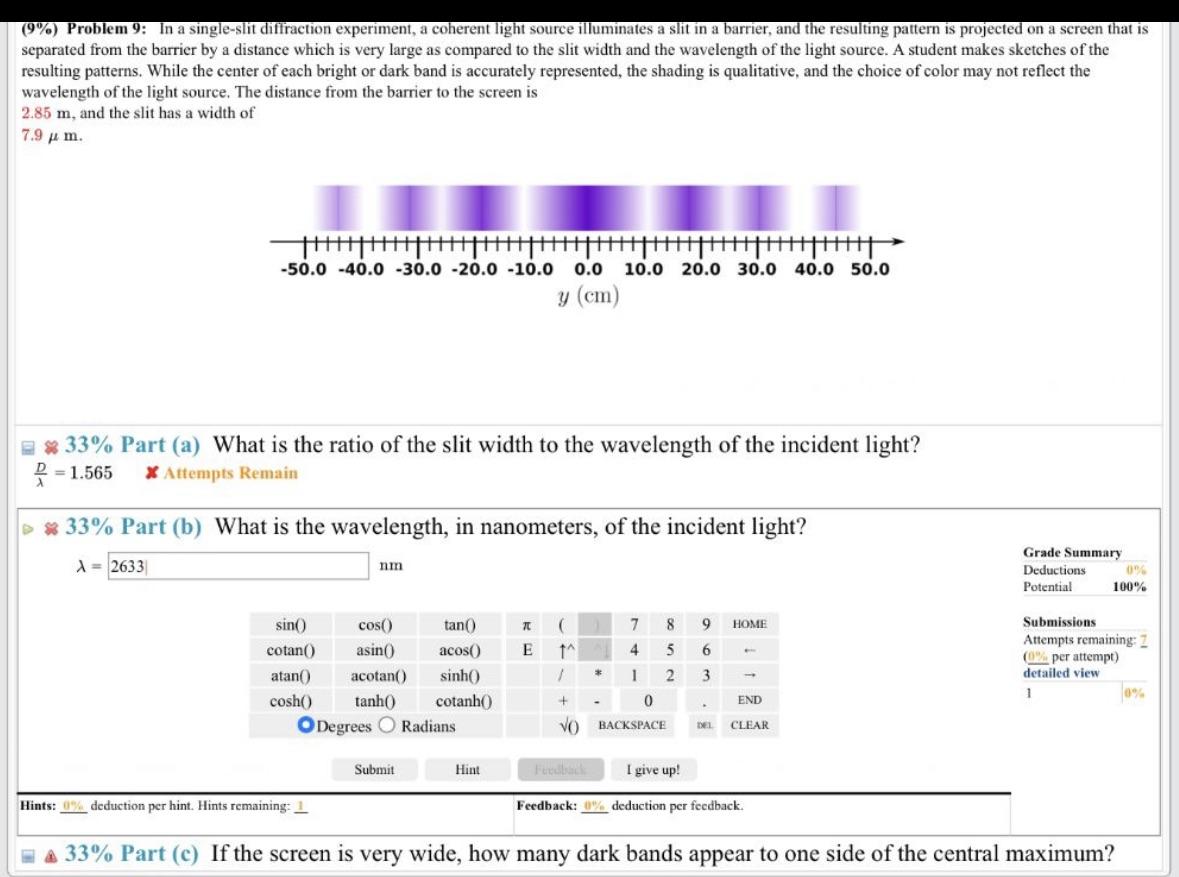
(9%) Problem 9: In a single-slit diffraction experiment, a coherent light source illuminates a slit in a barrier, and the resulting pattern is projected on a screen that is separated from the barrier by a distance which is very large as compared to the slit width and the wavelength of the light source. A student makes sketches of the resulting patterns. While the center of each bright or dark band is accurately represented, the shading is qualitative, and the choice of color may not reflect the wavelength of the light source. The distance from the barrier to the screen is 2.85 m, and the slit has a width of 7.9 m. +| -50.0 40.0 -30.0 -20.0 -10.0 0.0 10.0 20.0 30.0 40.0 50.0 y (cm) 33% Part (a) What is the ratio of the slit width to the wavelength of the incident light? R=1.565 * Attempts Remain > 33% Part (b) What is the wavelength, in nanometers, of the incident light? A = 2633 sin() cotan() atan() cosh() nm cos() asin() acotan() tanh() ODegrees O Radians tan() 70 acos() E sinh() cotanh() Submit Hint ( ^ 1 + VO Feedback 7 8 9 4 5 6 1 2 3 0 BACKSPACE * I give up! HOME - END DEL CLEAR Feedback: 0% deduction per feedback. Grade Summary Deductions Potential 0% 100% Submissions Attempts remaining: 1 (0% per attempt) detailed view 1 Hints: 0% deduction per hint. Hints remaining: 1 A 33% Part (c) If the screen is very wide, how many dark bands appear to one side of the central maximum?
Step by Step Solution
There are 3 Steps involved in it
Since the center of each bright or dark band is accurately re... View full answer

Get step-by-step solutions from verified subject matter experts
 Study Help