







Question: 9 thru 15 ( odd problems only) SECTION 2.1 EXERCISES Getting Started T 12. Given the function f(x) = -16x + 64x, complete the 1.
9 thru 15 ( odd problems only)
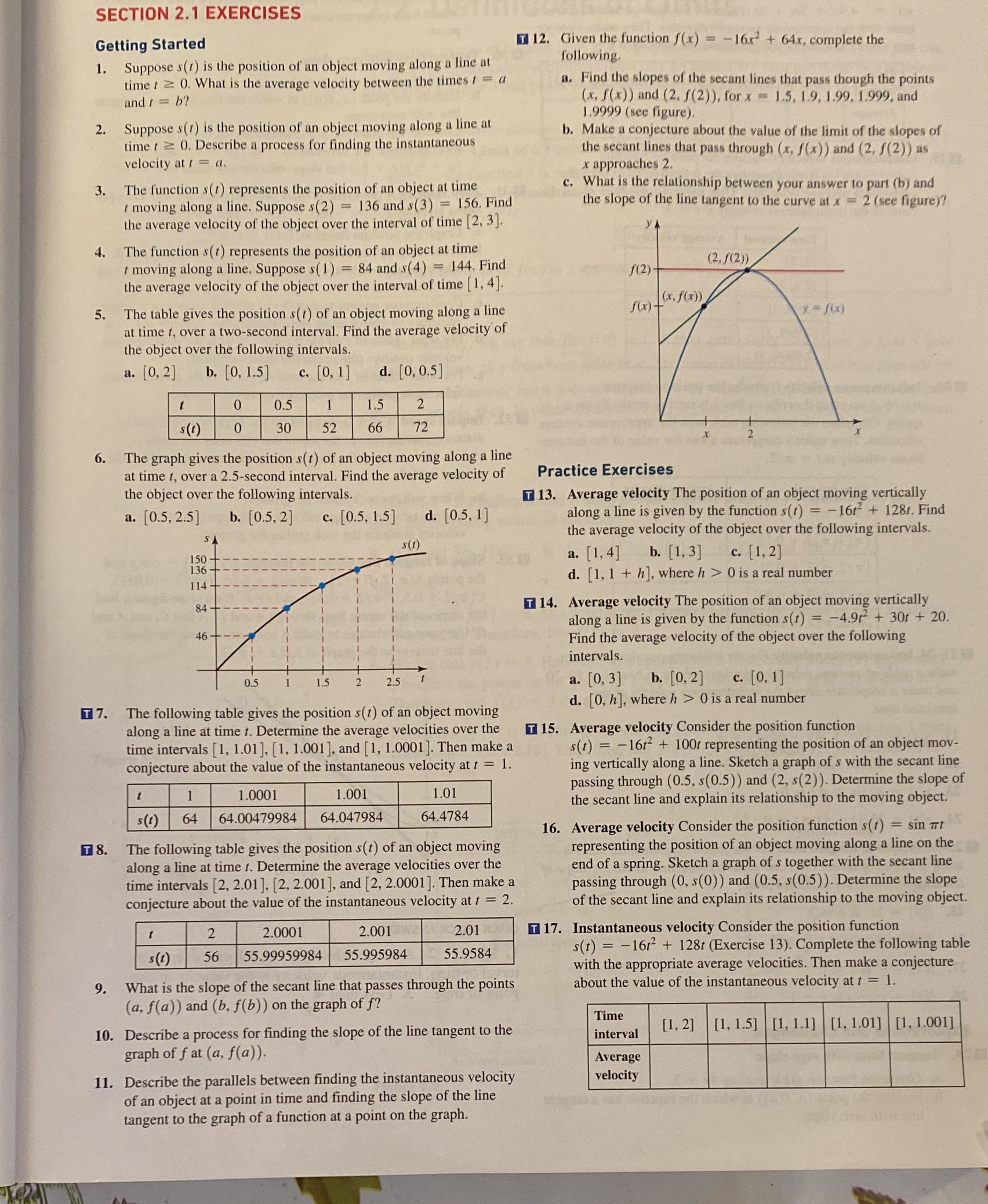
SECTION 2.1 EXERCISES Getting Started T 12. Given the function f(x) = -16x + 64x, complete the 1. Suppose s(1) is the position of an object moving along a line at following. time : 2 0. What is the average velocity between the times t = a a, Find the slopes of the secant lines that pass though the points and 1 = b? x, f(x)) and (2. f(2) ), for x = 1.5, 1.9, 1.99, 1.999, and 2. Suppose s(1) is the position of an object moving along a line at 1,9999 (see figure). time / 2 0. Describe a process for finding the instantaneous b. Make a conjecture about the value of the limit of the slopes of velocity at 1 = a. the secant lines that pass through (x, f(x) ) and (2, f(2)) as x approaches 2. 3. The function s(1) represents the position of an object at time c. What is the relationship between your answer to part (b) and I moving along a line. Suppose s(2) = 136 and s(3) = 156. Find the slope of the line tangent to the curve at x = 2 (see figure)? the average velocity of the object over the interval of time [2, 3]. 4. The function s(1) represents the position of an object at time 1 moving along a line. Suppose s( 1) = 84 and s(4) = 144. Find (2, f(2 ) ) f(2) the average velocity of the object over the interval of time [ 1, 4]. The table gives the position s() of an object moving along a line ( x , f ( x ) 5. f( x) +" at time t, over a two-second interval, Find the average velocity of the object over the following intervals. a. [0, 2] b. [0, 1.5] c. [0, 1] d. [0, 0.5] 0 0.5 1.5 2 s ( 1 ) 0 30 52 66 72 6. The graph gives the position s(1) of an object moving along a line at time t, over a 2.5-second interval. Find the average velocity of Practice Exercises the object over the following intervals. T 13. Average velocity The position of an object moving vertically a. [0.5, 2.5] b. [0.5, 2] c. [0.5, 1.5] d. [0.5, 1 ] along a line is given by the function s(t) = -1612 + 128t. Find the average velocity of the object over the following intervals. s ( 1 ) 150- a. [1, 4] b. [1, 3] c. [1, 2 ] 136- 114 - d. [1, 1 + h], where h > 0 is a real number 84 T 14. Average velocity The position of an object moving vertically along a line is given by the function s(1) = -4.912 + 30t + 20. 46 Find the average velocity of the object over the following intervals. 05 2.5 a. [0, 3] b. [0, 2] c. [0, 1] T 7. The following table gives the position s(1) of an object moving d. [0, h], where h > 0 is a real number along a line at time t. Determine the average velocities over the T 15. Average velocity Consider the position function time intervals [1, 1.01], [1, 1.001 ], and [1, 1.0001 ]. Then make a s(1) = -1612 + 100t representing the position of an object mov- conjecture about the value of the instantaneous velocity at t = 1. ing vertically along a line. Sketch a graph of s with the secant line 1.0001 1.001 1.01 passing through (0.5, s(0.5) ) and (2, s(2)). Determine the slope of the secant line and explain its relationship to the moving object. s ( 1 ) 64 64.00479984 64.047984 64.4784 16. Average velocity Consider the position function s(t) = sin it T 8. The following table gives the position s(t) of an object moving representing the position of an object moving along a line on the along a line at time t. Determine the average velocities over the end of a spring. Sketch a graph of s together with the secant line time intervals [2, 2.01 ], [2, 2.001 ], and [2, 2.0001 ]. Then make a passing through (0, s(0)) and (0.5, s(0.5)). Determine the slope conjecture about the value of the instantaneous velocity at t = 2. of the secant line and explain its relationship to the moving object. 2.0001 2.001 2.01 T 17. Instantaneous velocity Consider the position function s ( 1 ) 56 55.99959984 55.995984 55.9584 s(t) = -1612 + 1281 (Exercise 13). Complete the following table with the appropriate average velocities. Then make a conjecture 9. What is the slope of the secant line that passes through the points about the value of the instantaneous velocity at t = 1. (a, f(a) ) and (b, f(b) ) on the graph of f Time 10. Describe a process for finding the slope of the line tangent to the interval [1, 2] [1, 1.5] [1, 1.1] [1, 1.01] [1, 1.001] graph of f at (a, f(a)). Average 11. Describe the parallels between finding the instantaneous velocity velocity of an object at a point in time and finding the slope of the line tangent to the graph of a function at a point on the graph
Step by Step Solution
There are 3 Steps involved in it

Get step-by-step solutions from verified subject matter experts
 Study Help