



Question: 9. What is a prime cost? A) A fixed cost. per unit. B) Direct Labor and Manufacturing Overhead. C) Raw Material and Variable Cost.
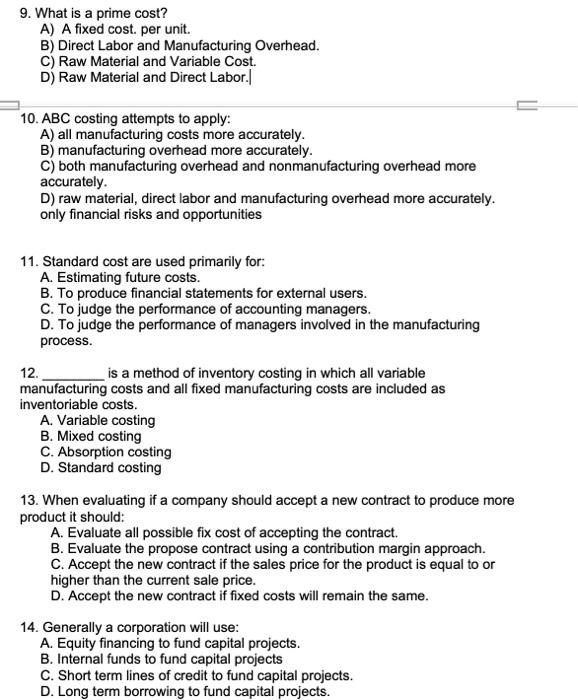
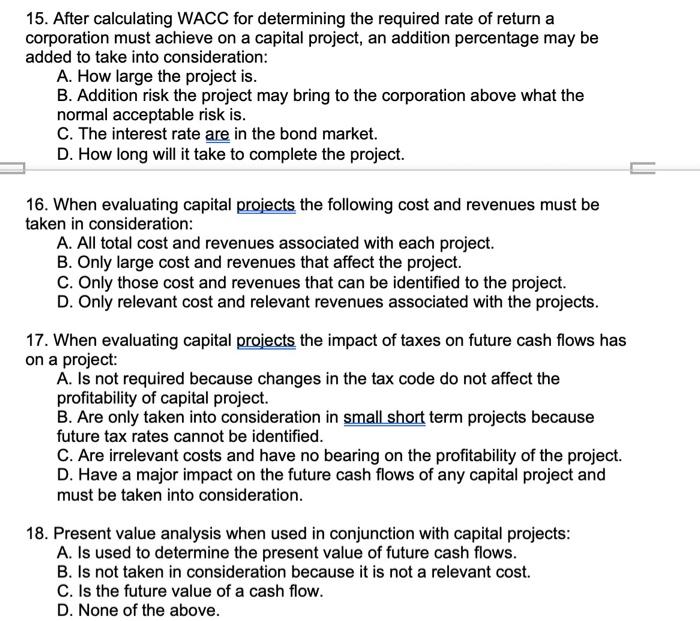
9. What is a prime cost? A) A fixed cost. per unit. B) Direct Labor and Manufacturing Overhead. C) Raw Material and Variable Cost. D) Raw Material and Direct Labor. 10. ABC costing attempts to apply: A) all manufacturing costs more accurately. B) manufacturing overhead more accurately. C) both manufacturing overhead and nonmanufacturing overhead more accurately. D) raw material, direct labor and manufacturing overhead more accurately. only financial risks and opportunities 11. Standard cost are used primarily for: 12. A. Estimating future costs. B. To produce financial statements for external users. C. To judge the performance of accounting managers. D. To judge the performance of managers involved in the manufacturing process. is a method of inventory costing in which all variable manufacturing costs and all fixed manufacturing costs are included as inventoriable costs. A. Variable costing B. Mixed costing C. Absorption costing D. Standard costing 13. When evaluating if a company should accept a new contract to produce more product it should: A. Evaluate all possible fix cost of accepting the contract. B. Evaluate the propose contract using a contribution margin approach. C. Accept the new contract if the sales price for the product is equal to or higher than the current sale price. D. Accept the new contract if fixed costs will remain the same. 14. Generally a corporation will use: A. Equity financing to fund capital projects. B. Internal funds to fund capital projects C. Short term lines of credit to fund capital projects. D. Long term borrowing to fund capital projects.
Step by Step Solution
There are 3 Steps involved in it

Get step-by-step solutions from verified subject matter experts