







Question: 9.1 Case StudyWhats in a Name? Springfield High Schools athletic teams have been called the Redskins since the school opened in 1944. The small town

9.1 Case StudyWhats in a Name?
Springfield High Schools athletic teams have been called the Redskins since the school opened in 1944. The small town of 7,000, which is roughly 95% white, is located in an area of the Midwest that once had thriving Native American tribes, a fact the community is proud to promote in its tourism brochures. So when the members of a local family with Native American ancestry came before the school board to ask that the name of Springfield High Schools athletic teams be changed because they found the use of the word Redskins to be offensive, it created a firestorm in the town.
The schools athletic teams had competed as Redskins for 70 years, and many felt the name was an integral part of the community. People personally identified with the Redskins, and the team and the teams name were ingrained in the small towns culture. Flags with the Redskins logo flew outside homes and businesses, and decals with the image of the smiling Redskins mascot adorned many car windows.
Locals would come before the board and say, I was born a Redskin and Ill die a Redskin, recalls one board member. They argued that the name was never intended to be offensive, that it was chosen for the teams before political correctness was a thing, and that it honored the areas relatively strong Native American presence.
But several other local Native American families and individuals also came forward in support of changing the name. One pointed out that the use of the word Redskin is essentially a racial slur, and as a racial slur, it needs to be changed. The issue drew national attention, and speakers came in from outside the state to discuss the negative ramifications of Native American mascots.
However, the opposition to change was fierce. T-shirts and bumper stickers started appearing around town sporting the slogans Im a Redskin and Proud and Dont tell me Im not a Redskin. At board meetings, those in favor of keeping the name would boo and talk over those speaking in favor of changing it, and argue that speakers who werent from Springfield shouldnt even be allowed to be at the board meetings.
The board ultimately approved a motion, 52, to have the students at Springfield High School choose a new name for their athletic teams. The students immediately embraced the opportunity to choose a new name, developing designs and logos for their proposed choices. In the end, the student body voted to become the Redhawks.
There was still an angry community contingent, however, that was festering over the change. They began a petition to recall the school board members and received enough signatures for the recall to be put up for an election.
While the kids are going about the business of changing the name and the emblem, the community holds an election and proceeds to recall the five members of the board who voted in favor of it, one of the recalled board members said.
The remaining two board members, both of whom were ardent members of the athletic booster organization, held a special meeting of the board (all two of them) and voted to change the name back to the Redskins.
Thats when the state Department of Civil Rights and the states Commission for High School Athletics stepped in. They told the Springfield School Board there could not be a reversal of the name change and that the high schools teams would have to go for four years without one, competing only as Springfield.
Over the course of those four years, new school board members were elected, and the issue quieted down. At the end of that period, the students again voted to become the Springfield Redhawks. You know, the kids were fine with it, says one community member. Its been ten years, and theres an entire generation of kids who dont have a clue that it was ever different. They are Redhawks and have always been Redhawks.
It was the adults who had the problem. Theres still a small contingent today that cant get over it. A local hardware store still sells Springfield Redskins T-shirts and other gear. There is just this group of folks who believe there was nothing disrespectful in the Redskins name.
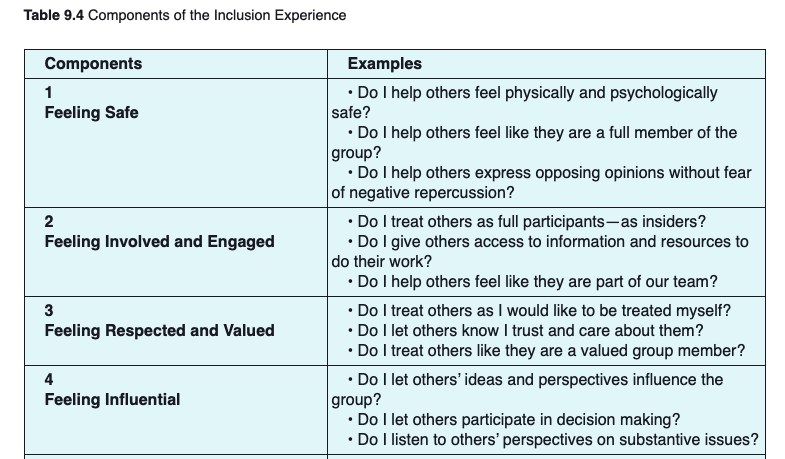
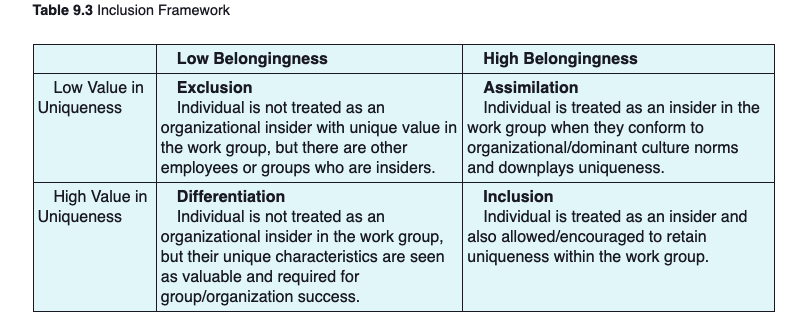
Questions 1. Do you agree with the assertion the athletic team name should be changed? 2. Describe how Ferdmans model of inclusion practices (Table 9.4) worked in this case. Did the influence for inclusive practices travel both up and down the model? 3. What barriers to embracing diversity and inclusion did the school board and community experience in this case? 4. Using the inclusion framework in Table 9.3, where would you place the Native American residents in the town of Springfield? What about Native American students at Springfield High School? 5. By changing the name of the athletic teams, do you believe the school board was showing inclusive practices? If so, which ones? 6. What role does privilege play in the resistance of community members to change the athletic teams name?
Table 9.4 Components of the Inclusion Experience Table 9.3 Inclusion FrameworkStep by Step Solution
There are 3 Steps involved in it

Get step-by-step solutions from verified subject matter experts
 Study Help