Question: 9:16 ( 11 Chapter 1 Activity 1.2 - Questions 1-15 1. DeWall et al. (2013) measured aggression with the voodoo doll task. In this task,
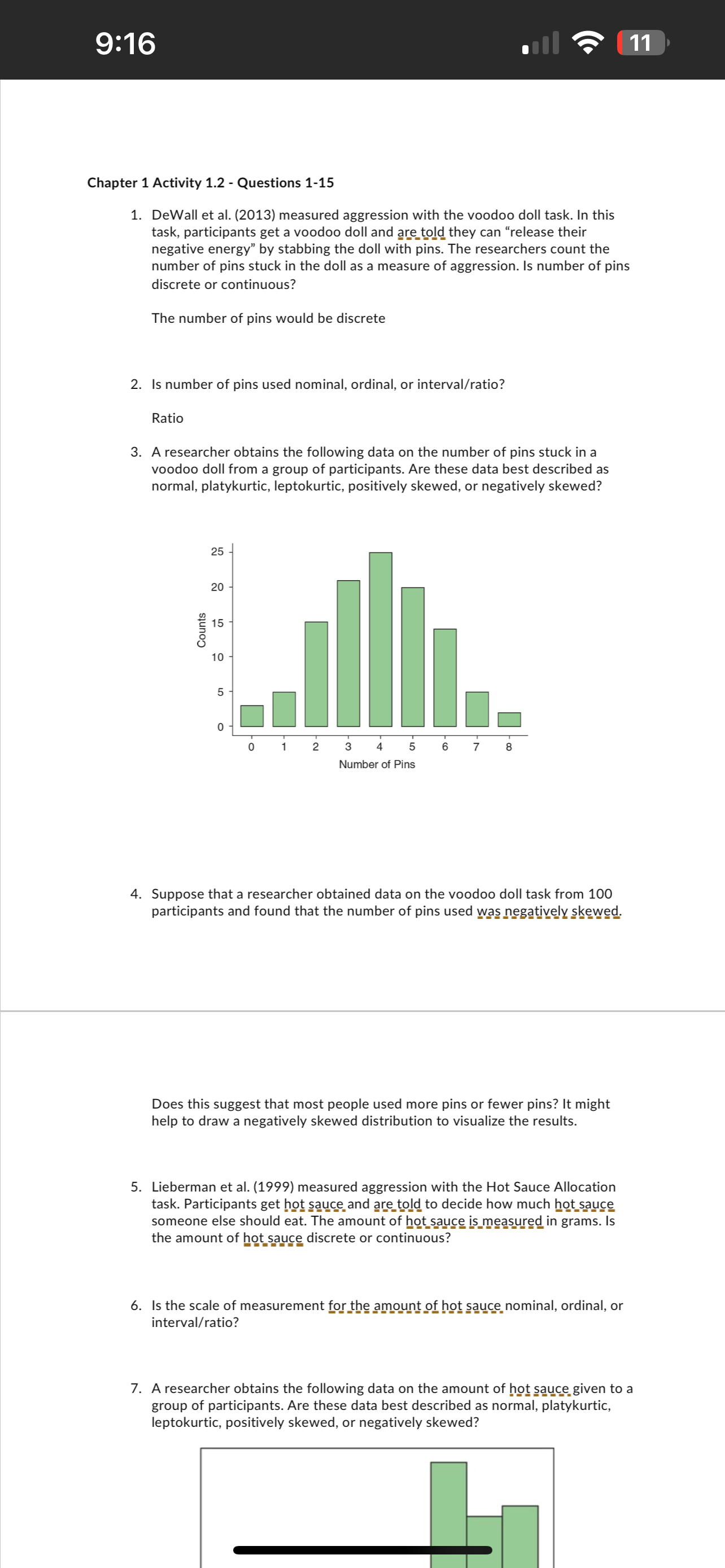
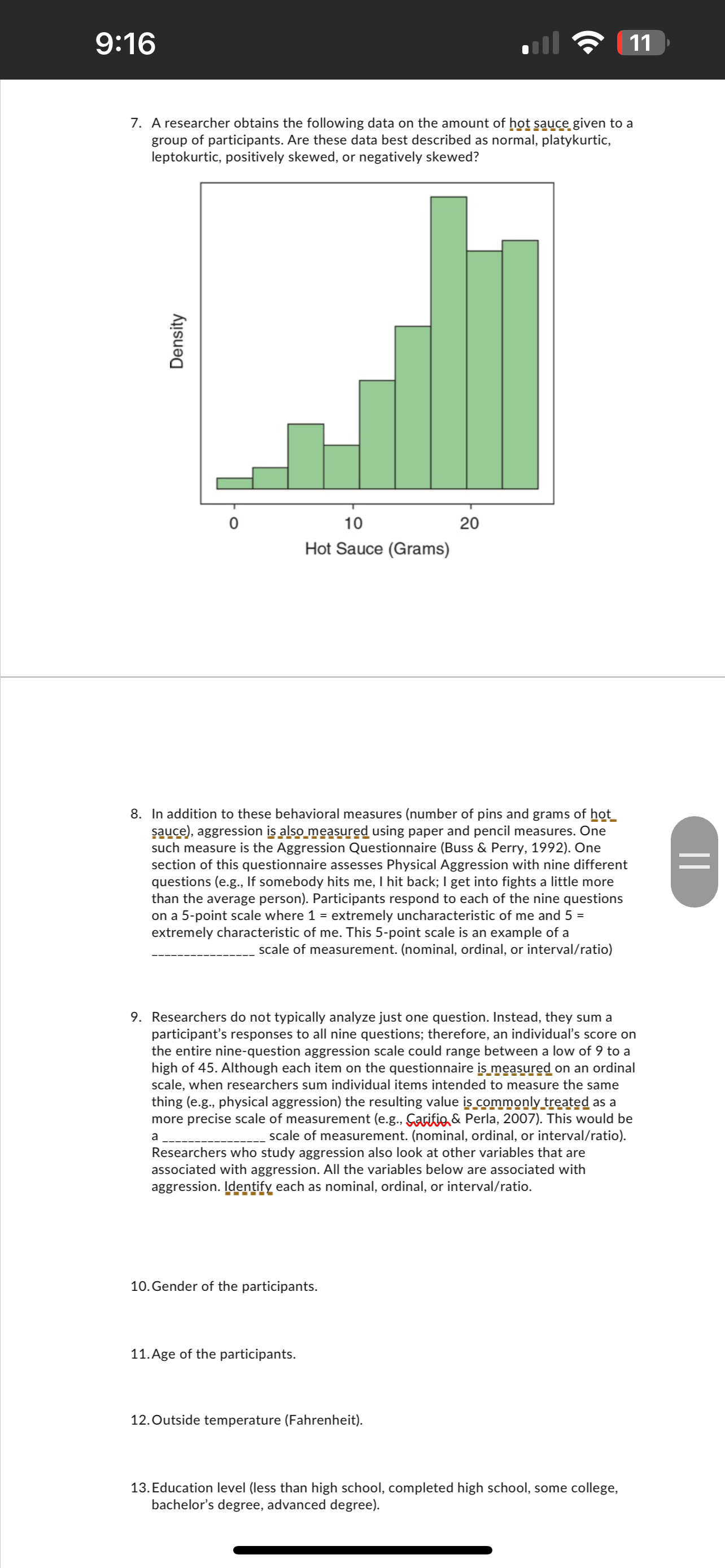
9:16 ( 11 Chapter 1 Activity 1.2 - Questions 1-15 1. DeWall et al. (2013) measured aggression with the voodoo doll task. In this task, participants get a voodoo doll and are told they can "release their negative energy" by stabbing the doll with pins. The researchers count the number of pins stuck in the doll as a measure of aggression. Is number of pins discrete or continuous? The number of pins would be discrete 2. Is number of pins used nominal, ordinal, or interval/ratio? Ratio 3. A researcher obtains the following data on the number of pins stuck in a voodoo doll from a group of participants. Are these data best described as normal, platykurtic, leptokurtic, positively skewed, or negatively skewed? 25 20 15 Counts 10 5 0 2 3 5 6 7 8 Number of Pins 4. Suppose that a researcher obtained data on the voodoo doll task from 100 participants and found that the number of pins used was negatively skewed. Does this suggest that most people used more pins or fewer pins? It might help to draw a negatively skewed distribution to visualize the results. 5. Lieberman et al. (1999) measured aggression with the Hot Sauce Allocation task. Participants get hot sauce and are told to decide how much hot sauce someone else should eat. The amount of hot sauce is measured in grams. Is the amount of hot sauce discrete or continuous? 6. Is the scale of measurement for the amount of hot sauce_ nominal, ordinal, or interval/ratio? 7. A researcher obtains the following data on the amount of hot sauce given to a group of participants. Are these data best described as normal, platykurtic, leptokurtic, positively skewed, or negatively skewed?9:16 ( 11 7. A researcher obtains the following data on the amount of hot sauce given to a group of participants. Are these data best described as normal, platykurtic, leptokurtic, positively skewed, or negatively skewed? Density 0 10 20 Hot Sauce (Grams) 8. In addition to these behavioral measures (number of pins and grams of hot_ sauce), aggression is also measured using paper and pencil measures. One such measure is the Aggression Questionnaire (Buss & Perry, 1992). One section of this questionnaire assesses Physical Aggression with nine different questions (e.g., If somebody hits me, I hit back; I get into fights a little more than the average person). Participants respond to each of the nine questions on a 5-point scale where 1 = extremely uncharacteristic of me and 5 = extremely characteristic of me. This 5-point scale is an example of a scale of measurement. (nominal, ordinal, or interval/ratio) 9. Researchers do not typically analyze just one question. Instead, they sum a participant's responses to all nine questions; therefore, an individual's score on the entire nine-question aggression scale could range between a low of 9 to a high of 45. Although each item on the questionnaire is measured on an ordinal scale, when researchers sum individual items intended to measure the same thing (e.g., physical aggression) the resulting value is commonly treated as a more precise scale of measurement (e.g., Carifjo & Perla, 2007). This would be a _ scale of measurement. (nominal, ordinal, or interval/ratio). Researchers who study aggression also look at other variables that are associated with aggression. All the variables below are associated with aggression. Identify each as nominal, ordinal, or interval/ratio 10. Gender of the participants. 11. Age of the participants. 12. Outside temperature (Fahrenheit). 13. Education level (less than high school, completed high school, some college, bachelor's degree, advanced degree).extremely characteristic of me. This 5-point scale is an example of a scale of measurement. (nominal, ordinal, or interval/ratio) 9. Researchers do not typically analyze just one question. Instead, they sum a participant's responses to all nine questions; therefore, an individual's score on the entire nine-question aggression scale could range between a low of 9 to a more precise scale of measurement (e.g., Garifio.& Perla, 2007). This would be a scale of measurement. (nominal, ordinal, or interval/ratio). Researchers who study aggression also look at other variables that are associated with aggression. All the variables below are associated with aggression. |dentify each as nominal, ordinal, or interval/ratio. 10.Gender of the participants. 11.Age of the participants. 12.0Outside temperature (Fahrenheit). 13.Education level (less than high school, completed high school, some college, bachelor's degree, advanced degree). 14.Amount of alcohol consumed (in ounces) per week. 15.Testosterone levels measured as below average, average, and above average
Step by Step Solution
There are 3 Steps involved in it
1 Expert Approved Answer
Step: 1 Unlock
Question Has Been Solved by an Expert!
Get step-by-step solutions from verified subject matter experts
Step: 2 Unlock
Step: 3 Unlock
Students Have Also Explored These Related Mathematics Questions!









 Study Help