







Question: 9-26 Variable costing versus absorption costing. (LO 3) The Garvis Company uses an absorption-costing system based on standard costs. Variable manufacturing cost consists of direct
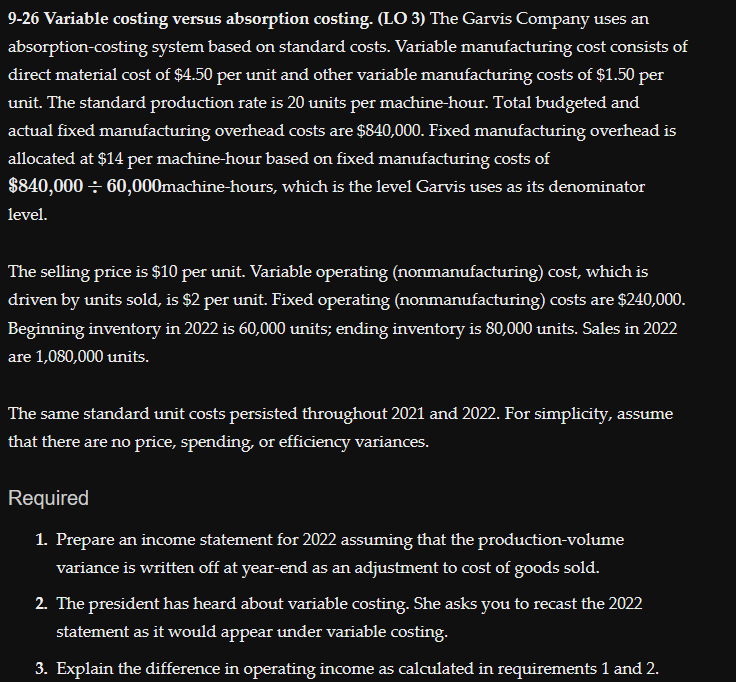
9-26 Variable costing versus absorption costing. (LO 3) The Garvis Company uses an absorption-costing system based on standard costs. Variable manufacturing cost consists of direct material cost of $4.50 per unit and other variable manufacturing costs of $1.50 per unit. The standard production rate is 20 units per machine-hour. Total budgeted and actual fixed manufacturing overhead costs are $840,000. Fixed manufacturing overhead is allocated at $14 per machine-hour based on fixed manufacturing costs of $840,00060,000 machine-hours, which is the level Garvis uses as its denominator level. The selling price is $10 per unit. Variable operating (nonmanufacturing) cost, which is driven by units sold, is $2 per unit. Fixed operating (nonmanufacturing) costs are $240,000. Beginning inventory in 2022 is 60,000 units; ending inventory is 80,000 units. Sales in 2022 are 1,080,000 units. The same standard unit costs persisted throughout 2021 and 2022. For simplicity, assume that there are no price, spending, or efficiency variances. Required 1. Prepare an income statement for 2022 assuming that the production-volume variance is written off at year-end as an adjustment to cost of goods sold. 2. The president has heard about variable costing. She asks you to recast the 2022 statement as it would appear under variable costing. 3. Explain the difference in operating income as calculated in requirements 1 and 2
Step by Step Solution
There are 3 Steps involved in it

Get step-by-step solutions from verified subject matter experts
 Study Help