







Question: 9-37. Activity-Based Costing After reviewing the new activity-based costing system that Nancy Chen has implemented at IVC's CenterPoint manufacturing facility. Tom Spencer, the production supervisor,
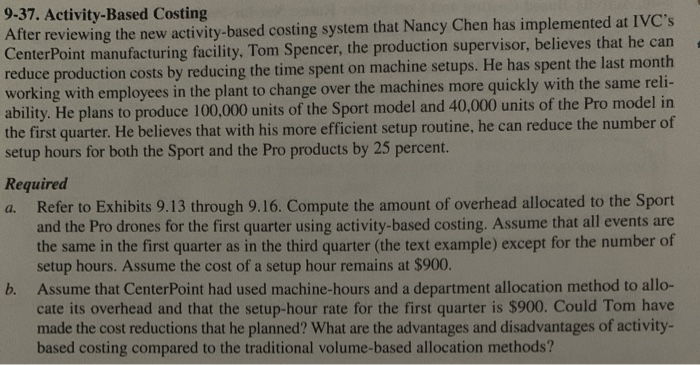
9-37. Activity-Based Costing After reviewing the new activity-based costing system that Nancy Chen has implemented at IVC's CenterPoint manufacturing facility. Tom Spencer, the production supervisor, believes that he can reduce production costs by reducing the time spent on machine setups. He has spent the last month working with employees in the plant to change over the machines more quickly with the same reli- ability. He plans to produce 100,000 units of the Sport model and 40,000 units of the Pro model in the first quarter. He believes that with his more efficient setup routine, he can reduce the number of setup hours for both the Sport and the Pro products by 25 percent. Required a. Refer to Exhibits 9.13 through 9.16. Compute the amount of overhead allocated to the Sport and the Pro drones for the first quarter using activity-based costing. Assume that all events are the same in the first quarter as in the third quarter the text example) except for the number of setup hours. Assume the cost of a setup hour remains at $900. Assume that CenterPoint had used machine-hours and a department allocation method to allo- cate its overhead and that the setup-hour rate for the first quarter is $900. Could Tom have made the cost reductions that he planned? What are the advantages and disadvantages of activity- based costing compared to the traditional volume-based allocation methods? 9-37. Activity-Based Costing After reviewing the new activity-based costing system that Nancy Chen has implemented at IVC's CenterPoint manufacturing facility. Tom Spencer, the production supervisor, believes that he can reduce production costs by reducing the time spent on machine setups. He has spent the last month working with employees in the plant to change over the machines more quickly with the same reli- ability. He plans to produce 100,000 units of the Sport model and 40,000 units of the Pro model in the first quarter. He believes that with his more efficient setup routine, he can reduce the number of setup hours for both the Sport and the Pro products by 25 percent. Required a. Refer to Exhibits 9.13 through 9.16. Compute the amount of overhead allocated to the Sport and the Pro drones for the first quarter using activity-based costing. Assume that all events are the same in the first quarter as in the third quarter (the text example) except for the number of setup hours. Assume the cost of a setup hour remains at $900. b. Assume that CenterPoint had used machine-hours and a department allocation method to allo- cate its overhead and that the setup-hour rate for the first quarter is $900. Could Tom have made the cost reductions that he planned? What are the advantages and disadvantages of activity- based costing compared to the traditional volume-based allocation methods? 9-37. Activity-Based Costing After reviewing the new activity-based costing system that Nancy Chen has implemented at IVC's CenterPoint manufacturing facility. Tom Spencer, the production supervisor, believes that he can reduce production costs by reducing the time spent on machine setups. He has spent the last month working with employees in the plant to change over the machines more quickly with the same reli- ability. He plans to produce 100,000 units of the Sport model and 40,000 units of the Pro model in the first quarter. He believes that with his more efficient setup routine, he can reduce the number of setup hours for both the Sport and the Pro products by 25 percent. Required a. Refer to Exhibits 9.13 through 9.16. Compute the amount of overhead allocated to the Sport and the Pro drones for the first quarter using activity-based costing. Assume that all events are the same in the first quarter as in the third quarter the text example) except for the number of setup hours. Assume the cost of a setup hour remains at $900. Assume that CenterPoint had used machine-hours and a department allocation method to allo- cate its overhead and that the setup-hour rate for the first quarter is $900. Could Tom have made the cost reductions that he planned? What are the advantages and disadvantages of activity- based costing compared to the traditional volume-based allocation methods? 9-37. Activity-Based Costing After reviewing the new activity-based costing system that Nancy Chen has implemented at IVC's CenterPoint manufacturing facility. Tom Spencer, the production supervisor, believes that he can reduce production costs by reducing the time spent on machine setups. He has spent the last month working with employees in the plant to change over the machines more quickly with the same reli- ability. He plans to produce 100,000 units of the Sport model and 40,000 units of the Pro model in the first quarter. He believes that with his more efficient setup routine, he can reduce the number of setup hours for both the Sport and the Pro products by 25 percent. Required a. Refer to Exhibits 9.13 through 9.16. Compute the amount of overhead allocated to the Sport and the Pro drones for the first quarter using activity-based costing. Assume that all events are the same in the first quarter as in the third quarter (the text example) except for the number of setup hours. Assume the cost of a setup hour remains at $900. b. Assume that CenterPoint had used machine-hours and a department allocation method to allo- cate its overhead and that the setup-hour rate for the first quarter is $900. Could Tom have made the cost reductions that he planned? What are the advantages and disadvantages of activity- based costing compared to the traditional volume-based allocation methods
Step by Step Solution
There are 3 Steps involved in it

Get step-by-step solutions from verified subject matter experts
 Study Help