







Question: 97 A study was conducted in which students were asked to estimate the number of calories in a cheeseburger. One group was asked to do
97
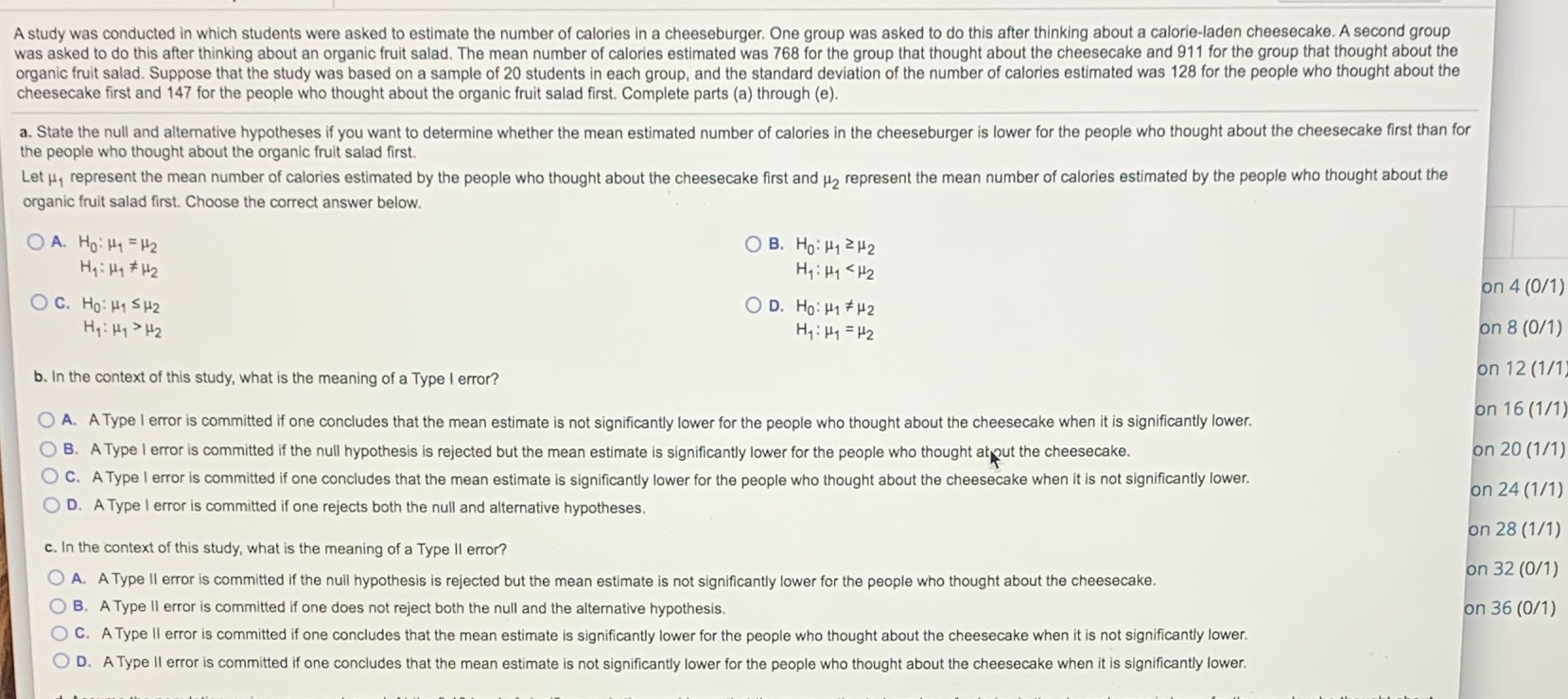
A study was conducted in which students were asked to estimate the number of calories in a cheeseburger. One group was asked to do this after thinking about a calorie-laden cheesecake. A second group was asked to do this after thinking about an organic fruit salad. The mean number of calories estimated was 768 for the group that thought about the cheesecake and 911 for the group that thought about the organic fruit salad. Suppose that the study was based on a sample of 20 students in each group, and the standard deviation of the number of calories estimated was 128 for the people who thought about the cheesecake first and 147 for the people who thought about the organic fruit salad first. Complete parts (a) through (e). a. State the null and alternative hypotheses if you want to determine whether the mean estimated number of calories in the cheeseburger is lower for the people who thought about the cheesecake first than for the people who thought about the organic fruit salad first. Let u, represent the mean number of calories estimated by the people who thought about the cheesecake first and 2 represent the mean number of calories estimated by the people who thought about the organic fruit salad first. Choose the correct answer below. O A. HO: H1 = H2 OB. HO: H1 2 H2 H1: My # H2 H1: H1
H2 H1: H1 = H2 on 8 (0/1) b. In the context of this study, what is the meaning of a Type I error? on 12 (1/1 on 16 (1/1) O A. A Type I error is committed if one concludes that the mean estimate is not significantly lower for the people who thought about the cheesecake when it is significantly lower. O B. A Type I error is committed if the null hypothesis is rejected but the mean estimate is significantly lower for the people who thought about the cheesecake. on 20 (1/1) O C. A Type I error is committed if one concludes that the mean estimate is significantly lower for the people who thought about the cheesecake when it is not significantly lower. on 24 (1/1) O D. A Type I error is committed if one rejects both the null and alternative hypotheses. on 28 (1/1) c. In the context of this study, what is the meaning of a Type II error? O A. A Type II error is committed if the null hypothesis is rejected but the mean estimate is not significantly lower for the people who thought about the cheesecake. on 32 (0/1) O B. A Type II error is committed if one does not reject both the null and the alternative hypothesis. on 36 (0/1) O C. A Type II error is committed if one concludes that the mean estimate is significantly lower for the people who thought about the cheesecake when it is not significantly lower. D. A Type II error is committed if one concludes that the mean estimate is not significantly lower for the people who thought about the cheesecake when it is significantly lower
Step by Step Solution
There are 3 Steps involved in it

Get step-by-step solutions from verified subject matter experts
 Study Help