







Question: A 0.15 kg pool ball moving on a horizontal table in the +x direction at a speed of 4 m/s collides with an identical
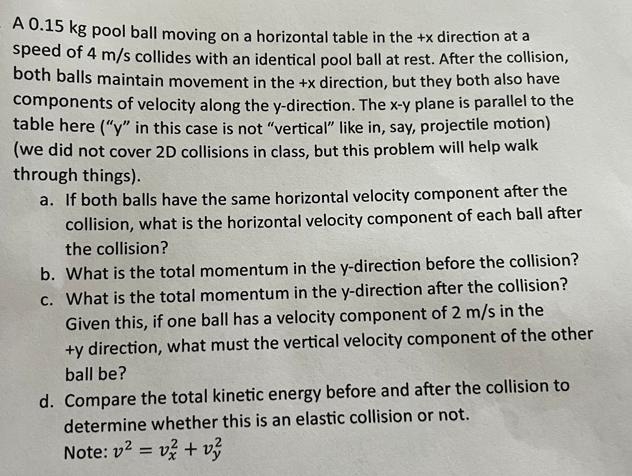
A 0.15 kg pool ball moving on a horizontal table in the +x direction at a speed of 4 m/s collides with an identical pool ball at rest. After the collision, both balls maintain movement in the +x direction, but they both also have components of velocity along the y-direction. The x-y plane is parallel to the table here ("y" in this case is not "vertical" like in, say, projectile motion) (we did not cover 2D collisions in class, but this problem will help walk through things). a. If both balls have the same horizontal velocity component after the collision, what is the horizontal velocity component of each ball after the collision? b. What is the total momentum in the y-direction before the collision? c. What is the total momentum in the y-direction after the collision? Given this, if one ball has a velocity component of 2 m/s in the +y direction, what must the vertical velocity component of the other ball be? d. Compare the total kinetic energy before and after the collision to determine whether this is an elastic collision or not. Note: v = v+v
Step by Step Solution
There are 3 Steps involved in it

Get step-by-step solutions from verified subject matter experts
 Study Help