







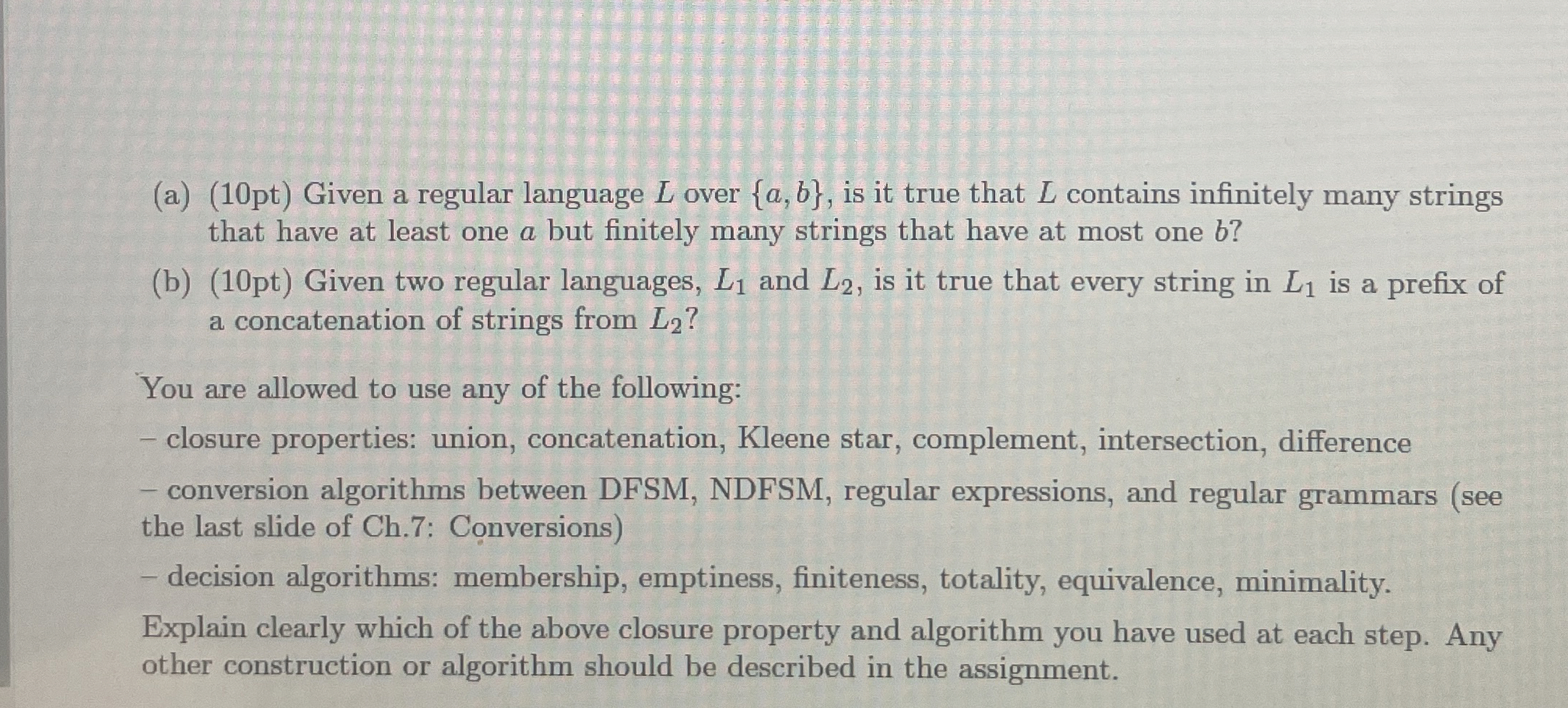
Question: ( a ) ( 1 0 pt ) Given a regular language L over { a , b } , is it true that L
apt Given a regular language over is it true that contains infinitely many strings
that have at least one a but finitely many strings that have at most one
b Given two regular languages, and is it true that every string in is a prefix of
a concatenation of strings from
You are allowed to use any of the following:
closure properties: union, concatenation, Kleene star, complement, intersection, difference
conversion algorithms between DFSM NDFSM regular expressions, and regular grammars see
the last slide of Ch: Conversions
decision algorithms: membership, emptiness, finiteness, totality, equivalence, minimality.
Explain clearly which of the above closure property and algorithm you have used at each step. Any
other construction or algorithm should be described in the assignment.
Step by Step Solution
There are 3 Steps involved in it
1 Expert Approved Answer
Step: 1 Unlock

Question Has Been Solved by an Expert!
Get step-by-step solutions from verified subject matter experts
Step: 2 Unlock
Step: 3 Unlock
 Study Help