







Question: (a) (12 pts) Show how forward checking helps to solve this problem. Assume that (1) variables are selected using the most constrained variable heuristic, with

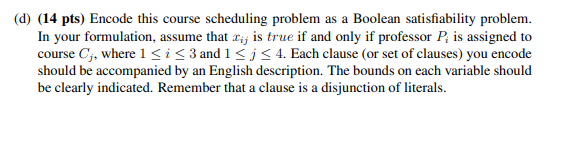
(a) (12 pts) Show how forward checking helps to solve this problem. Assume that (1) variables are selected using the most constrained variable heuristic, with ties broken using the most constraining variable heuristic; and (2) values are selected using the least constraining value heuristic. In the solution found by forward checking, - the first variable selected is and its value is - the second variable selected is and its value is - the third variable selected is and its value is (b) (6 pts) One way to enable forward checking to find a solution more quickly is to apply constraint propagation to the initial domains to eliminate illegal values prior to forward checking. After constraint propagation is applied to their initial domains, - C1 's set of legal values is - C2 's set of legal values is - C3 's set of legal values is - C4 's set of legal values is (c) (10 pts) An alternative way to solve the course scheduling problem is to employ local search. Describe a local search algorithm for solving the course scheduling problem. (Note: Your goal should be to specify all the elements needed to apply local search to this problem, rather than finding a solution to the problem using local search.) (d) (14 pts) Encode this course scheduling problem as a Boolean satisfiability problem. In your formulation, assume that xij is true if and only if professor Pi is assigned to course Cj, where 1i3 and 1j4. Each clause (or set of clauses) you encode should be accompanied by an English description. The bounds on each variable should be clearly indicated. Remember that a clause is a disjunction of literals
Step by Step Solution
There are 3 Steps involved in it

Get step-by-step solutions from verified subject matter experts
 Study Help