







Question: A 15.0 kg block is released from rest from a 3.00 m height at point A as shown in the figure below. The track is
A 15.0 kg block is released from rest from a 3.00 m height at point A as shown in the figure below. The track is frictionless except for the portion between points B and C, which has a length of 4.20 m. The block travels down the track, hits at the end of it a spring and compresses the spring 0.320 m from its equilibrium position before coming to rest momentarily. Then the spring expands, forcing the block back to the left, and the block - after losing the contact with the spring - continues sliding to the left, slows down at the rough part of the track between C and B and stops exactly at point B.
a) What is in magnitude the kinetic friction force, fr,exerted on the block by the rough part of the track between points B and C?
b) What is the spring constant, k?
c) What is the speed of the block at point C?
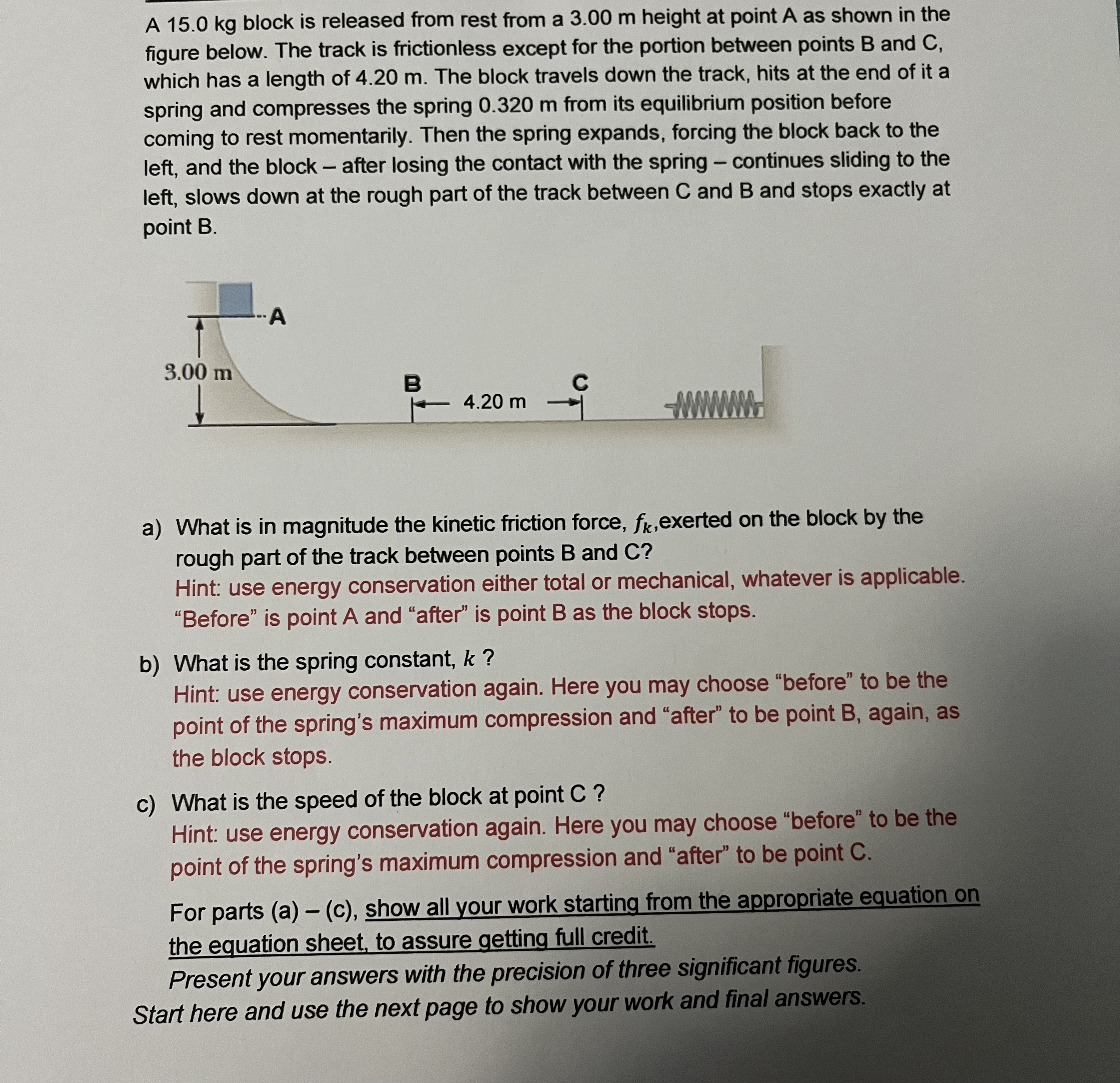
A 15.0 kg block is released from rest from a 3.00 m height at point A as shown in the figure below. The track is frictionless except for the portion between points B and C, which has a length of 4.20 m. The block travels down the track, hits at the end of it a spring and compresses the spring 0.320 m from its equilibrium position before coming to rest momentarily. Then the spring expands, forcing the block back to the left, and the block - after losing the contact with the spring - continues sliding to the left, slows down at the rough part of the track between C and B and stops exactly at point B. 3.00 m B 4.20 m C a) What is in magnitude the kinetic friction force, fx,exerted on the block by the rough part of the track between points B and C? Hint: use energy conservation either total or mechanical, whatever is applicable. "Before" is point A and "after" is point B as the block stops. b) What is the spring constant, k ? Hint: use energy conservation again. Here you may choose "before" to be the point of the spring's maximum compression and "after" to be point B, again, as the block stops. c) What is the speed of the block at point C ? Hint: use energy conservation again. Here you may choose "before" to be the point of the spring's maximum compression and "after" to be point C. For parts (a) - (c), show all your work starting from the appropriate equation on the equation sheet, to assure getting full credit. Present your answers with the precision of three significant figures. Start here and use the next page to show your work and final answers
Step by Step Solution
There are 3 Steps involved in it

Get step-by-step solutions from verified subject matter experts
 Study Help