







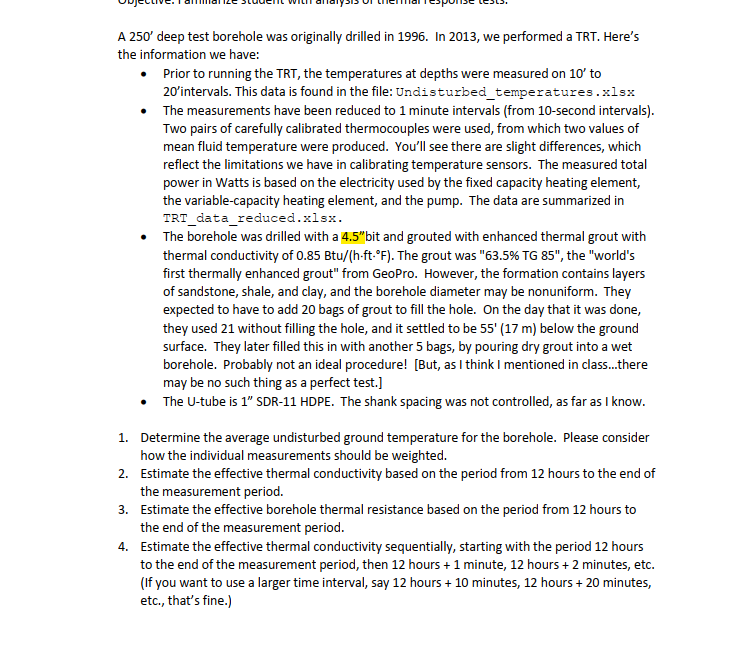
Question: A 2 5 0 ' deep test borehole was originally drilled in 1 9 9 6 . In 2 0 1 3 , we performed
A deep test borehole was originally drilled in In we performed a TRT Here's
the information we have:
Prior to running the TRT the temperatures at depths were measured on to
'intervals. This data is found in the file: Undisturbedtemperatures xlsx
The measurements have been reduced to minute intervals from second intervals
Two pairs of carefully calibrated thermocouples were used, from which two values of
mean fluid temperature were produced. You'll see there are slight differences, which
reflect the limitations we have in calibrating temperature sensors The measured total
power in Watts is based on the electricity used by the fixed capacity heating element,
the variablecapacity heating element, and the pump. The data are summarized in
TRTdatareduced.xlsx
The borehole was drilled with a bit and grouted with enhanced thermal grout with
thermal conductivity of The grout was the "world's
first thermally enhanced grout" from GeoPro. However, the formation contains layers
of sandstone, shale, and clay, and the borehole diameter may be nonuniform. They
expected to have to add bags of grout to fill the hole. On the day that it was done,
they used without filling the hole, and it settled to be m below the ground
surface. They later filled this in with another bags, by pouring dry grout into a wet
borehole. Probably not an ideal procedure! But as I think I mentioned in class...there
may be no such thing as a perfect test.
The Utube is SDR HDPE. The shank spacing was not controlled, as far as I know.
Determine the average undisturbed ground temperature for the borehole. Please consider
how the individual measurements should be weighted.
Estimate the effective thermal conductivity based on the period from hours to the end of
the measurement period.
Estimate the effective borehole thermal resistance based on the period from hours to
the end of the measurement period.
Estimate the effective thermal conductivity sequentially, starting with the period hours
to the end of the measurement period, then hours minute, hours minutes, etc.
If you want to use a larger time interval, say hours minutes, hours minutes,
etc., that's fine.
Step by Step Solution
There are 3 Steps involved in it
1 Expert Approved Answer
Step: 1 Unlock

Question Has Been Solved by an Expert!
Get step-by-step solutions from verified subject matter experts
Step: 2 Unlock
Step: 3 Unlock
 Study Help