







Question: a = 2. (a) Let X be a random variable with finite variance. Let Y = aX + B for some numbers a, E R.
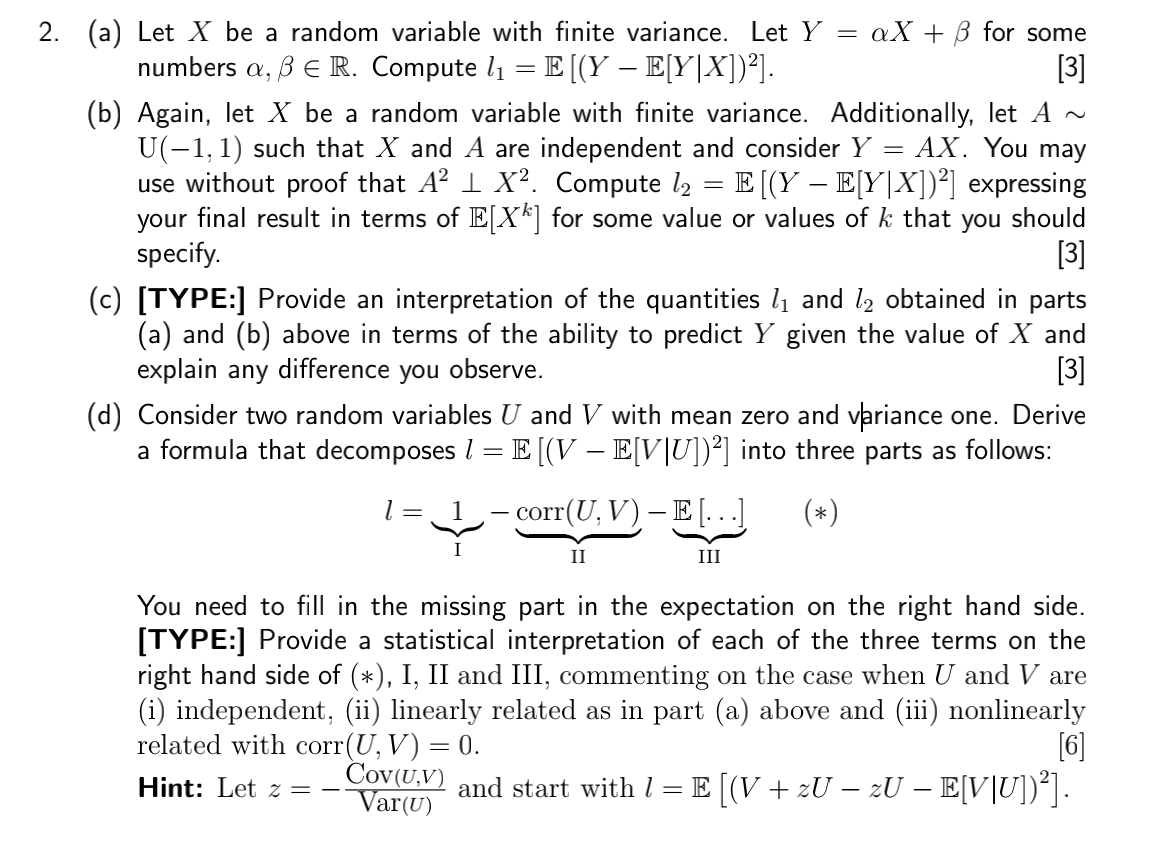
a = 2. (a) Let X be a random variable with finite variance. Let Y = aX + B for some numbers a, E R. Compute l = E[(Y E[Y|X])2]. [3] (b) Again, let X be a random variable with finite variance. Additionally, let A U(-1, 1) such that X and A are independent and consider Y = AX. You may use without proof that A 1 X?. Compute la E[(Y E[Y|X])?] expressing your final result in terms of E[Xk] for some value or values of k that you should specify. [3] (c) (TYPE:) Provide an interpretation of the quantities l and l2 obtained in parts (a) and (b) above in terms of the ability to predict Y given the value of X and explain any difference you observe. [3] (d) Consider two random variables U and V with mean zero and variance one. Derive a formula that decomposes 1 = E[(V E[V|U])?] into three parts as follows: 1 = - corr(U, V) E [...] (*) = II III You need to fill in the missing part in the expectation on the right hand side. [TYPE:] Provide a statistical interpretation of each of the three terms on the right hand side of (*), I, II and III, commenting on the case when U and V are (i) independent, (ii) linearly related as in part (a) above and (iii) nonlinearly related with corr(U, V) = 0. [6] Hint: Let z = - Cov(UV) Var(U) and start with 1 = E[(V+zU ZU E[V]U])?]. = a = 2. (a) Let X be a random variable with finite variance. Let Y = aX + B for some numbers a, E R. Compute l = E[(Y E[Y|X])2]. [3] (b) Again, let X be a random variable with finite variance. Additionally, let A U(-1, 1) such that X and A are independent and consider Y = AX. You may use without proof that A 1 X?. Compute la E[(Y E[Y|X])?] expressing your final result in terms of E[Xk] for some value or values of k that you should specify. [3] (c) (TYPE:) Provide an interpretation of the quantities l and l2 obtained in parts (a) and (b) above in terms of the ability to predict Y given the value of X and explain any difference you observe. [3] (d) Consider two random variables U and V with mean zero and variance one. Derive a formula that decomposes 1 = E[(V E[V|U])?] into three parts as follows: 1 = - corr(U, V) E [...] (*) = II III You need to fill in the missing part in the expectation on the right hand side. [TYPE:] Provide a statistical interpretation of each of the three terms on the right hand side of (*), I, II and III, commenting on the case when U and V are (i) independent, (ii) linearly related as in part (a) above and (iii) nonlinearly related with corr(U, V) = 0. [6] Hint: Let z = - Cov(UV) Var(U) and start with 1 = E[(V+zU ZU E[V]U])?]. =
Step by Step Solution
There are 3 Steps involved in it

Get step-by-step solutions from verified subject matter experts
 Study Help