







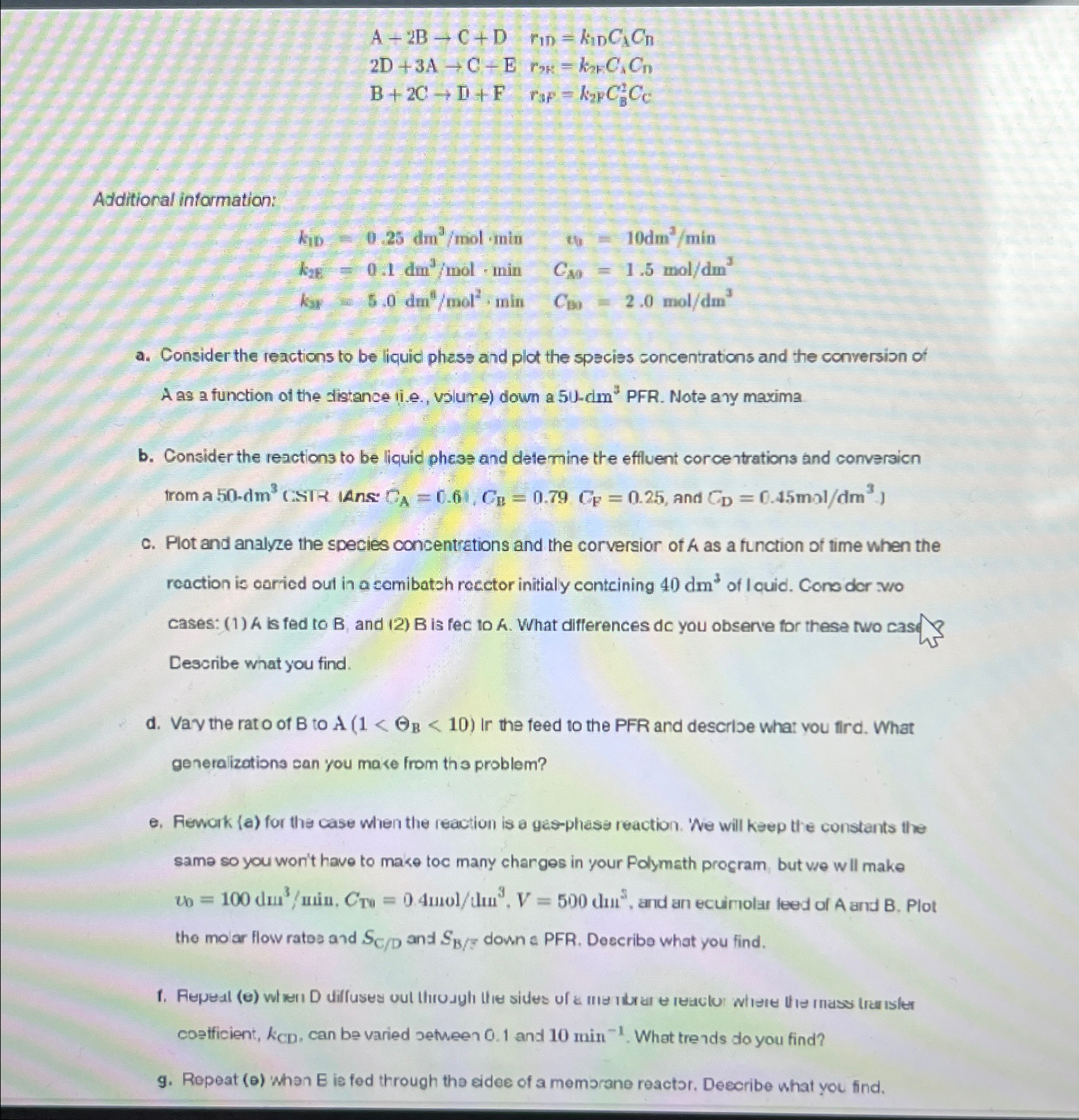
Question: A + 2 B C + D , r 1 D = k 1 D C A C n 2 D + 3 A C
Additional information:
a Consider the reactions to be liquid phese and plot the species concentrations and the conversion of A as a function of the distance lie vilure down a PFR Note ay maxima
b Consider the reactiona to be liquid phese and detemine the effluent corcentrations and converaicn trom a CSIR IAns and
c Plot and analyze the species concentrations and the corversior of as a function of time when the reaction is corried out in a comibatoh recctor initialy contcining of l quid. Cono dor wo cases: is fed to and is fec to What differences do you obsen'e for these two case Describe what you find.
d Vay the rat of to Ir the feed to the PFR and descrise what you fird. What generalizotions can you mase from th problem?
e Fewark a for the case when the reaction is a gasphase reaction. Ne will keep the constants the same so you won't have to make toc many charges in your Polymsth procram, but ve will make uin, and an ecuimolan leed of A and B Plot the mo ar flow rates and and down a PFR Deecribo what you find. coetficient, can be varied setween and What trends do you find?
g Repeat whan is fed through the sidee of a memorane resctor. Describe what you find.
Step by Step Solution
There are 3 Steps involved in it
1 Expert Approved Answer
Step: 1 Unlock

Question Has Been Solved by an Expert!
Get step-by-step solutions from verified subject matter experts
Step: 2 Unlock
Step: 3 Unlock
 Study Help