







Question: a 3. A simple heat engine. Suppose you have two rooms: A hot one whose temperature is maintained equal to T and a cold one
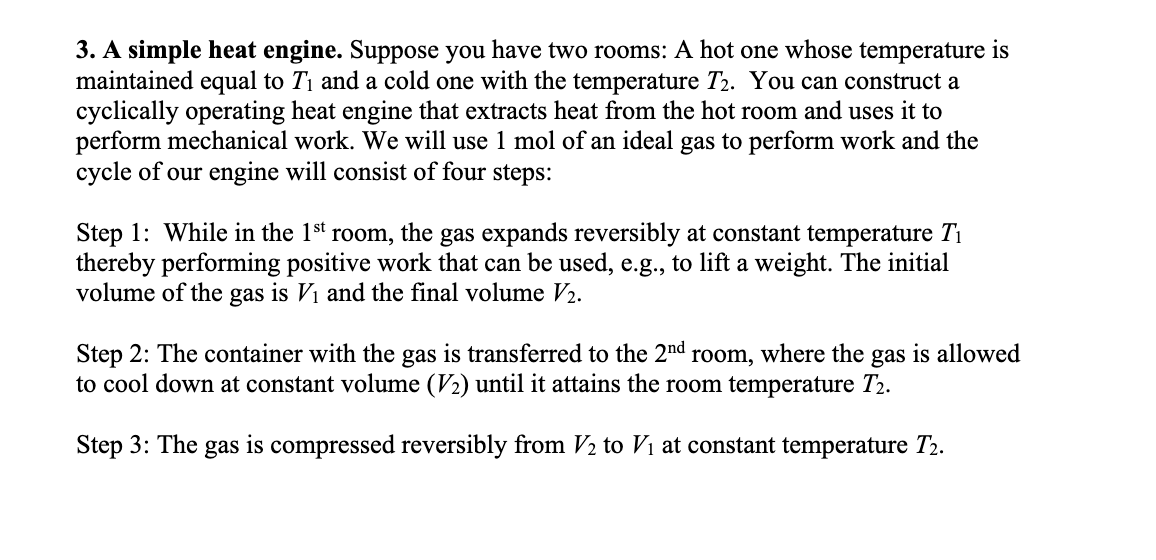
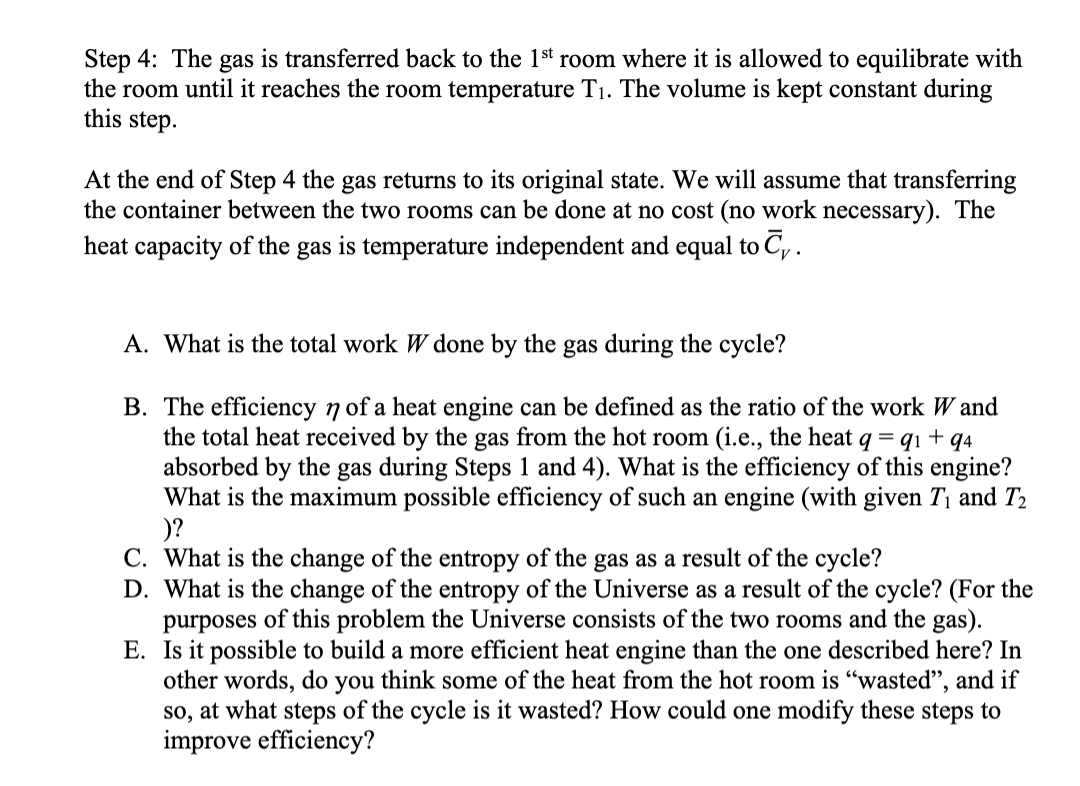
a 3. A simple heat engine. Suppose you have two rooms: A hot one whose temperature is maintained equal to T and a cold one with the temperature T2. You can construct a cyclically operating heat engine that extracts heat from the hot room and uses it to perform mechanical work. We will use 1 mol of an ideal gas to perform work and the cycle of our engine will consist of four steps: Step 1: While in the 1st room, the gas expands reversibly at constant temperature Ti thereby performing positive work that can be used, e.g., to lift a weight. The initial volume of the gas is Vi and the final volume V2. a Step 2: The container with the gas is transferred to the 2nd room, where the gas is allowed to cool down at constant volume (V2) until it attains the room temperature T2. Step 3: The gas is compressed reversibly from 12 to Vi at constant temperature T2. Step 4: The gas is transferred back to the 1st room where it is allowed to equilibrate with the room until it reaches the room temperature T1. The volume is kept constant during this step. At the end of Step 4 the gas returns to its original state. We will assume that transferring the container between the two rooms can be done at no cost (no work necessary). The heat capacity of the gas is temperature independent and equal to C, . A. What is the total work W done by the gas during the cycle? + B. The efficiency n of a heat engine can be defined as the ratio of the work W and the total heat received by the gas from the hot room (i.e., the heat q =q1 94 absorbed by the gas during Steps 1 and 4). What is the efficiency of this engine? What is the maximum possible efficiency of such an engine (with given T1 and T2 )? C. What is the change of the entropy of the gas as a result of the cycle? D. What is the change of the entropy of the Universe as a result of the cycle? (For the purposes of this problem the Universe consists of the two rooms and the gas). E. Is it possible to build a more efficient heat engine than the one described here? In other words, do you think some of the heat from the hot room is wasted, and if so, at what steps of the cycle is it wasted? How could one modify these steps to improve efficiency
Step by Step Solution
There are 3 Steps involved in it

Get step-by-step solutions from verified subject matter experts
 Study Help