Question: a. (3 pts.) Using the Earliest Due Date (EDD) sequencing rule, complete the following table, including determining the right sequence in which the orders should
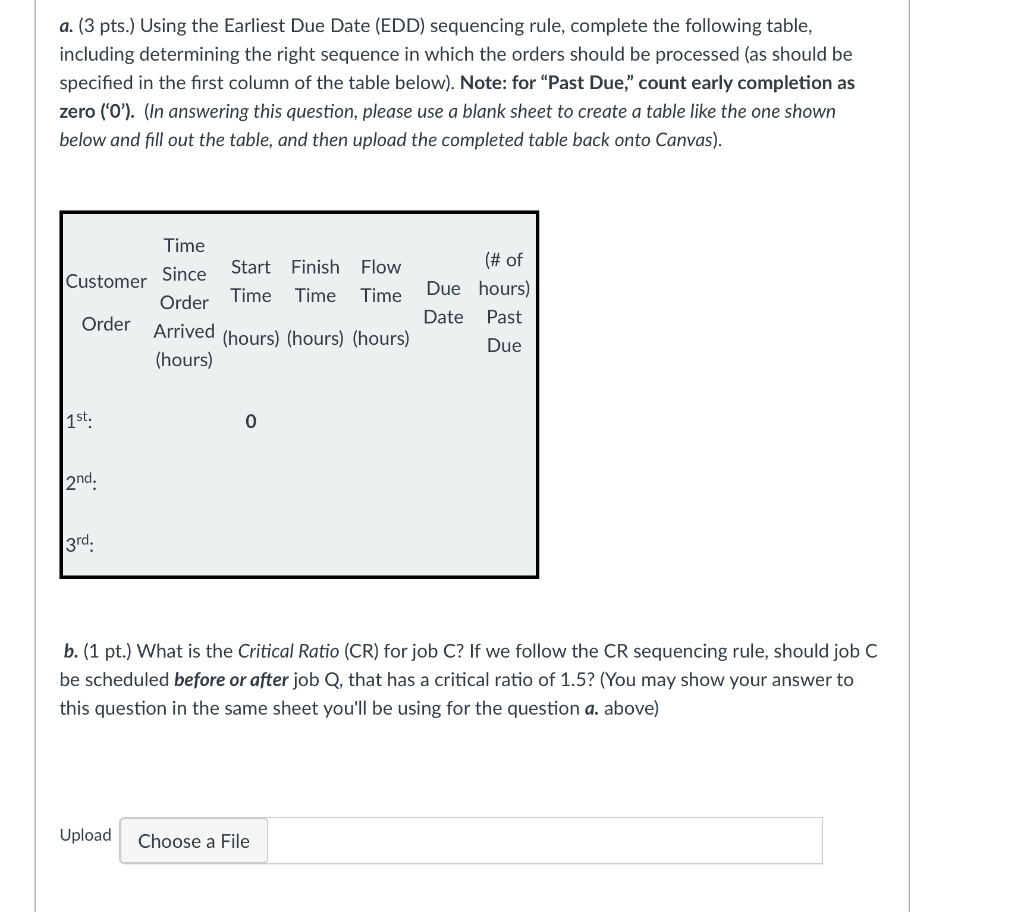
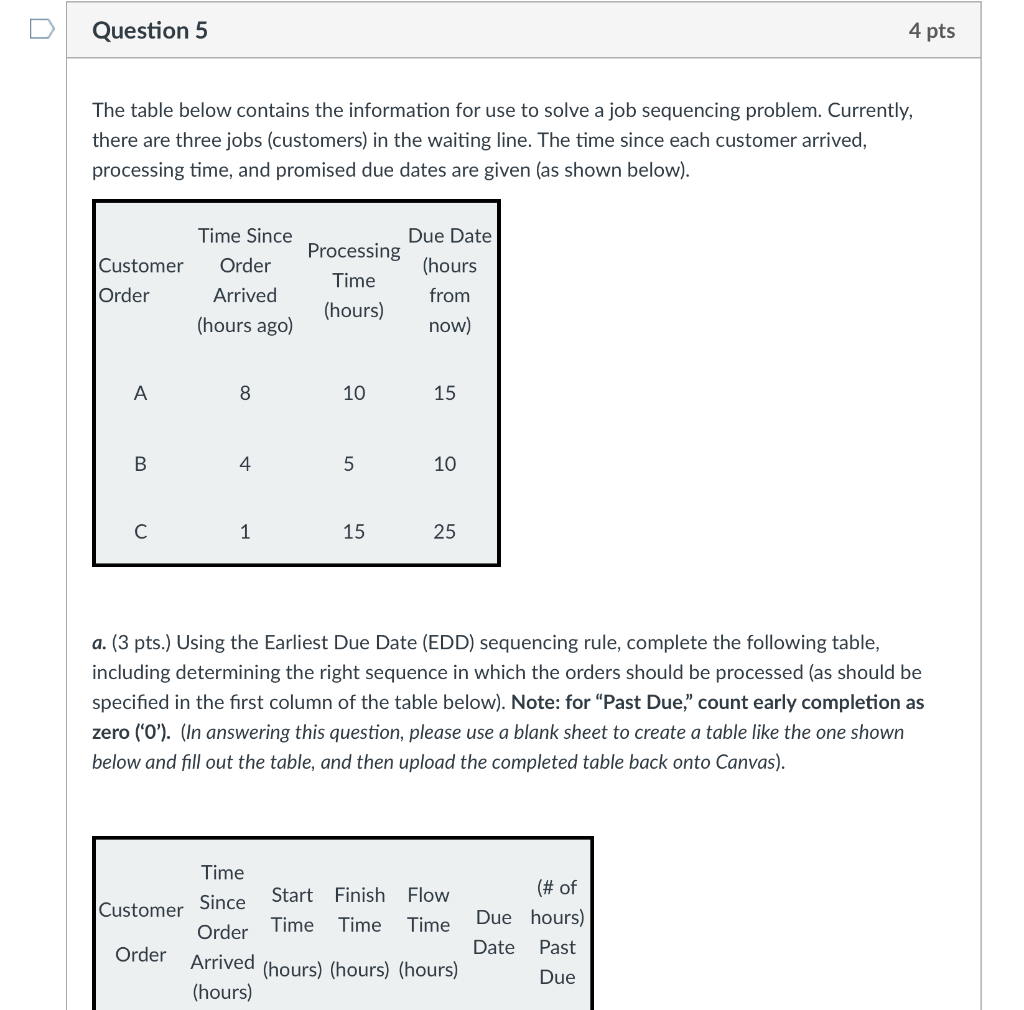
a. (3 pts.) Using the Earliest Due Date (EDD) sequencing rule, complete the following table, including determining the right sequence in which the orders should be processed (as should be specified in the first column of the table below). Note: for "Past Due," count early completion as zero ('0'). (In answering this question, please use a blank sheet to create a table like the one shown below and fill out the table, and then upload the completed table back onto Canvas). Time Start Finish Flow (# of Customer Since Order Time Time Time Due hours) Order Date Past Arrived (hours) (hours) (hours) Due (hours) 0 3rd. b. (1 pt.) What is the Critical Ratio (CR) for job C? If we follow the CR sequencing rule, should job C be scheduled before or after job Q, that has a critical ratio of 1.5? (You may show your answer to this question in the same sheet you'll be using for the question a. above) Upload Choose a File 1st. 2nd. Question 5 4 pts The table below contains the information for use to solve a job sequencing problem. Currently, there are three jobs (customers) in the waiting line. The time since each customer arrived, processing time, and promised due dates are given (as shown below). Time Since Due Date Processing Customer Order (hours Time Order Arrived from (hours) (hours ago) now) A 8 10 15 B 4 5 10 C 1 15 25 a. (3 pts.) Using the Earliest Due Date (EDD) sequencing rule, complete the following table, including determining the right sequence in which the orders should be processed (as should be specified in the first column of the table below). Note: for "Past Due," count early completion as zero ('0'). (In answering this question, please use a blank sheet to create a table like the one shown below and fill out the table, and then upload the completed table back onto Canvas). Time (# of Customer Since Start Finish Flow Time Time Due hours) Order Time Date Past Order Arrived (hours) (hours) (hours) Due (hours) a. (3 pts.) Using the Earliest Due Date (EDD) sequencing rule, complete the following table, including determining the right sequence in which the orders should be processed (as should be specified in the first column of the table below). Note: for "Past Due," count early completion as zero ('0'). (In answering this question, please use a blank sheet to create a table like the one shown below and fill out the table, and then upload the completed table back onto Canvas). Time Start Finish Flow (# of Customer Since Order Time Time Time Due hours) Order Date Past Arrived (hours) (hours) (hours) Due (hours) 0 3rd. b. (1 pt.) What is the Critical Ratio (CR) for job C? If we follow the CR sequencing rule, should job C be scheduled before or after job Q, that has a critical ratio of 1.5? (You may show your answer to this question in the same sheet you'll be using for the question a. above) Upload Choose a File 1st. 2nd. Question 5 4 pts The table below contains the information for use to solve a job sequencing problem. Currently, there are three jobs (customers) in the waiting line. The time since each customer arrived, processing time, and promised due dates are given (as shown below). Time Since Due Date Processing Customer Order (hours Time Order Arrived from (hours) (hours ago) now) A 8 10 15 B 4 5 10 C 1 15 25 a. (3 pts.) Using the Earliest Due Date (EDD) sequencing rule, complete the following table, including determining the right sequence in which the orders should be processed (as should be specified in the first column of the table below). Note: for "Past Due," count early completion as zero ('0'). (In answering this question, please use a blank sheet to create a table like the one shown below and fill out the table, and then upload the completed table back onto Canvas). Time (# of Customer Since Start Finish Flow Time Time Due hours) Order Time Date Past Order Arrived (hours) (hours) (hours) Due (hours)









 Study Help