







Question: a) (4pts) Define a function funpower in Racket. funpower takes in two arguments f (a function) and n (a non-negative integer), and returns a new
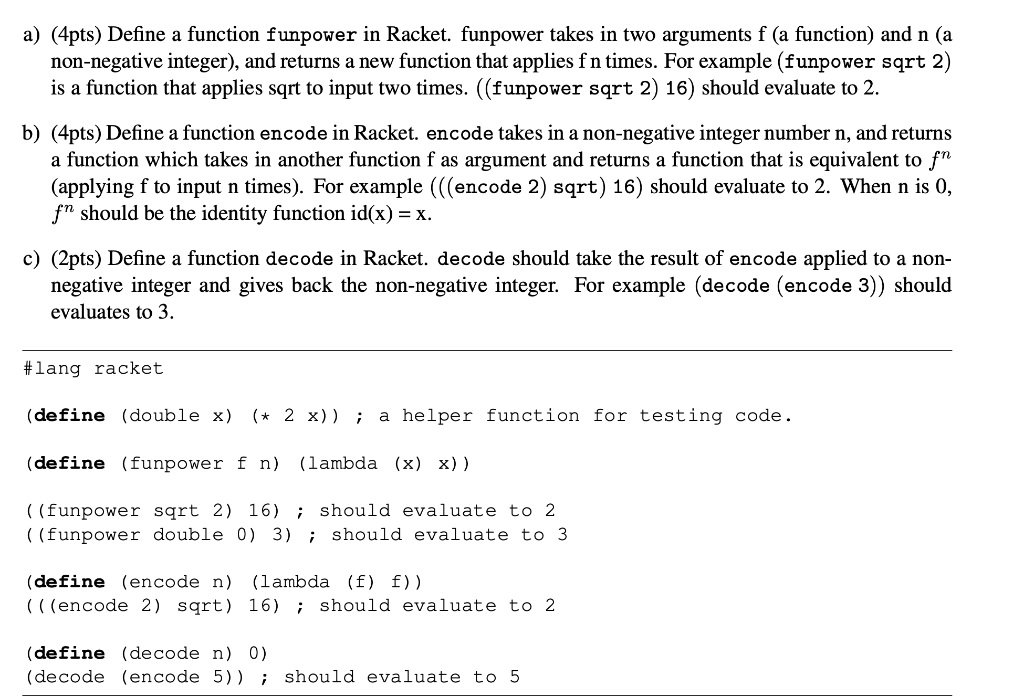
a) (4pts) Define a function funpower in Racket. funpower takes in two arguments f (a function) and n (a non-negative integer), and returns a new function that applies fn times. For example (funpower sqrt 2) is a function that applies sqrt to input two times. ((funpower sqrt 2) 16) should evaluate to 2. b) (4pts) Define a function encode in Racket. encode takes in a non-negative integer number n, and returns a function which takes in another function f as argument and returns a function that is equivalent to fn (applying f to input n times). For example (((encode 2) sqrt) 16) should evaluate to 2. When n is 0, f" should be the identity function id(x) = x. c) (2pts) Define a function decode in Racket. decode should take the result of encode applied to a non- negative integer and gives back the non-negative integer. For example (decode (encode 3)) should evaluates to 3. #lang racket (define (double x) (* 2 x)) ; a helper function for testing code. (define (funpower f n) (lambda (x) x)) ( (funpower sqrt 2) 16) ; should evaluate to 2 ( (funpower double 0) 3) ; should evaluate to 3 (define (encode n) (lambda (f) f)) (((encode 2) sqrt) 16) ; should evaluate to 2 (define (decode n) 0) (decode (encode 5)) ; should evaluate to 5 a) (4pts) Define a function funpower in Racket. funpower takes in two arguments f (a function) and n (a non-negative integer), and returns a new function that applies fn times. For example (funpower sqrt 2) is a function that applies sqrt to input two times. ((funpower sqrt 2) 16) should evaluate to 2. b) (4pts) Define a function encode in Racket. encode takes in a non-negative integer number n, and returns a function which takes in another function f as argument and returns a function that is equivalent to fn (applying f to input n times). For example (((encode 2) sqrt) 16) should evaluate to 2. When n is 0, f" should be the identity function id(x) = x. c) (2pts) Define a function decode in Racket. decode should take the result of encode applied to a non- negative integer and gives back the non-negative integer. For example (decode (encode 3)) should evaluates to 3. #lang racket (define (double x) (* 2 x)) ; a helper function for testing code. (define (funpower f n) (lambda (x) x)) ( (funpower sqrt 2) 16) ; should evaluate to 2 ( (funpower double 0) 3) ; should evaluate to 3 (define (encode n) (lambda (f) f)) (((encode 2) sqrt) 16) ; should evaluate to 2 (define (decode n) 0) (decode (encode 5)) ; should evaluate to 5
Step by Step Solution
There are 3 Steps involved in it

Get step-by-step solutions from verified subject matter experts
 Study Help