



Question: A 5 0 Hz , 4 - pole turbo generator rated 2 0 MVA, 1 3 . 2 k V has an inertia constant of
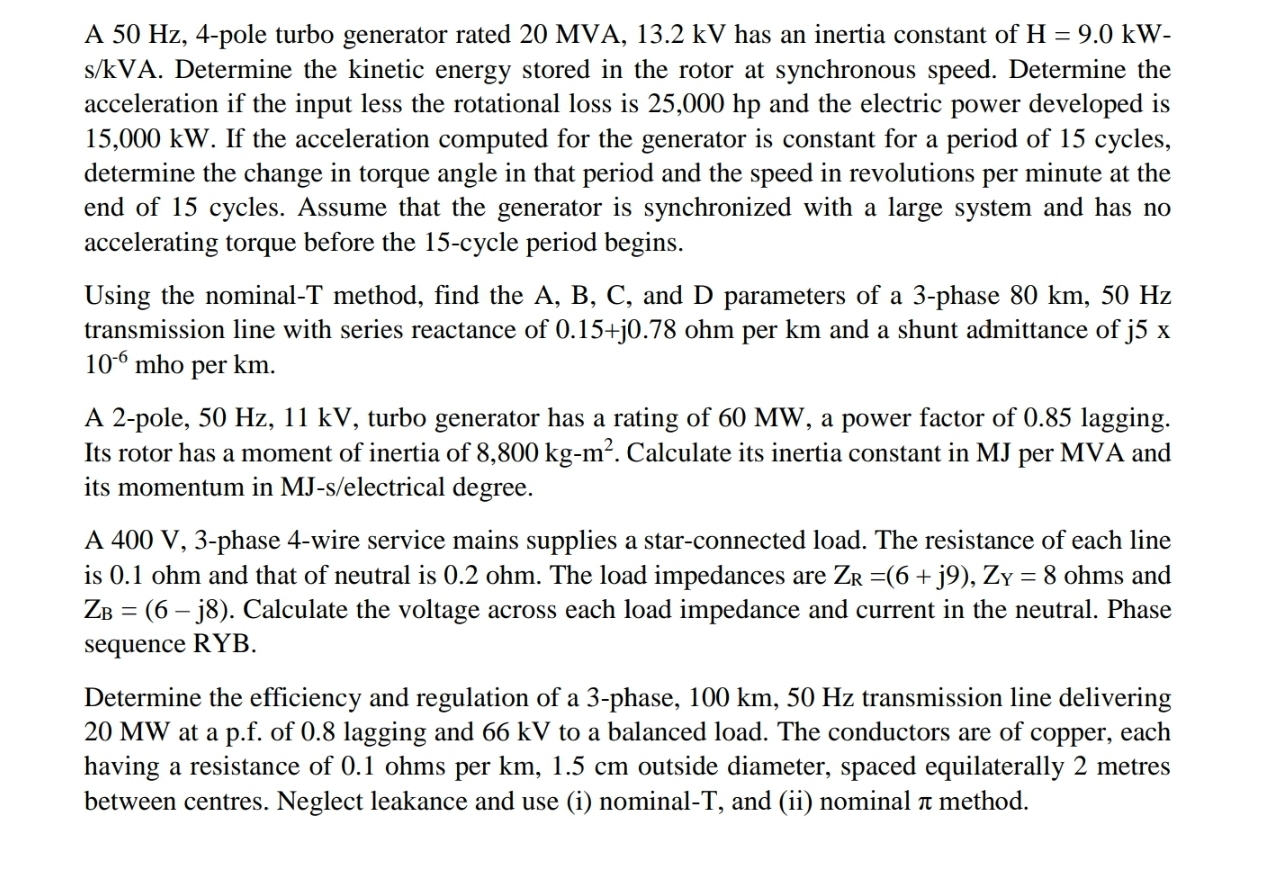
A Hz pole turbo generator rated MVA, has an inertia constant of Determine the kinetic energy stored in the rotor at synchronous speed. Determine the acceleration if the input less the rotational loss is and the electric power developed is If the acceleration computed for the generator is constant for a period of cycles, determine the change in torque angle in that period and the speed in revolutions per minute at the end of cycles. Assume that the generator is synchronized with a large system and has no accelerating torque before the cycle period begins.
Using the nominalT method, find the A B C and D parameters of a phase transmission line with series reactance of ohm per km and a shunt admittance of j x mho per km
A pole, turbo generator has a rating of MW a power factor of lagging. Its rotor has a moment of inertia of Calculate its inertia constant in MJ per MVA and its momentum in MJselectrical degree.
A V phase wire service mains supplies a starconnected load. The resistance of each line is ohm and that of neutral is ohm The load impedances are ohms and Calculate the voltage across each load impedance and current in the neutral. Phase sequence RYB
Determine the efficiency and regulation of a phase, transmission line delivering MW at a pf of lagging and kV to a balanced load. The conductors are of copper, each having a resistance of ohms per outside diameter, spaced equilaterally metres between centres. Neglect leakance and use i nominalT and ii nominal method.
Step by Step Solution
There are 3 Steps involved in it
1 Expert Approved Answer
Step: 1 Unlock

Question Has Been Solved by an Expert!
Get step-by-step solutions from verified subject matter experts
Step: 2 Unlock
Step: 3 Unlock