







Question: `` a (5, n)uEE + 2B(5, n)uEn + 7(5, n)unn + 6(5, n)us + E(5, n)un + (5, n)u = 0, (2) where a(5, n)
``
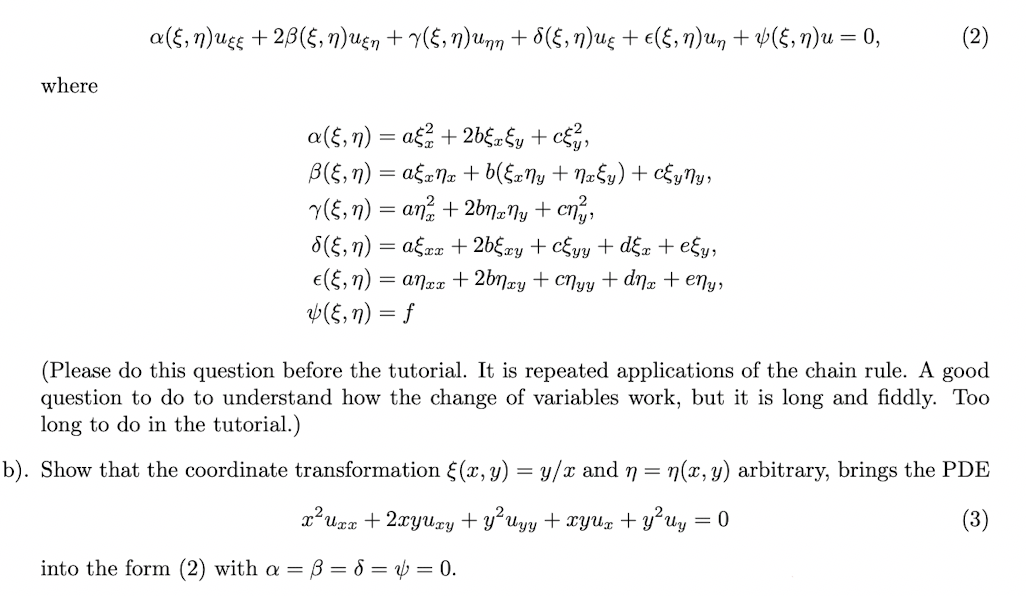
a (5, n)uEE + 2B(5, n)uEn + 7(5, n)unn + 6(5, n)us + E(5, n)un + (5, n)u = 0, (2) where a(5, n) = atx + 2beaty + cg2 B(5, n) = aExx + b(Exny + nosy) + csyly, 7 (5, n) = anx + 2bnxy + Cny; 8(5, n) = aExx + 2bExy + cyy + dex + ely, E(5, n) = anxx + 2bnxy + Cnyy + dnx + eny, (5, n) = f (Please do this question before the tutorial. It is repeated applications of the chain rule. A good question to do to understand how the change of variables work, but it is long and fiddly. Too long to do in the tutorial.) b). Show that the coordinate transformation (x, y) = y/x and n = n(x, y) arbitrary, brings the PDE X'uxx + 2xyury + y"ugy + xyur + y'uy = 0 (3 into the form (2) with a = 3 = 6 = 1 =0
Step by Step Solution
There are 3 Steps involved in it

Get step-by-step solutions from verified subject matter experts
 Study Help