







Question: a. (5 points) Intuitively, how do you expect the bias and variance to behave for small values of m? What about large values of m?
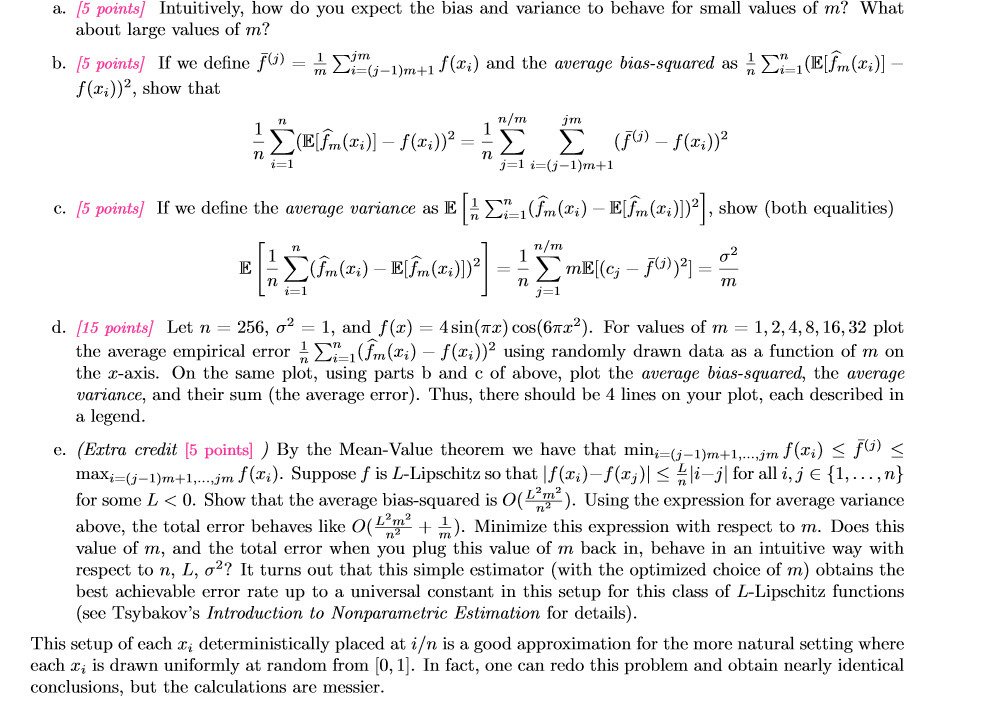
a. (5 points) Intuitively, how do you expect the bias and variance to behave for small values of m? What about large values of m? b. [5 points) If we define f) = m ):"(-1)m+1 f(:) and the average bias-squared as , Et (Elfm(x;)] - f(x;))2, show that / m jm [( E fm(2.)] - f(z.))' = = _ E ( F() - f(Ii) ) ? j=li=(j-1)m+1 C. (5 points) If we define the average variance as E : Et(fm(x.) -Elfm(x.)])?|, show (both equalities) j=1 m d. [15 points) Let n = 256, o2 = 1, and f(x) = 4sin(x) cos(6x2). For values of m = 1, 2, 4, 8, 16, 32 plot the average empirical error , Et-(fm(x.) -f(x.)) using randomly drawn data as a function of m on the r-axis. On the same plot, using parts b and c of above, plot the average bias-squared, the average variance, and their sum (the average error). Thus, there should be 4 lines on your plot, each described in a legend. e. (Extra credit [5 points] ) By the Mean-Value theorem we have that mini=(j-1)m+1,...,jm f(I.)
Step by Step Solution
There are 3 Steps involved in it

Get step-by-step solutions from verified subject matter experts
 Study Help