







Question: (a) [6 points) Consider the following instance of a database containing transactions of items bought by customers at a grocery store. Each item in a
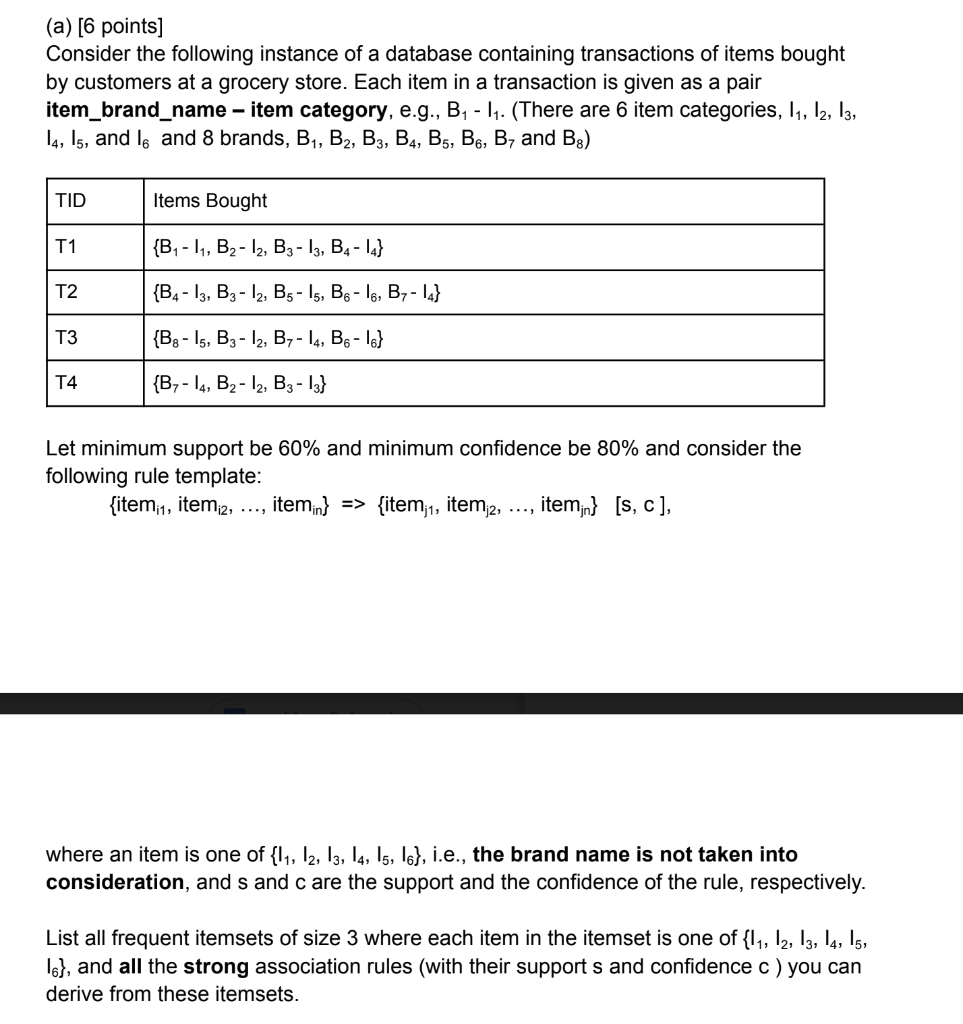
(a) [6 points) Consider the following instance of a database containing transactions of items bought by customers at a grocery store. Each item in a transaction is given as a pair item_brand_name item category, e.g., B. - 11. (There are 6 item categories, 11, 12, 13, 14, 15, and 16 and 8 brands, B1, B2, B3, B4, B5, B6, B, and B8) TID Items Bought T1 {B.- 11, B2-12, B3 - 13, B4 - 14} T2 {B4 - 13, B3 - 12, B5-15, B6- 16, B7-1} T3 {B:- 15, B3-12, B,- 14, B6- 16} T4 {B7-14, B2-12, B3 - 13} Let minimum support be 60% and minimum confidence be 80% and consider the following rule template: {itemi, item2, ..., item in} => {item 1, itemj2, ..., item;n} [s, c], where an item is one of {11, 12, 13, 14, 15, 16), i.e., the brand name is not taken into consideration, and s and c are the support and the confidence of the rule, respectively. List all frequent itemsets of size 3 where each item in the itemset is one of {11, 12, 13, 14, 15, 16}, and all the strong association rules (with their support s and confidence c ) you can derive from these itemsets
Step by Step Solution
There are 3 Steps involved in it

Get step-by-step solutions from verified subject matter experts
 Study Help