







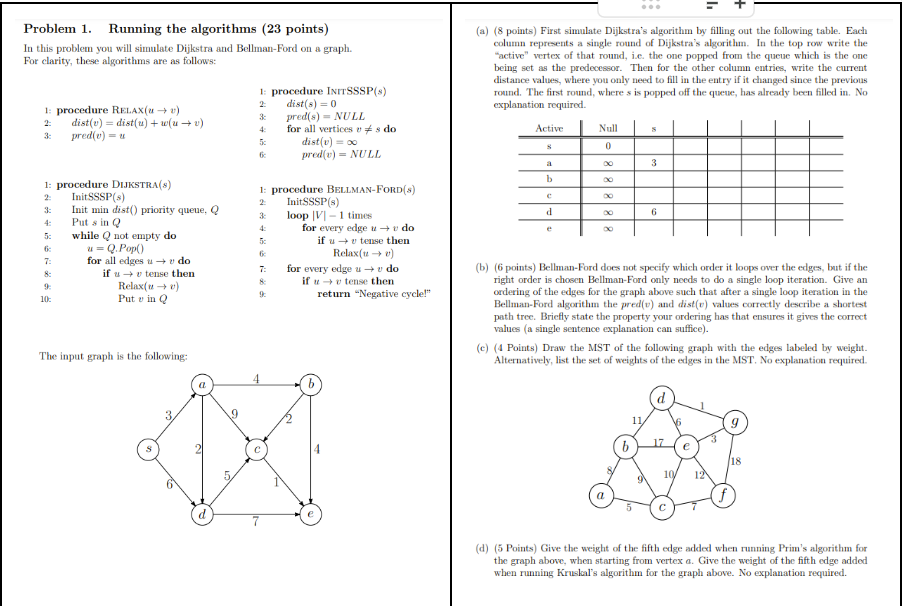
Question: ( a ) ( 8 points ) First simulate Dijkstra's algorithm by filling out the following table. Each column represents a single round of Dijkstra's
a points First simulate Dijkstra's algorithm by filling out the following table. Each
column represents a single round of Dijkstra's algorithm. In the top row write the
"active" vertex of that round, ie the one popped from the queue which is the one
being set as the predecessor. Then for the other column entries, write the current
distance values, where you only need to fill in the entry if it changed since the previous
round. The first round, where is popped off the queue, has already been filled in No
explanation required.
b points BellmanFord does not specify which order it loops over the edges, but if the
right order is chosen BellmanFord only needs to do a single loop iteration. Give an
ordering of the edges for the graph above such that after a single loop iteration in the
BellmanFord algorithm the pred and dist values correctly describe a shortest
path tree. Briefly state the property your ordering has that ensures it gives the correct
values a single sentence explanation can suffice
c Points Draw the MST of the following graph with the edges labeled by weight.
Alternatively, list the set of weights of the edges in the MST No explanation required.
d Points Give the weight of the fifth edge added when running Prim's algorithm for
the graph above, when starting from vertex Give the weight of the fifth edge added
when running Kruskal's algorithm for the graph above. No explanation required.Problem Running the algorithms points
In this problem you will simulate Dijkstra and BellmanFord on a graph.
For clarity, these algorithms are as follows:
The input graph is the followins.
a points First simulate Dijkstra's algorithm by filling out the following table. Each
column represents a single round of Dijkstra's algorithm. In the top row write the
"active" vertex of that round, ie the one popped from the queue which is the one
being set as the predecessor. Then for the other column entries, write the current
distance values, where you only need to fill in the entry if it changed since the previous
round. The first round, where is popped off the queue, has already been filled in No
explanation required.
b points BellmanFord does not specify which order it loops over the edges, but if the
right order is chosen BellmanFord only needs to do a single loop iteration. Give an
ordering of the edges for the graph above such that after a single loop iteration in the
BellmanFord algorithm the pred and distv values correctly describe a shortest
path tree. Briefly state the property your ordering has that ensures it gives the correct
values a single sentence explanation can suffice
c Points Draw the MST of the following graph with the edges labeled by weight.
Alternatively, list the set of weights of the edges in the MST No explanation required.
d Points Give the weight of the fifth edge added when running Prim's algorithm for
the graph above, when starting from vertex Give the weight of the fifth edge added
when running Kruskal's algorithm for the graph above. No explanation required.
Step by Step Solution
There are 3 Steps involved in it
1 Expert Approved Answer
Step: 1 Unlock

Question Has Been Solved by an Expert!
Get step-by-step solutions from verified subject matter experts
Step: 2 Unlock
Step: 3 Unlock
 Study Help