



Question: a) A force F is applied to a particle which has position vector r and momentum p. (i) Use Newton's laws to show that rxF
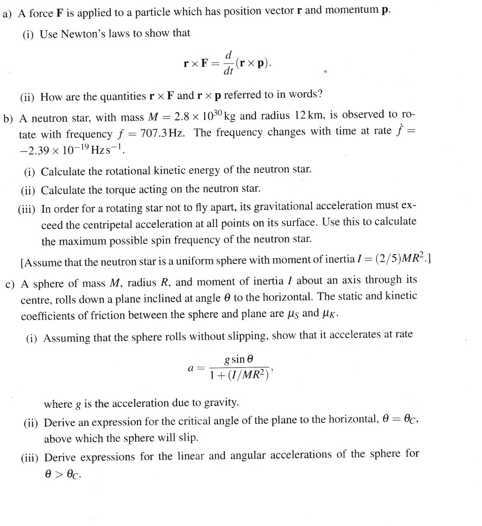
a) A force F is applied to a particle which has position vector r and momentum p. (i) Use Newton's laws to show that rxF =- "(rxp) dr (ii) How are the quantities r x F and r x p referred to in words? b) A neutron star, with mass M = 2.8 x 10"0 kg and radius 12 km, is observed to ro- tate with frequency f = 707.3 Hz. The frequency changes with time at rate / = -2.39 x 10-" Has-. (i) Calculate the rotational kinetic energy of the neutron star, (ii) Calculate the torque acting on the neutron star. (iii) In order for a rotating star not to fly apart, its gravitational acceleration must ex- ceed the centripetal acceleration at all points on its surface. Use this to calculate the maximum possible spin frequency of the neutron star. [Assume that the neutron star is a uniform sphere with moment of inertia / = (2/5)MR. ] c) A sphere of mass M. radius R, and moment of inertia / about an axis through its centre, rolls down a plane inclined at angle e to the horizontal. The static and kinetic coefficients of friction between the sphere and plane are us and ux. (i) Assuming that the sphere rolls without slipping, show that it accelerates at rate g sine a = 1 + (1/MR] ) where g is the acceleration due to gravity. (ii) Derive an expression for the critical angle of the plane to the horizontal, 0 = ec. above which the sphere will slip. (iii) Derive expressions for the linear and angular accelerations of the sphere for
Step by Step Solution
There are 3 Steps involved in it

Get step-by-step solutions from verified subject matter experts