



Question: A) A perfectly mixed gas permeation module is separating carbon dioxide from nitrogen using an ethyl cellulose membrane. The feed which is at 25C has
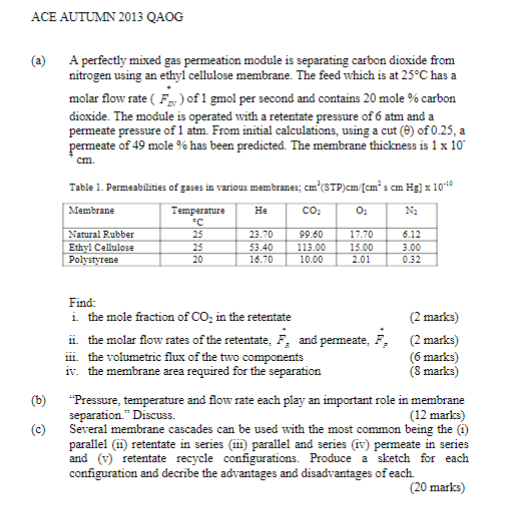
A) A perfectly mixed gas permeation module is separating carbon dioxide from nitrogen using an ethyl cellulose membrane. The feed which is at 25C has a molar flow rate ( FNV ) of 1 gmol per second and contains 20 mole \% carbon dioxide. The module is operated with a retentate pressure of 6 atm and a permeate pressure of 1atm. From initial calculations, using a cut ( ) of 0.25 , a permeate of 49 mole % has been predicted. The membrane thickness is 110 Cm. Table 1. Permeabilities of gases in various membranes; cm2(STP)cm2[cm2scmHg]10410 Find: i. the mole fraction of CO2 in the retentate (2 marks) ii. the molar flow rates of the retentate, Fz and permeate, FF (2 marks) iii. the volumetric flux of the two components (6 marks) iv. the membrane area required for the separation ( 8 marks) "Pressure, temperature and flow rate each play an important role in membrane separation." Discuss. (12 marks) Several membrane cascades can be used with the most common being the (i) parallel (ii) retentate in series (iii) parallel and series (iv) permeate in series and (v) retentate recycle configurations. Produce a sketch for each configuration and decribe the advantages and disadvantages of each. (20 marks) A) A perfectly mixed gas permeation module is separating carbon dioxide from nitrogen using an ethyl cellulose membrane. The feed which is at 25C has a molar flow rate ( FNV ) of 1 gmol per second and contains 20 mole \% carbon dioxide. The module is operated with a retentate pressure of 6 atm and a permeate pressure of 1atm. From initial calculations, using a cut ( ) of 0.25 , a permeate of 49 mole % has been predicted. The membrane thickness is 110 Cm. Table 1. Permeabilities of gases in various membranes; cm2(STP)cm2[cm2scmHg]10410 Find: i. the mole fraction of CO2 in the retentate (2 marks) ii. the molar flow rates of the retentate, Fz and permeate, FF (2 marks) iii. the volumetric flux of the two components (6 marks) iv. the membrane area required for the separation ( 8 marks) "Pressure, temperature and flow rate each play an important role in membrane separation." Discuss. (12 marks) Several membrane cascades can be used with the most common being the (i) parallel (ii) retentate in series (iii) parallel and series (iv) permeate in series and (v) retentate recycle configurations. Produce a sketch for each configuration and decribe the advantages and disadvantages of each. (20 marks)
Step by Step Solution
There are 3 Steps involved in it

Get step-by-step solutions from verified subject matter experts