







Question: a) A polygon is a closed shape with straight sides. Rectangles, triangles, hexagons, and octagons are all examples of polygons. A polygon with n sides
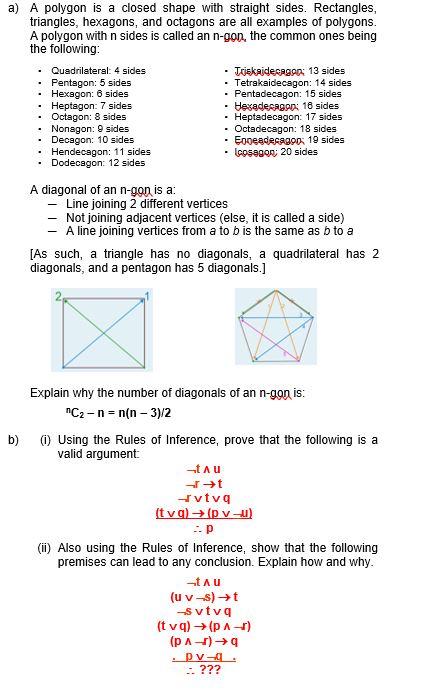
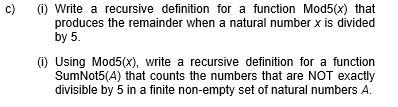
a) A polygon is a closed shape with straight sides. Rectangles, triangles, hexagons, and octagons are all examples of polygons. A polygon with n sides is called an n-gon, the common ones being the following: Quadrilateral: 4 sides Tojskadesagen: 13 sides Pentagon: 5 sides Tetrakaidecagon: 14 sides Hexagon: 6 sides Pentadecagon: 15 sides Heptagon: 7 sides Hexadeorgan: 16 sides Octagon: 8 sides Heptadecagon: 17 sides Nonagon: 9 sides . Octadecagon: 18 sides Decagon: 10 sides Eooeadesaggo: 19 sides Hendecagon: 11 sides cosegon: 20 sides . Dodecagon: 12 sides . A diagonal of an n-gon is a: Line joining 2 different vertices Not joining adjacent vertices (else, it is called a side) A line joining vertices from a to b is the same as b to [As such, a triangle has no diagonals, a quadrilateral has 2 diagonals, and a pentagon has 5 diagonals.] b) Explain why the number of diagonals of an n-gon is: "Cz-n=n(n-3)/2 0 Using the Rules of Inference, prove that the following is a valid argument: -AU - tvtvg (tvg) (PV-U) --P (i) Also using the Rules of Inference, show that the following premises can lead to any conclusion. Explain how and why LAU (u v-s) svtva (t vq) (P-1) (p-1) . PV- . ??? c) 0 Write a recursive definition for a function Mod5(x) that produces the remainder when a natural number x is divided by 5. ( Using Mod5(x), write a recursive definition for a function SumNot5(A) that counts the numbers that are NOT exactly divisible by 5 in a finite non-empty set of natural numbers A
Step by Step Solution
There are 3 Steps involved in it

Get step-by-step solutions from verified subject matter experts
 Study Help