







Question: a. A researcher is planning an experiment using a completely randomized design with five treatments. A review of the literature suggests that an approximation of
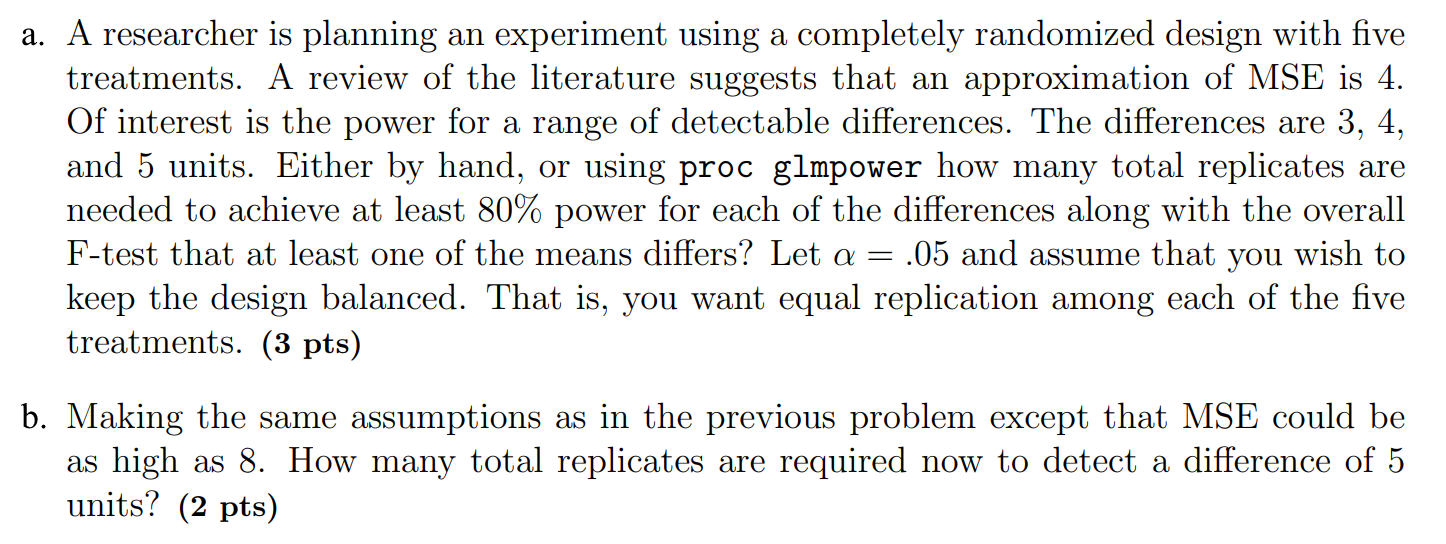
a. A researcher is planning an experiment using a completely randomized design with five treatments. A review of the literature suggests that an approximation of MSE is 4. Of interest is the power for a range of detectable differences. The differences are 3, 4, and 5 units. Either by hand, or using proc glmpower how many total replicates are needed to achieve at least 80% power for each of the differences along with the overall F-test that at least one of the means differs? Let a = .05 and assume that you wish to keep the design balanced. That is, you want equal replication among each of the five treatments. (3 pts) = b. Making the same assumptions as in the previous problem except that MSE could be as high as 8. How many total replicates are equired now to detect a difference of 5 units? (2 pts) a. A researcher is planning an experiment using a completely randomized design with five treatments. A review of the literature suggests that an approximation of MSE is 4. Of interest is the power for a range of detectable differences. The differences are 3, 4, and 5 units. Either by hand, or using proc glmpower how many total replicates are needed to achieve at least 80% power for each of the differences along with the overall F-test that at least one of the means differs? Let a = .05 and assume that you wish to keep the design balanced. That is, you want equal replication among each of the five treatments. (3 pts) = b. Making the same assumptions as in the previous problem except that MSE could be as high as 8. How many total replicates are equired now to detect a difference of 5 units? (2 pts)
Step by Step Solution
There are 3 Steps involved in it

Get step-by-step solutions from verified subject matter experts
 Study Help