







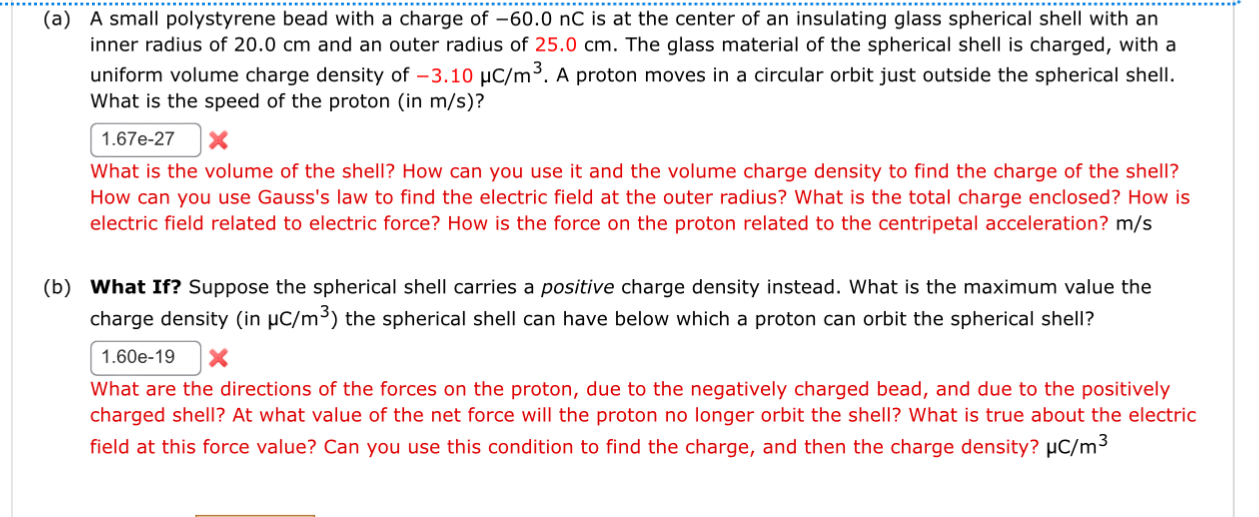
Question: ( a ) A small polystyrene bead with a charge of - 6 0 . 0 nC is at the center of an insulating glass
a A small polystyrene bead with a charge of nC is at the center of an insulating glass spherical shell with an inner radius of cm and an outer radius of cm The glass material of the spherical shell is charged, with a uniform volume charge density of mu mathrmCmathrmm A proton moves in a circular orbit just outside the spherical shell. What is the speed of the proton in mathrmmmathrms
What is the volume of the shell? How can you use it and the volume charge density to find the charge of the shell? How can you use Gauss's law to find the electric field at the outer radius? What is the total charge enclosed? How is electric field related to electric force? How is the force on the proton related to the centripetal acceleration? mathrmmmathrms
b What If Suppose the spherical shell carries a positive charge density instead. What is the maximum value the charge density in mu mathrmCmathrmm the spherical shell can have below which a proton can orbit the spherical shell?
What are the directions of the forces on the proton, due to the negatively charged bead, and due to the positively charged shell? At what value of the net force will the proton no longer orbit the shell? What is true about the electric field at this force value? Can you use this condition to find the charge, and then the charge density? mu mathrmCmathrmm
Step by Step Solution
There are 3 Steps involved in it
1 Expert Approved Answer
Step: 1 Unlock

Question Has Been Solved by an Expert!
Get step-by-step solutions from verified subject matter experts
Step: 2 Unlock
Step: 3 Unlock
 Study Help