







Question: a) A typical star has a number density, N , of about 10^(16)cm^(-3) , while in an H II region the number density is more
a) A typical star has a number density,
N, of about
10^(16)cm^(-3), while in an
HII region the number density is more typically
10^(4)cm^(-3). In each case what is the highest level of atomic hydrogen that is likely to be occupied? State any assumptions made in obtaining this answer.\ b) The partition function for atomic hydrogen can be written as\
z=\\\\sum_(n=1)^(\\\\infty ) 2n^(2)exp(-(R_(H))/(n^(2)kT))\ This series cannot be summed as it diverges. Can you suggest why, in practical astronomical applications, the partition function for the
Hatom is finite?
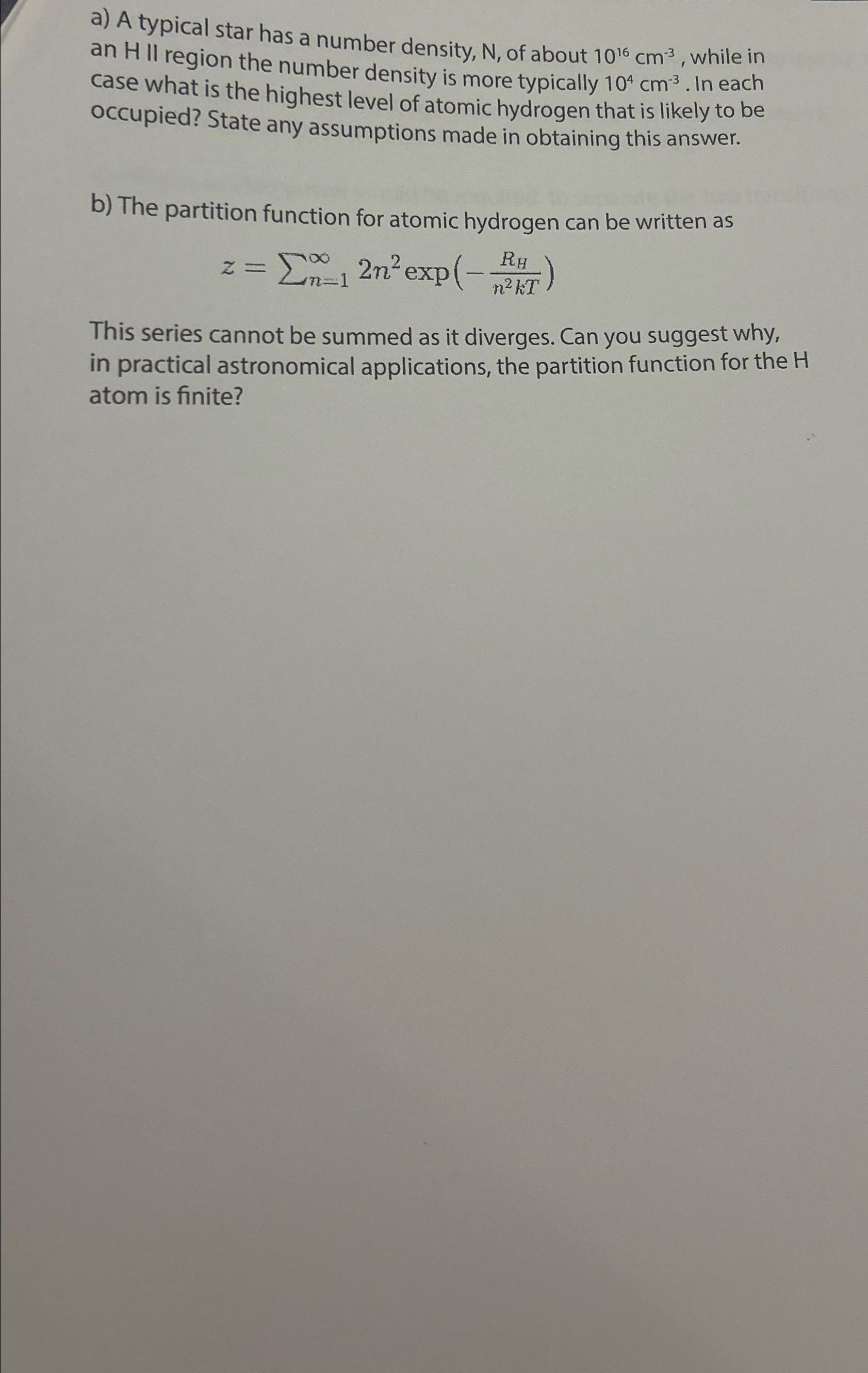
a) A typical star has a number density, N, of about 1016cm3, while in an H II region the number density is more typically 104cm3. In each case what is the highest level of atomic hydrogen that is likely to be occupied? State any assumptions made in obtaining this answer. b) The partition function for atomic hydrogen can be written as z=n=12n2exp(n2kTRH) This series cannot be summed as it diverges. Can you suggest why, in practical astronomical applications, the partition function for the H atom is finite
Step by Step Solution
There are 3 Steps involved in it

Get step-by-step solutions from verified subject matter experts
 Study Help