



Question: a. Answer questions 1-9 draw a diagram or a decision tree to help answer the questions The Estate Tax 205 EXAMPLE 6-68 Continuing the prior
 a. Answer questions 1-9 draw a diagram or a decision tree to help answer the questions
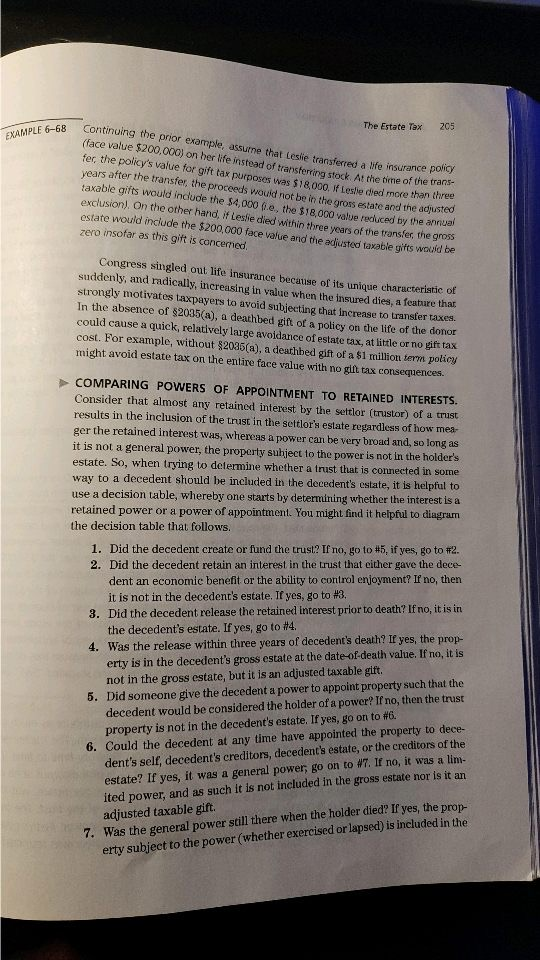
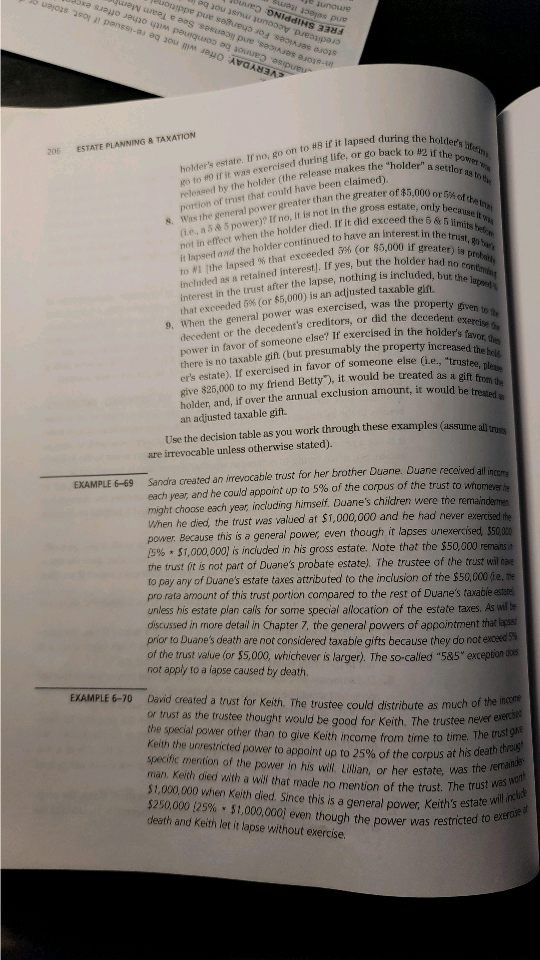
The Estate Tax 205 EXAMPLE 6-68 Continuing the prior exemple, assure that Lesie transferred a life insurance policy (face value $200,000) on her life instead of transferring stock At the time of the trans fer the policy's value for gift tax purposes was $18.000. Leslie died more than three years after the transfer the proceeds would not be in the gross estate and the adjusted taxable gifts would indude the $4,000 (e. the $18,000 value reduced by the annual exclusion). On the other hand, if Lesbe died within three years of the transfer, the gross estate would include the $200,000 face value and the adjusted taxable gifts would be zero insofar as this gift is concerned Congress singled out life insurance because of its unique characteristic of suddenly, and radically, increasing in value when the insured dies, a feature that strongly motivates taxpayers to avoid subjecting that increase to transfer taxes. In the absence of $2035(a), a deathbed gift of a policy on the life of the donor could cause a quick, relatively large avoidance of estate tax, at little or no gift tax cost. For example, without $2035(a), a deathbed gift of a $1 million term policy might avoid estate tax on the entire face value with no gift tax consequences. COMPARING POWERS OF APPOINTMENT TO RETAINED INTERESTS. Consider that almost any retained interest by the settior (trustor) of a trust results in the inclusion of the trust in the settlor's estate regardless of how mea. ger the retained interest was, whereas a power can be very broad and, so long as it is not a general power, the property subject to the power is not in the holder's estate. So, when trying to determine whether a trust that is connected in some way to a decedent should be included in the decedent's estate, it is helpful to use a decision table, whereby one starts by determining whether the interest is a retained power or a power of appointment. You might find it helpful to diagram the decision table that follows. 1. Did the decedent create or fund the trust? If no, go to #5, if yes, go to #2 2. Did the decedent retain an interest in the trust that either gave the dece dent an economic benefit or the ability to control enjoyment? If no, then it is not in the decedent's estate. If yes, go to #3. 3. Did the decedent release the retained interest prior to death? If no, it is in the decedent's estate. If yes, go to #4 4. Was the release within three years of decedent's death? If yes, the prop- erty is in the decedent's gross estate at the date-of-death value. If no, it is not in the gross estate, but it is an adjusted taxable gift. 5. Did someone give the decedent a power to appoint property such that the decedent would be considered the holder of a power? If no, then the trust property is not in the decedent's estate. If yes, go on to #6. 6. Could the decedent at any time have appointed the property to dece- dent's self, decedent's creditors, decedent's estate, or the creditors of the estate? If yes, it was a general power, go on to #7. If no, it was a lim- ited power, and as such it is not included in the gross estate nor is it an adjusted taxable gift 7. Was the general power still there when the holder died? If yes, the prop erty subject to the power (whether exercised or lapsed) is included in the Set 13e pue ng NiddINS 3 You hy pre oppe pure shres 2015 eurs D D - SOM powere 100 pensou O AVOANE holder's estate. Ir no go on to if it lapsed during the holder's A for it was exercised during life or go back to #2 if the pow eldhy the holder (the release takes the "holder a setilor si Wihe general power greater than the greater of $5,000 or hot not in effect when the holder died. If it did exceed the 6 & fi mister (1.59 5 power) trno, It is not in the gross escate, only became It is and the holdercontinued to have an interest in the trust to the lapsed that exceeded 3% (or 85,000 if greater) peck Included as a retained interest. If yes, but the holder had now interest in the stafter the lapse, nothing is included, but the last 9. When the general power was exercised, was the property given decedent of the decedent's creditors, or did the decedent exercise power in favor of someone else? If exercised in the holder's favor, there is no taxable gift (but presumably the property increased the er's estate). I exercised in favor of someone else (ie, trustee, ple glve $25,000 to my friend Betty), it would be treated as it gilt from the Spre mention of the power in his w Wan, or her estate, was the demande mall. Keith died with a wis that made no mention of the trust. The trust wes om $1,000,000 when Keith died. Since this is a general power, Keith's estate will incat $250,000 25% $1,000,000) even though the power was restricted to exer holder, and, if over the annual exclusion amount, it would be treated Use the decision table as you work through these examples assume ali or trust as the trustee thought would be good for Keith. The trustee never en ungure 31 ESTATE PLANNING A TAXATION portion of thist that could have been claimed). that exceeded 5% (or $5,000) is an adjusted taxablegin ah adjusted taxable gift are irrevocable unless otherwise stated). EXAMPLE 6-69 Sandra created an irrevocable trust for her brother Duane. Duane received all income each year, and he could appoint up to 5% of the corpus of the trust to whome might choose each year, including himself. Duane's children were the remainder When he died, the trust was valued at $1,000,000 and he had never exercised the power. Because this is a general power, even though it lapses unexercised $50,000 25% $1,000,000) is included in his gross estate. Note that the $50,000 remans The trust it is not part of Duane's probate estate). The trustee of the trust wil ta to pay any of Duane's estate taxes attributed to the inclusion of the $50,000 ie, te pro rata amount of this trust portion compared to the rest of Duane's taxable este unless his estate plan calls for some special allocation of the estate taxes. As will discussed in more detail in Chapter 7 the general powers of appointment that last prior to Duane's death are not considered taxable gifts because they do not exceed of the trust value for $5,000, whichever is larger). The so-called "585 exception 10 not apply to a lapse caused by death EXAMPLE 6-70 David created a must for Keith The trustee could distribute as much of the income the special power other than to give Keith income from time to time. The trust on Keith the restricted power to appoint up to 25% of the corpus at his death througe death and Keith let it lapse without exercise The Estate Tax 205 EXAMPLE 6-68 Continuing the prior exemple, assure that Lesie transferred a life insurance policy (face value $200,000) on her life instead of transferring stock At the time of the trans fer the policy's value for gift tax purposes was $18.000. Leslie died more than three years after the transfer the proceeds would not be in the gross estate and the adjusted taxable gifts would indude the $4,000 (e. the $18,000 value reduced by the annual exclusion). On the other hand, if Lesbe died within three years of the transfer, the gross estate would include the $200,000 face value and the adjusted taxable gifts would be zero insofar as this gift is concerned Congress singled out life insurance because of its unique characteristic of suddenly, and radically, increasing in value when the insured dies, a feature that strongly motivates taxpayers to avoid subjecting that increase to transfer taxes. In the absence of $2035(a), a deathbed gift of a policy on the life of the donor could cause a quick, relatively large avoidance of estate tax, at little or no gift tax cost. For example, without $2035(a), a deathbed gift of a $1 million term policy might avoid estate tax on the entire face value with no gift tax consequences. COMPARING POWERS OF APPOINTMENT TO RETAINED INTERESTS. Consider that almost any retained interest by the settior (trustor) of a trust results in the inclusion of the trust in the settlor's estate regardless of how mea. ger the retained interest was, whereas a power can be very broad and, so long as it is not a general power, the property subject to the power is not in the holder's estate. So, when trying to determine whether a trust that is connected in some way to a decedent should be included in the decedent's estate, it is helpful to use a decision table, whereby one starts by determining whether the interest is a retained power or a power of appointment. You might find it helpful to diagram the decision table that follows. 1. Did the decedent create or fund the trust? If no, go to #5, if yes, go to #2 2. Did the decedent retain an interest in the trust that either gave the dece dent an economic benefit or the ability to control enjoyment? If no, then it is not in the decedent's estate. If yes, go to #3. 3. Did the decedent release the retained interest prior to death? If no, it is in the decedent's estate. If yes, go to #4 4. Was the release within three years of decedent's death? If yes, the prop- erty is in the decedent's gross estate at the date-of-death value. If no, it is not in the gross estate, but it is an adjusted taxable gift. 5. Did someone give the decedent a power to appoint property such that the decedent would be considered the holder of a power? If no, then the trust property is not in the decedent's estate. If yes, go on to #6. 6. Could the decedent at any time have appointed the property to dece- dent's self, decedent's creditors, decedent's estate, or the creditors of the estate? If yes, it was a general power, go on to #7. If no, it was a lim- ited power, and as such it is not included in the gross estate nor is it an adjusted taxable gift 7. Was the general power still there when the holder died? If yes, the prop erty subject to the power (whether exercised or lapsed) is included in the Set 13e pue ng NiddINS 3 You hy pre oppe pure shres 2015 eurs D D - SOM powere 100 pensou O AVOANE holder's estate. Ir no go on to if it lapsed during the holder's A for it was exercised during life or go back to #2 if the pow eldhy the holder (the release takes the "holder a setilor si Wihe general power greater than the greater of $5,000 or hot not in effect when the holder died. If it did exceed the 6 & fi mister (1.59 5 power) trno, It is not in the gross escate, only became It is and the holdercontinued to have an interest in the trust to the lapsed that exceeded 3% (or 85,000 if greater) peck Included as a retained interest. If yes, but the holder had now interest in the stafter the lapse, nothing is included, but the last 9. When the general power was exercised, was the property given decedent of the decedent's creditors, or did the decedent exercise power in favor of someone else? If exercised in the holder's favor, there is no taxable gift (but presumably the property increased the er's estate). I exercised in favor of someone else (ie, trustee, ple glve $25,000 to my friend Betty), it would be treated as it gilt from the Spre mention of the power in his w Wan, or her estate, was the demande mall. Keith died with a wis that made no mention of the trust. The trust wes om $1,000,000 when Keith died. Since this is a general power, Keith's estate will incat $250,000 25% $1,000,000) even though the power was restricted to exer holder, and, if over the annual exclusion amount, it would be treated Use the decision table as you work through these examples assume ali or trust as the trustee thought would be good for Keith. The trustee never en ungure 31 ESTATE PLANNING A TAXATION portion of thist that could have been claimed). that exceeded 5% (or $5,000) is an adjusted taxablegin ah adjusted taxable gift are irrevocable unless otherwise stated). EXAMPLE 6-69 Sandra created an irrevocable trust for her brother Duane. Duane received all income each year, and he could appoint up to 5% of the corpus of the trust to whome might choose each year, including himself. Duane's children were the remainder When he died, the trust was valued at $1,000,000 and he had never exercised the power. Because this is a general power, even though it lapses unexercised $50,000 25% $1,000,000) is included in his gross estate. Note that the $50,000 remans The trust it is not part of Duane's probate estate). The trustee of the trust wil ta to pay any of Duane's estate taxes attributed to the inclusion of the $50,000 ie, te pro rata amount of this trust portion compared to the rest of Duane's taxable este unless his estate plan calls for some special allocation of the estate taxes. As will discussed in more detail in Chapter 7 the general powers of appointment that last prior to Duane's death are not considered taxable gifts because they do not exceed of the trust value for $5,000, whichever is larger). The so-called "585 exception 10 not apply to a lapse caused by death EXAMPLE 6-70 David created a must for Keith The trustee could distribute as much of the income the special power other than to give Keith income from time to time. The trust on Keith the restricted power to appoint up to 25% of the corpus at his death througe death and Keith let it lapse without exercise
Step by Step Solution
There are 3 Steps involved in it

Get step-by-step solutions from verified subject matter experts