







Question: (a) Assuming equal priors, P(C1) = P(C2) = 0.5, classify an object with the attribute value r = 1.5. (b) Assuming unequal priors, P(C1) =
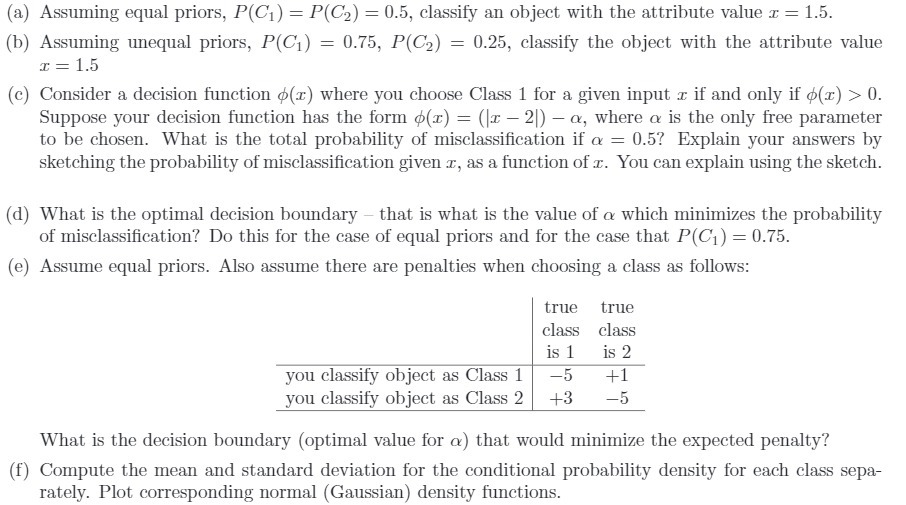
(a) Assuming equal priors, P(C1) = P(C2) = 0.5, classify an object with the attribute value r = 1.5. (b) Assuming unequal priors, P(C1) = 0.75, P(C2) = 0.25, classify the object with the attribute value x = 1.5 (c) Consider a decision function o(r) where you choose Class 1 for a given input a if and only if o(x) > 0. Suppose your decision function has the form o(x) = (|x -2)) -a, where a is the only free parameter to be chosen. What is the total probability of misclassification if o = 0.5? Explain your answers by sketching the probability of misclassification given r, as a function of r. You can explain using the sketch. (d) What is the optimal decision boundary - that is what is the value of o which minimizes the probability of misclassification? Do this for the case of equal priors and for the case that P(C1) = 0.75. (e) Assume equal priors. Also assume there are penalties when choosing a class as follows: true true class class is 1 is 2 you classify object as Class 1 -5 +1 you classify object as Class 2 +3 -5 What is the decision boundary (optimal value for or) that would minimize the expected penalty? (f) Compute the mean and standard deviation for the conditional probability density for each class sepa- rately. Plot corresponding normal (Gaussian) density functions
Step by Step Solution
There are 3 Steps involved in it

Get step-by-step solutions from verified subject matter experts
 Study Help