







Question: (a) (b) 10 begin{tabular}{|c||c|c|c|c|c|c|c|} hline & & & Unit & & Total & & hline Date & Units & x & Cost & =
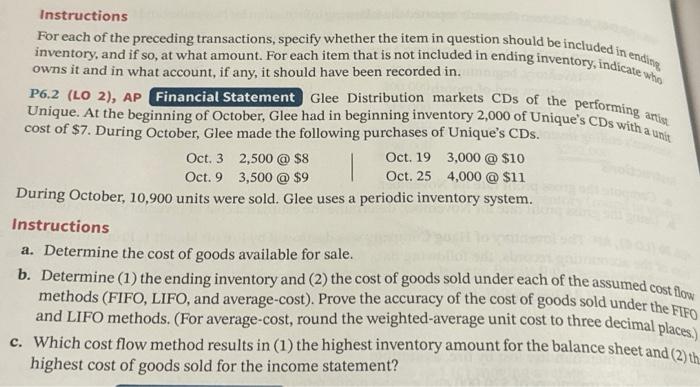
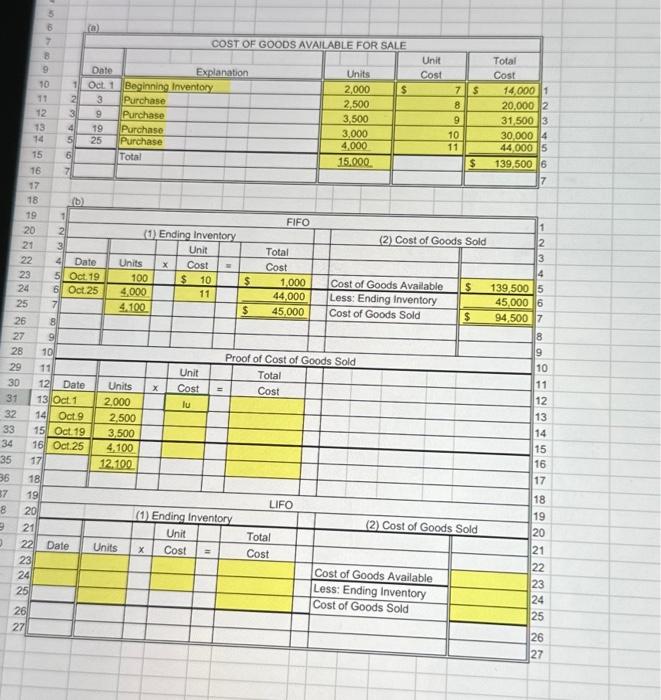
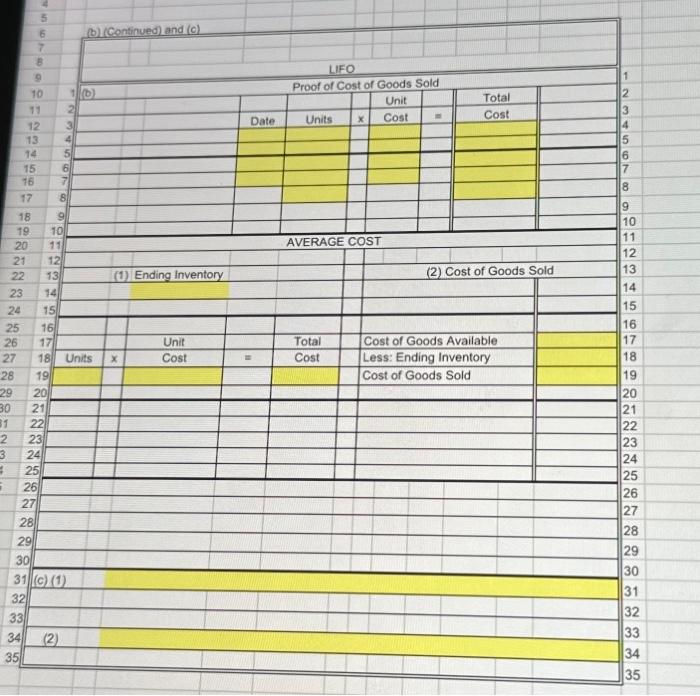
(a) (b) 10 \begin{tabular}{|c||c|c|c|c|c|c|c|} \hline & & & Unit & & Total & & \\ \hline Date & Units & x & Cost & = & Cost & & \\ \hline Oct 1 & 2,000 & & lu & & & & \\ \hline \end{tabular} 11 12 Oct 9 13 Oct 19 14 Oct.25 15 3.500 16 4,10012,100 17 18 LIFO 19 17 12.100 19 (1) Ending Inventory (2) Cost of Goods Sold 20 Instructions For each of the preceding transactions, specify whether the item in question should be included in endiling inventory, and if so, at what amount. For each item that is not included in ending inventory, indicate who owns it and in what account, if any, it should have been recorded in. P6.2 (LO 2), AP Glee Distribution markets CDs of the performing antist. Unique. At the beginning of October, Glee had in beginning inventory 2,000 of Unique's CDs with a unifi. cost of \$7. During October, Glee made the following purchases of Unique's CDs. During October, 10,900 units were sold. Glee uses a periodic inventory system. Instructions a. Determine the cost of goods available for sale. b. Determine (1) the ending inventory and (2) the cost of goods sold under each of the assumed cost flow methods (FIFO, LIFO, and average-cost). Prove the accuracy of the cost of goods sold under the FIF and LIFO methods. (For average-cost, round the weighted-average unit cost to three decimal places, c. Which cost flow method results in (1) the highest inventory amount for the balance sheet and (2) highest cost of goods sold for the income statement? (B) (Continued) and (c) LIFO (B) Proof of Cost of Goods Sold
Step by Step Solution
There are 3 Steps involved in it

Get step-by-step solutions from verified subject matter experts
 Study Help