







Question: a, b,..., 2:, y are integers. p = prime. Sum of three squares (of integers). You can use the following results directly. (1). Suppose d
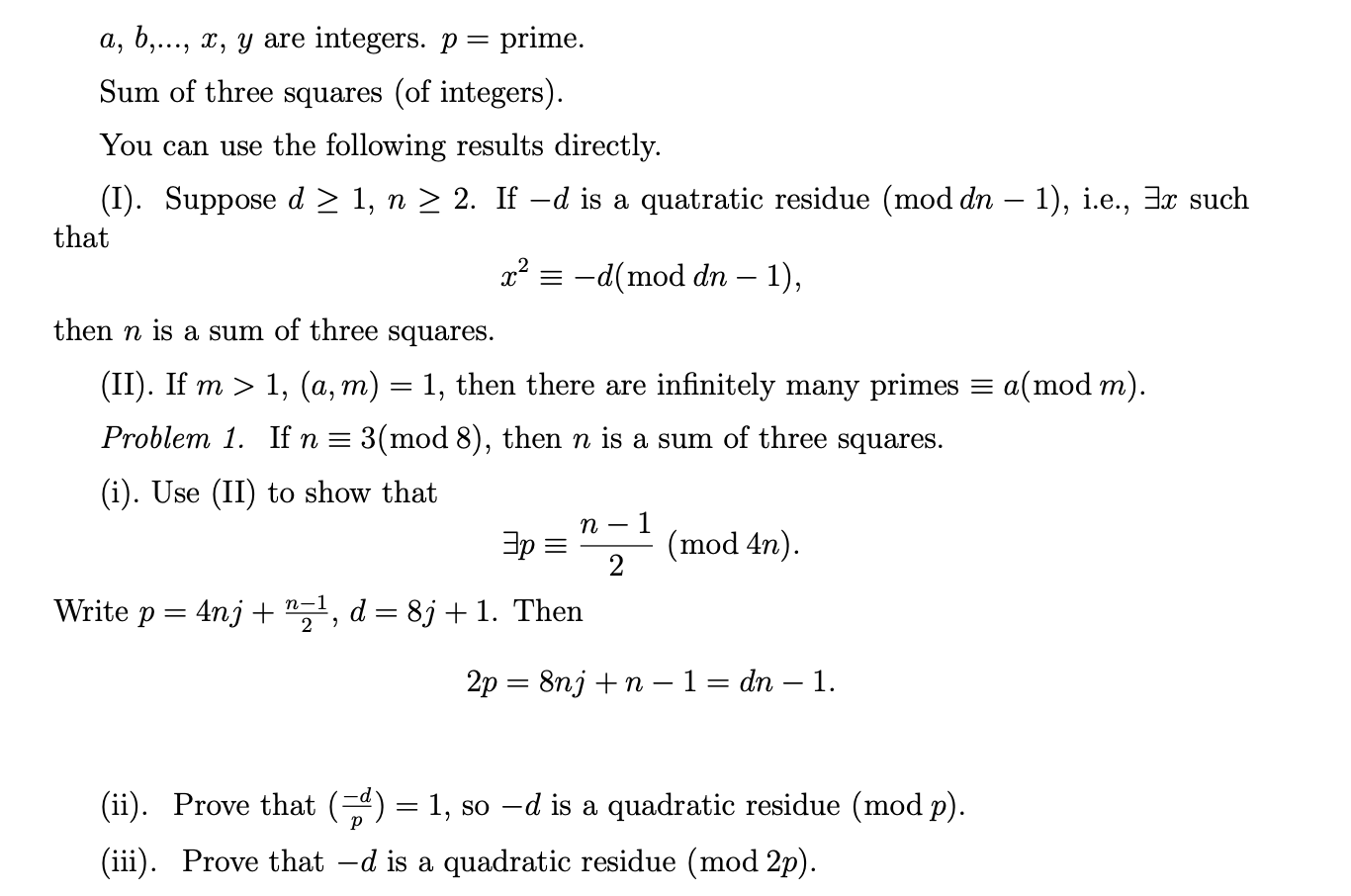
a, b,..., 2:, y are integers. p = prime. Sum of three squares (of integers). You can use the following results directly. (1). Suppose d 2 1, n 2 2. If d is a quatratic residue (mod din. 1), i.e., Elm such that :52 E d(m0d dn 1), then 71 is a sum of three squares. (II). If m > 1, (a, m) = 1, then there are innitely many primes E a(mod m). Problem 1. If n E 3(m0d 8), then 72 is a sum of three squares. (i). Use (11) to show that nl ElpE (mod4n). Write p = 4713' + \"7'1, d = 85? + 1. Then 2p=8nj+nl=dnl. (ii). Prove that (id) = 1, so d is a quadratic residue (mod 1)). (iii). Prove that d is a quadratic residue (mod 2p)
Step by Step Solution
There are 3 Steps involved in it
1 Expert Approved Answer
Step: 1 Unlock

Question Has Been Solved by an Expert!
Get step-by-step solutions from verified subject matter experts
Step: 2 Unlock
Step: 3 Unlock
 Study Help