







Question: a.) b.) c.) d.) 50E .. C t = ( ) r2+25 Are there any horizontal asymptote(s) of C(t)? If yes, find the horizontal asymptote
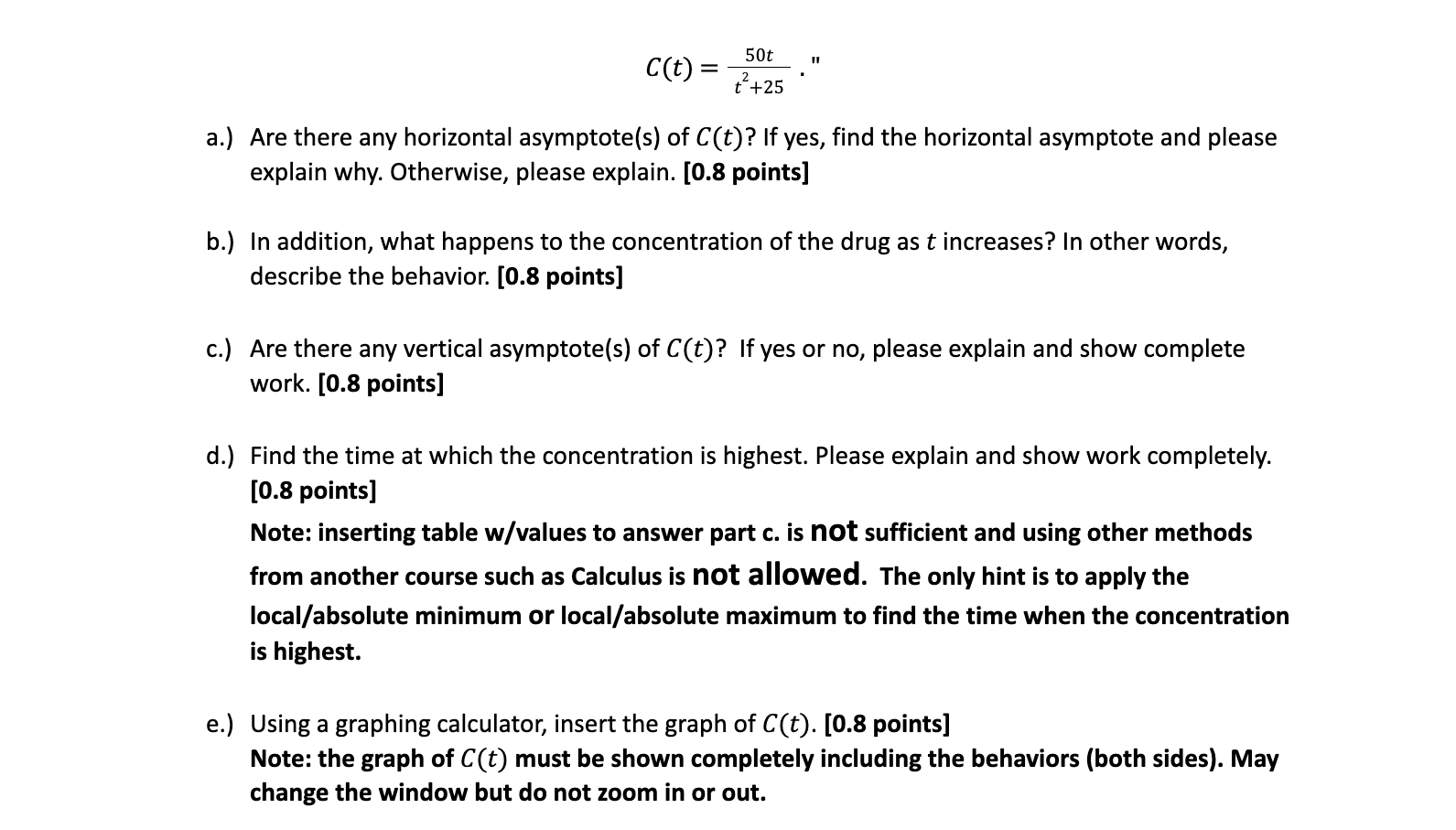
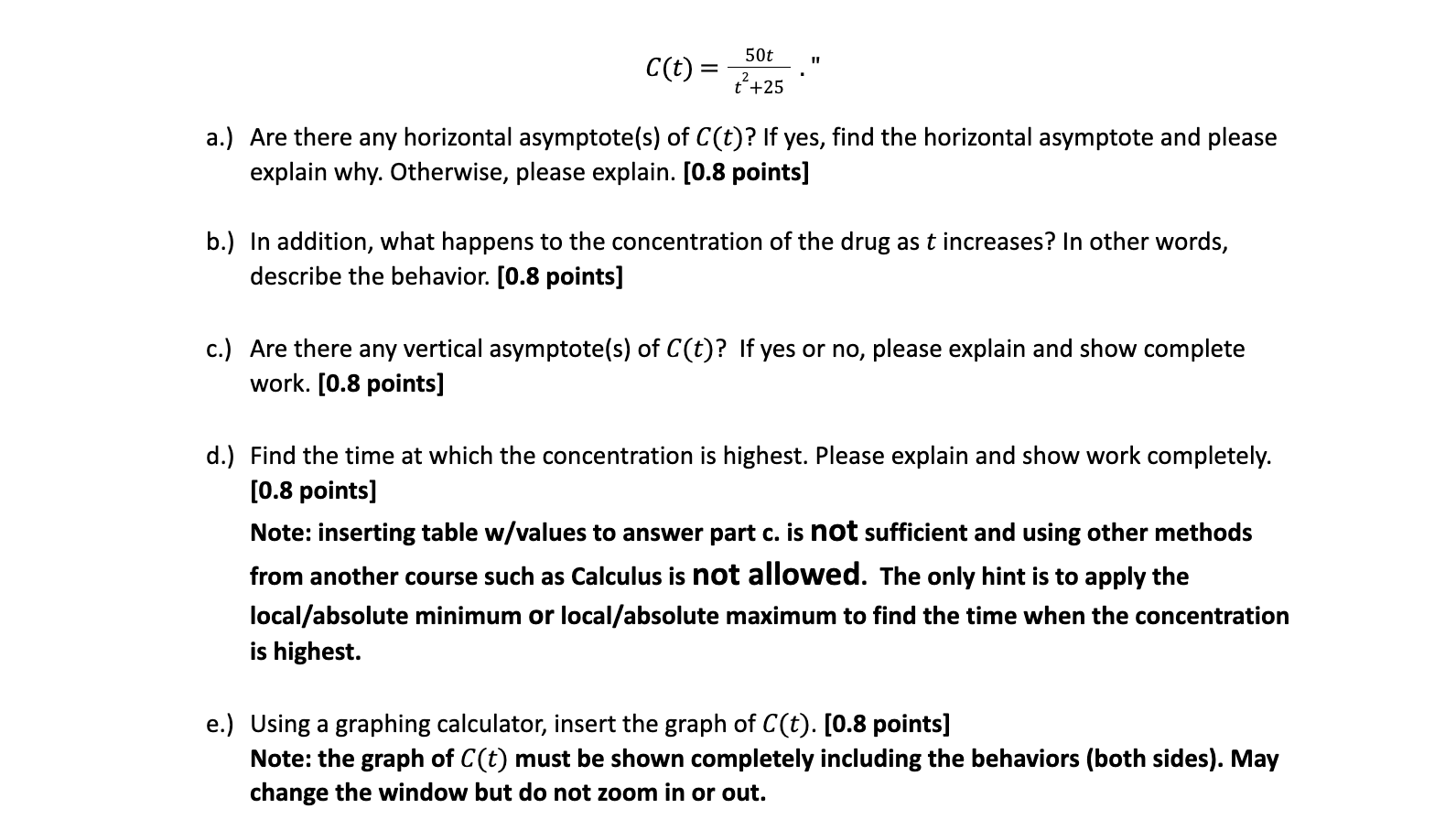
a.) b.) c.) d.) 50E .. C t = ( ) r2+25 Are there any horizontal asymptote(s) of C(t)? If yes, find the horizontal asymptote and please explain why. Otherwise, please explain. [0.8 points] In addition, what happens to the concentration of the drug as t increases? In other words, describe the behavior. [0.8 points] Are there any vertical asymptote(s) of C(t)? lfyes or no, please explain and show complete work. [0.8 points] Find the time at which the concentration is highest. Please explain and show work completely. [0.8 points] Note: inserting table w/values to answer part c. is not sufficient and using other methods from another course such as Calculus is not allowed. The only hint is to apply the local/absolute minimum or local/absolute maximum to find the time when the concentration is highest. Using a graphing calculator, insert the graph of C(t). [0.8 points] Note: the graph of C (1:) must be shown completely including the behaviors (both sides). May change the window but do not zoom in or out
Step by Step Solution
There are 3 Steps involved in it

Get step-by-step solutions from verified subject matter experts
 Study Help