



Question: (a) (b) (c) (d) (c) (f) (g) (h) (i) (i) (k) (1) Whether omitting or misstating an item could influence the decisionc Constraint that weighs
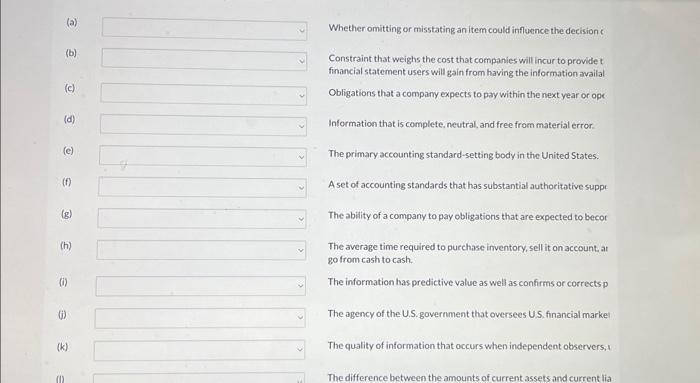
(a) (b) (c) (d) (c) (f) (g) (h) (i) (i) (k) (1) Whether omitting or misstating an item could influence the decisionc Constraint that weighs the cost that companies will incur to providet financial statement users will gain from having the information availat Obligations that a company expects to pay within the next year or ope Information that is complete, neutral, and free from material error. The primary accounting standard-setting body in the United States. A set of accounting standards that has substantial authoritative suppe The ability of a company to pay obligations that are expected to becor The average time required to purchase inventory, sell it on account, at go from cash to cash. The information has predictive value as well as confirms or correctsp The agency of the U.S. government that oversees U.S. financial market The quality of information that occurs when independent observers, 1 The difference between the amounts of current assets and current lia
Step by Step Solution
There are 3 Steps involved in it

Get step-by-step solutions from verified subject matter experts