







Question: A. B. C. D. E. F. G. Derive the individual's demand function for goods X and Y using the substitution method and the Lagrangian
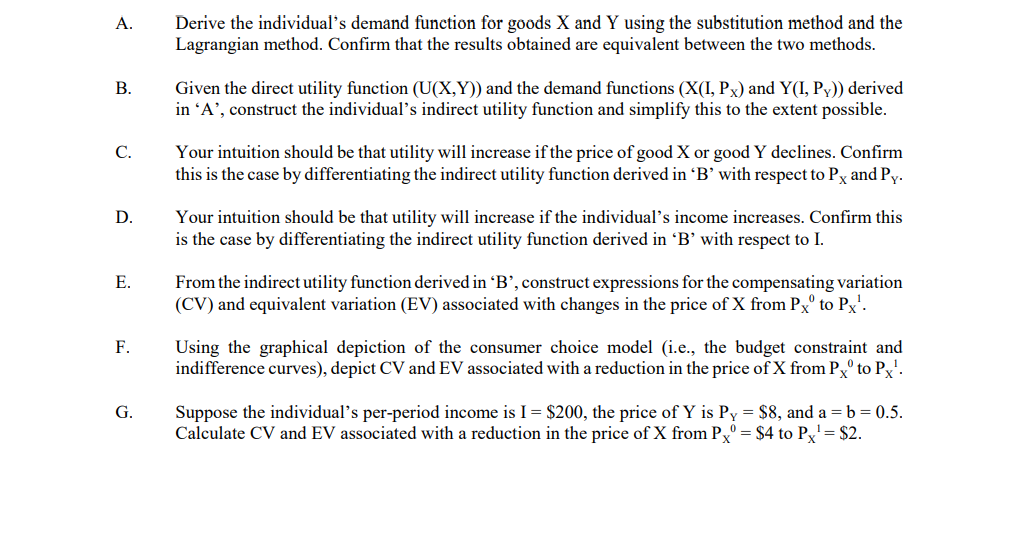
A. B. C. D. E. F. G. Derive the individual's demand function for goods X and Y using the substitution method and the Lagrangian method. Confirm that the results obtained are equivalent between the two methods. Given the direct utility function (U(X,Y)) and the demand functions (X(I, Px) and Y(I, Py)) derived in 'A', construct the individual's indirect utility function and simplify this to the extent possible. Your intuition should be that utility will increase if the price of good X or good Y declines. Confirm this is the case by differentiating the indirect utility function derived in 'B' with respect to Px and Py. Your intuition should be that utility will increase if the individual's income increases. Confirm this is the case by differentiating the indirect utility function derived in 'B' with respect to I. From the indirect utility function derived in 'B', construct expressions for the compensating variation (CV) and equivalent variation (EV) associated with changes in the price of X from Px to Px'. Using the graphical depiction of the consumer choice model (i.e., the budget constraint and indifference curves), depict CV and EV associated with a reduction in the price of X from Px to Px'. Suppose the individual's per-period income is I = $200, the price of Y is Py = $8, and a = b = 0.5. Calculate CV and EV associated with a reduction in the price of X from Px0 = $4 to Px = $2.
Step by Step Solution
There are 3 Steps involved in it

Get step-by-step solutions from verified subject matter experts
 Study Help