







Question: a) b) d) 4) a) TATO 5) a) 2) A ready process can move to the running state 3) A blocked process can move
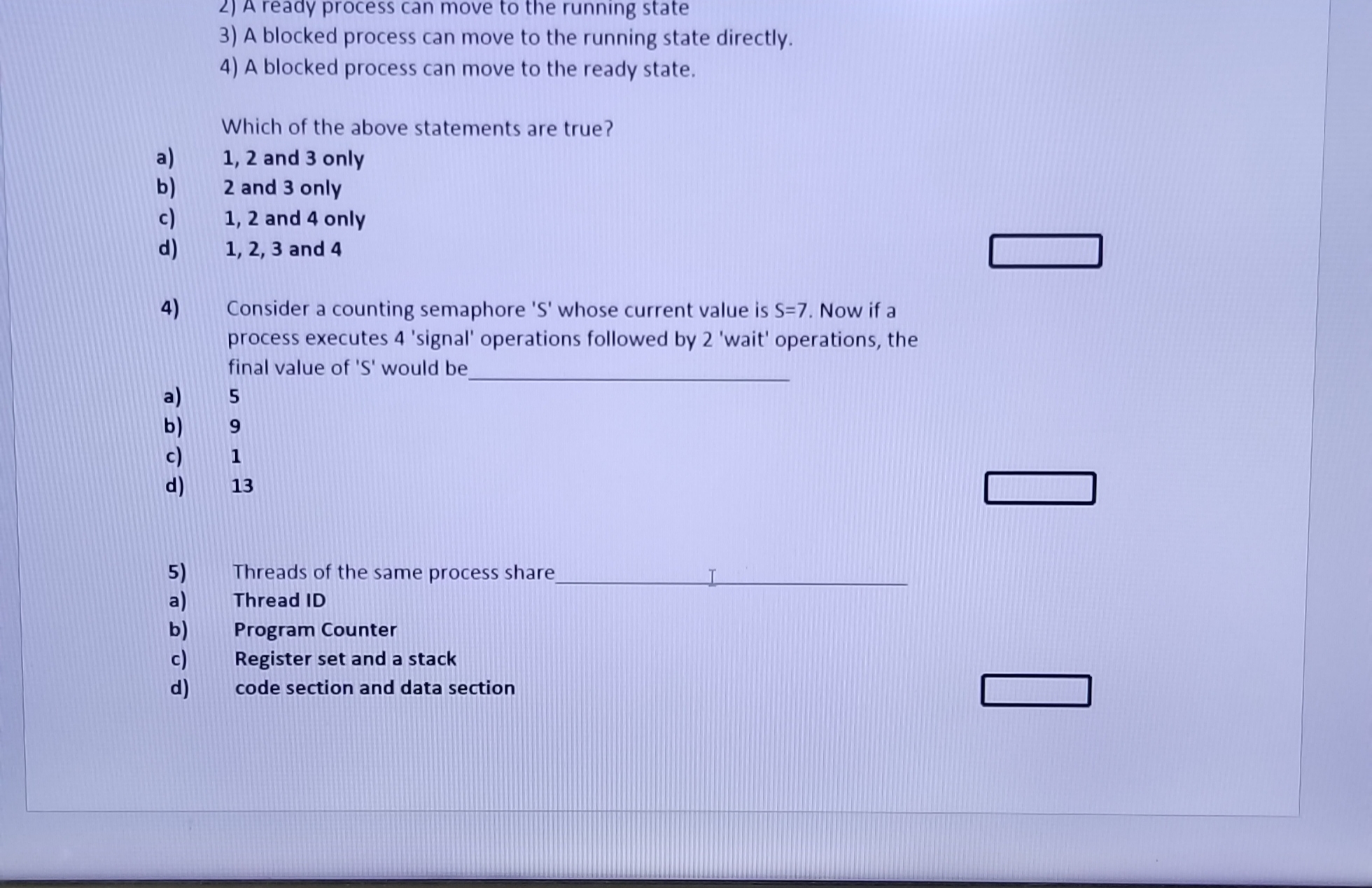
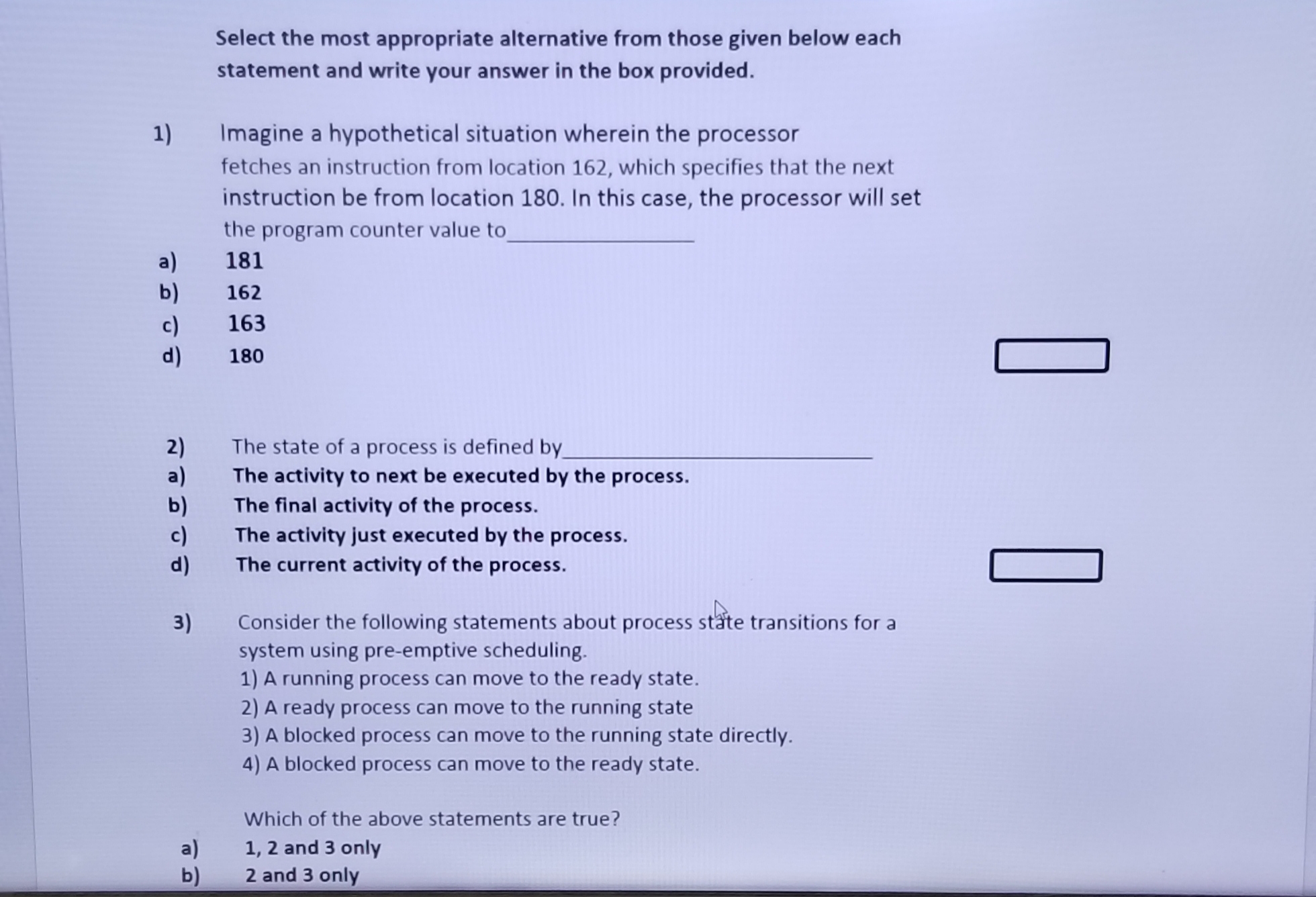
a) b) d) 4) a) TATO 5) a) 2) A ready process can move to the running state 3) A blocked process can move to the running state directly. 4) A blocked process can move to the ready state. Which of the above statements are true? 1, 2 and 3 only 2 and 3 only 1, 2 and 4 only 1, 2, 3 and 4 Consider a counting semaphore 'S' whose current value is S=7. Now if a process executes 4 'signal' operations followed by 2 'wait' operations, the final value of 'S' would be 5165 9 13 Threads of the same process share_ Thread ID Program Counter Register set and a stack code section and data section 0 0 0 1) a) b) c) d) 2) a) b) c) d) 3) a) b) Select the most appropriate alternative from those given below each statement and write your answer in the box provided. Imagine a hypothetical situation wherein the processor fetches an instruction from location 162, which specifies that the next instruction be from location 180. In this case, the processor will set the program counter value to 181 162 163 180 The state of a process is defined by The activity to next be executed by the process. The final activity of the process. The activity just executed by the process. The current activity of the process. Consider the following statements about process state transitions for a system using pre-emptive scheduling. 1) A running process can move to the ready state. 2) A ready process can move to the running state 3) A blocked process can move to the running state directly. 4) A blocked process can move to the ready state. Which of the above statements are true? 1, 2 and 3 only 2 and 3 only 0 0
Step by Step Solution
3.53 Rating (150 Votes )
There are 3 Steps involved in it
Youve presented four separate questions lets address each one in turn 1 The program counter PC is a register that holds the address of the next instru... View full answer

Get step-by-step solutions from verified subject matter experts
 Study Help