







Question: a Background Information: The only way to avoid a worst-case climate change scenario, scientists agree, is to start drastically cutting greenhouse gas emissions. To incentivize
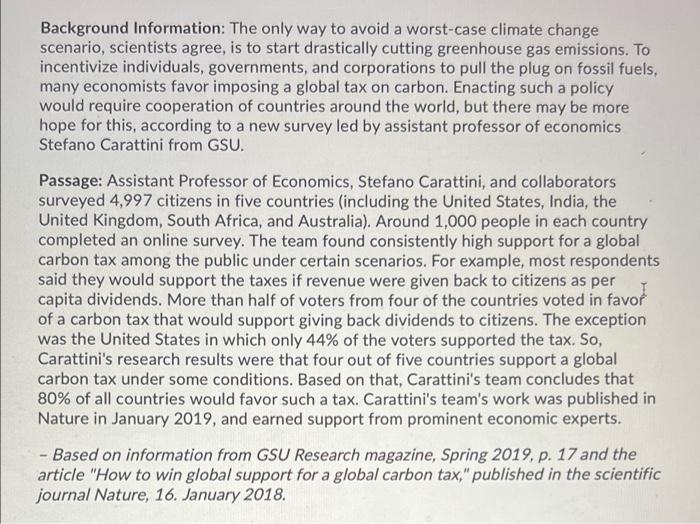

a Background Information: The only way to avoid a worst-case climate change scenario, scientists agree, is to start drastically cutting greenhouse gas emissions. To incentivize individuals, governments, and corporations to pull the plug on fossil fuels, many economists favor imposing a global tax on carbon. Enacting such a policy would require cooperation of countries around the world, but there may be more hope for this, according to a new survey led by assistant professor of economics Stefano Carattini from GSU. Passage: Assistant Professor of Economics, Stefano Carattini, and collaborators surveyed 4,997 citizens in five countries (including the United States, India, the United Kingdom, South Africa, and Australia). Around 1,000 people in each country completed an online survey. The team found consistently high support for a global carbon tax among the public under certain scenarios. For example, most respondents said they would support the taxes if revenue were given back to citizens as per capita dividends. More than half of voters from four of the countries voted in favor of a carbon tax that would support giving back dividends to citizens. The exception was the United States in which only 44% of the voters supported the tax. So, Carattini's research results were that four out of five countries support a global carbon tax under some conditions. Based on that, Carattini's team concludes that 80% of all countries would favor such a tax. Carattini's team's work was published in Nature in January 2019, and earned support from prominent economic experts. - Based on information from GSU Research magazine, Spring 2019, p. 17 and the article "How to win global support for a global carbon tax," published in the scientific journal Nature, 16. January 2018. Should you assume that each premise is uncontroversially true? Why or why not? If there is more than one premise in the argument, be sure to say something about each premise. a Background Information: The only way to avoid a worst-case climate change scenario, scientists agree, is to start drastically cutting greenhouse gas emissions. To incentivize individuals, governments, and corporations to pull the plug on fossil fuels, many economists favor imposing a global tax on carbon. Enacting such a policy would require cooperation of countries around the world, but there may be more hope for this, according to a new survey led by assistant professor of economics Stefano Carattini from GSU. Passage: Assistant Professor of Economics, Stefano Carattini, and collaborators surveyed 4,997 citizens in five countries (including the United States, India, the United Kingdom, South Africa, and Australia). Around 1,000 people in each country completed an online survey. The team found consistently high support for a global carbon tax among the public under certain scenarios. For example, most respondents said they would support the taxes if revenue were given back to citizens as per capita dividends. More than half of voters from four of the countries voted in favor of a carbon tax that would support giving back dividends to citizens. The exception was the United States in which only 44% of the voters supported the tax. So, Carattini's research results were that four out of five countries support a global carbon tax under some conditions. Based on that, Carattini's team concludes that 80% of all countries would favor such a tax. Carattini's team's work was published in Nature in January 2019, and earned support from prominent economic experts. - Based on information from GSU Research magazine, Spring 2019, p. 17 and the article "How to win global support for a global carbon tax," published in the scientific journal Nature, 16. January 2018. Should you assume that each premise is uncontroversially true? Why or why not? If there is more than one premise in the argument, be sure to say something about each premise
Step by Step Solution
There are 3 Steps involved in it

Get step-by-step solutions from verified subject matter experts
 Study Help