







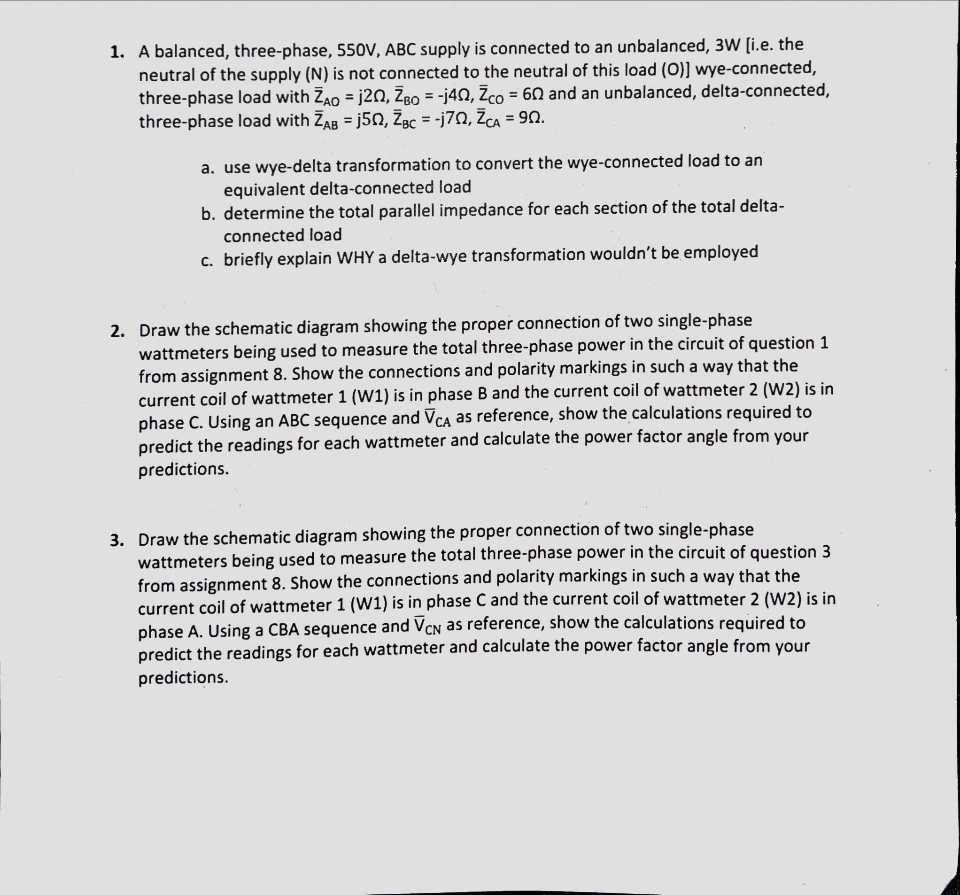
Question: A balanced, three - phase, 5 5 0 V , ABC supply is connected to an unbalanced, 3 W [ i . e . the
A balanced, threephase, ABC supply is connected to an unbalanced, W ie the neutral of the supply is not connected to the neutral of this load wyeconnected, threephase load with and an unbalanced, deltaconnected, threephase load with
a use wyedelta transformation to convert the wyeconnected load to an equivalent deltaconnected load
b determine the total parallel impedance for each section of the total deltaconnected load
c briefly explain WHY a deltawye transformation wouldn't be employed
Draw the schematic diagram showing the proper connection of two singlephase wattmeters being used to measure the total threephase power in the circuit of question from assignment Show the connections and polarity markings in such a way that the current coil of wattmeter W is in phase B and the current coil of wattmeter W is in phase Using an ABC sequence and as reference, show the calculations required to predict the readings for each wattmeter and calculate the power factor angle from your predictions.
Draw the schematic diagram showing the proper connection of two singlephase wattmeters being used to measure the total threephase power in the circuit of question from assignment Show the connections and polarity markings in such a way that the current coil of wattmeter W is in phase and the current coil of wattmeter W is in phase Using a CBA sequence and as reference, show the calculations required to predict the readings for each wattmeter and calculate the power factor angle from your predictions.
Could I get help with # please? Im not sure if Im doing it correct. Thank you.
Step by Step Solution
There are 3 Steps involved in it
1 Expert Approved Answer
Step: 1 Unlock

Question Has Been Solved by an Expert!
Get step-by-step solutions from verified subject matter experts
Step: 2 Unlock
Step: 3 Unlock
 Study Help