







Question: A bar with a rectangular cross section that has a width of 2 4 . 5 mm , a thickness of 6 . 1 mm
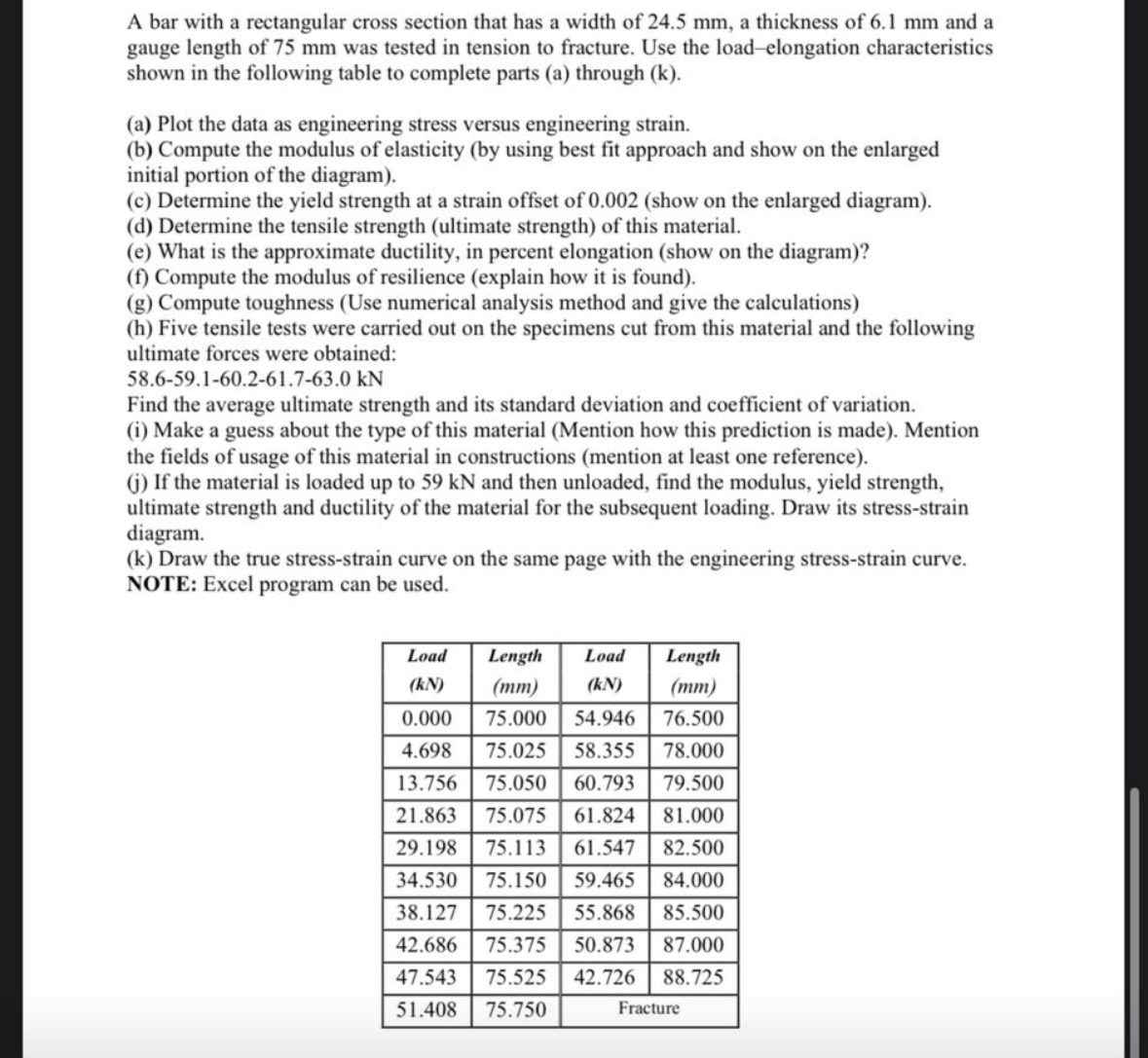
A bar with a rectangular cross section that has a width of mm a thickness of mm and a gauge length of mm was tested in tension to fracture. Use the loadelongation characteristics shown in the following table to complete parts a through k
a Plot the data as engineering stress versus engineering strain.
b Compute the modulus of elasticity by using best fit approach and show on the enlarged initial portion of the diagram
c Determine the yield strength at a strain offset of show on the enlarged diagram
d Determine the tensile strength ultimate strength of this material.
e What is the approximate ductility, in percent elongation show on the diagram
f Compute the modulus of resilience explain how it is found
g Compute toughness Use numerical analysis method and give the calculations
h Five tensile tests were carried out on the specimens cut from this material and the following ultimate forces were obtained:
kN
Find the average ultimate strength and its standard deviation and coefficient of variation.
i Make a guess about the type of this material Mention how this prediction is made Mention the fields of usage of this material in constructions mention at least one reference
j If the material is loaded up to kN and then unloaded, find the modulus, yield strength, ultimate strength and ductility of the material for the subsequent loading. Draw its stressstrain diagram.
k Draw the true stressstrain curve on the same page with the engineering stressstrain curve. NOTE: Excel program can be used.
tabletableLoad
Step by Step Solution
There are 3 Steps involved in it
1 Expert Approved Answer
Step: 1 Unlock

Question Has Been Solved by an Expert!
Get step-by-step solutions from verified subject matter experts
Step: 2 Unlock
Step: 3 Unlock
 Study Help