



Question: (a) Based on Figure 1(a), answer the following questions: Berdasarkan Rajah 1(a), jawab soalan-soalan berikut: i) Prove that the equation for current division of i_(2)
(a) Based on Figure 1(a), answer the following questions:\ Berdasarkan Rajah 1(a), jawab soalan-soalan berikut:\ i) Prove that the equation for current division of
i_(2)is given by:\ Buktikan bahawa persamaan untuk pembahagian arus
i_(2)diberikan oleh:\
(i_(2))/(G_(2))=(i)/(G_(1)+G_(2)+G_(3))\
G_(1),G_(2)and
G_(3)are conductance for resistors,
R_(1),R_(2)and
R_(3)respectively.
G_(1),G_(2)dan
G_(3)masing-masing adalah kekonduksian untuk
R_(1),R_(2)dan
R_(3).\ (13 marks/markah)\ ii) If given that
R_(1):R_(2):R_(3)=1:2:2, find the ratio of
P_(R_(1)):P_(R_(2)):P_(R_(3))where
P_(R_(1)),
P_(R_(2))and
P_(R_(3))are the power absorbed by
R_(1),R_(2)and
R_(3)respectively.\ Diberikan bahawa
R_(1):R_(2):R_(3)=1:2:2, dapatkan nisbah
P_(R_(1)):P_(R_(2)):P_(R_(3))dimana
P_(R_(1)),P_(R_(2))dan
P_(R_(3))masing-masing adalah kuasa yang diserap oleh
R_(1),R_(2)dan
R_(3).\ (17 marks/markah)\ Kajan (a)\ ...3/-\ SULIT
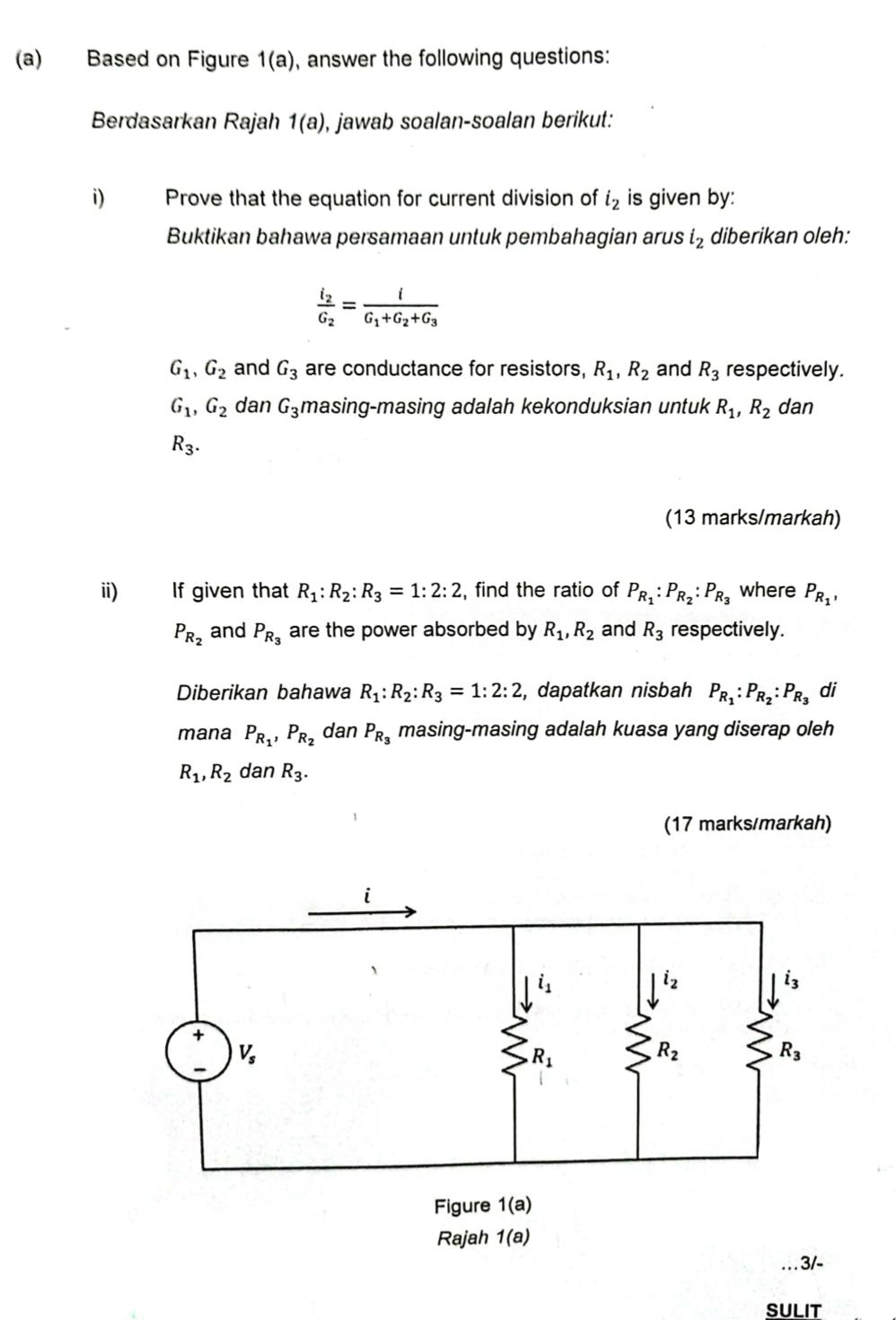
Prove that the equation for current division of i2 is given by: Buktikan bahawa persamaan untuk pembahagian arus i2 diberikan oleh: G2i2=G1+G2+G3i G1,G2 and G3 are conductance for resistors, R1,R2 and R3 respectively. G1,G2 dan G3 masing-masing adalah kekonduksian untuk R1,R2 dan R3. (13 marks/markah) ii) If given that R1:R2:R3=1:2:2, find the ratio of PR1:PR2:PR3 where PR1, PR2 and PR3 are the power absorbed by R1,R2 and R3 respectively. Diberikan bahawa R1:R2:R3=1:2:2, dapatkan nisbah PR1:PR2:PR3 di mana PR1,PR2 dan PR3 masing-masing adalah kuasa yang diserap oleh R1,R2 dan R3. (17 marks/markah) Figure 1(a) Rajah 1(a)
Step by Step Solution
There are 3 Steps involved in it

Get step-by-step solutions from verified subject matter experts