







Question: A Beginning Example Let's give an example of a grammar for a language and then discuss the process of deriving strings from the productions. Let
A Beginning Example
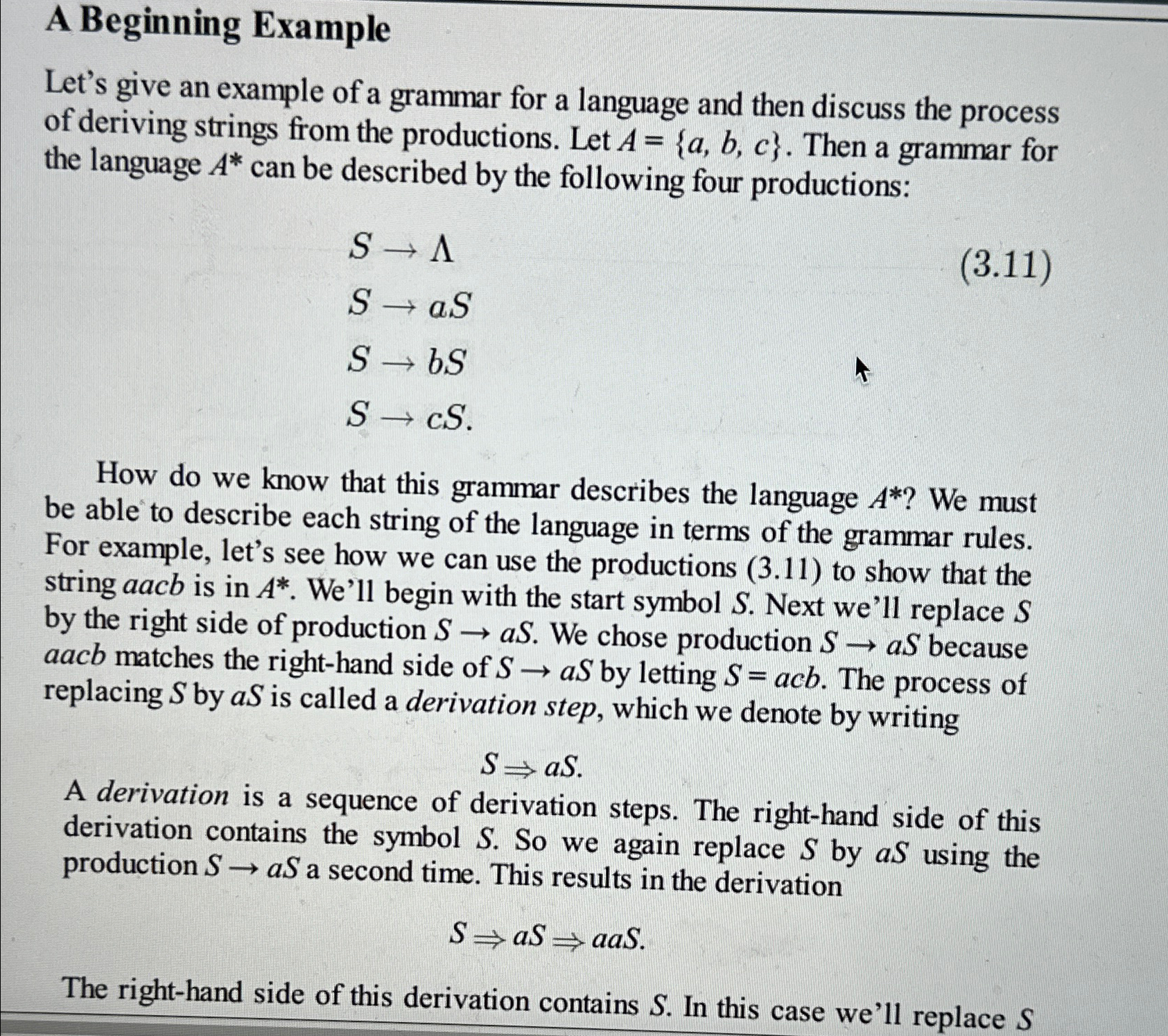
Let's give an example of a grammar for a language and then discuss the process of deriving strings from the productions. Let Then a grammar for the language can be described by the following four productions:
How do we know that this grammar describes the language We must be able to describe each string of the language in terms of the grammar rules. For example, let's see how we can use the productions to show that the string aacb is in We'll begin with the start symbol Next we'll replace by the right side of production We chose production because aacb matches the righthand side of by letting acb. The process of replacing by is called a derivation step, which we denote by writing
A derivation is a sequence of derivation steps. The righthand side of this derivation contains the symbol So we again replace by using the production a second time. This results in the derivation
aaS
The righthand side of this derivation contains In this case we'll replace
Step by Step Solution
There are 3 Steps involved in it
1 Expert Approved Answer
Step: 1 Unlock

Question Has Been Solved by an Expert!
Get step-by-step solutions from verified subject matter experts
Step: 2 Unlock
Step: 3 Unlock
 Study Help