







Question: A broker has calculated the expected values of two different nancial instruments X and Y. Suppose that E(X) = $84, E(Y) =$83, SD(X) = $12
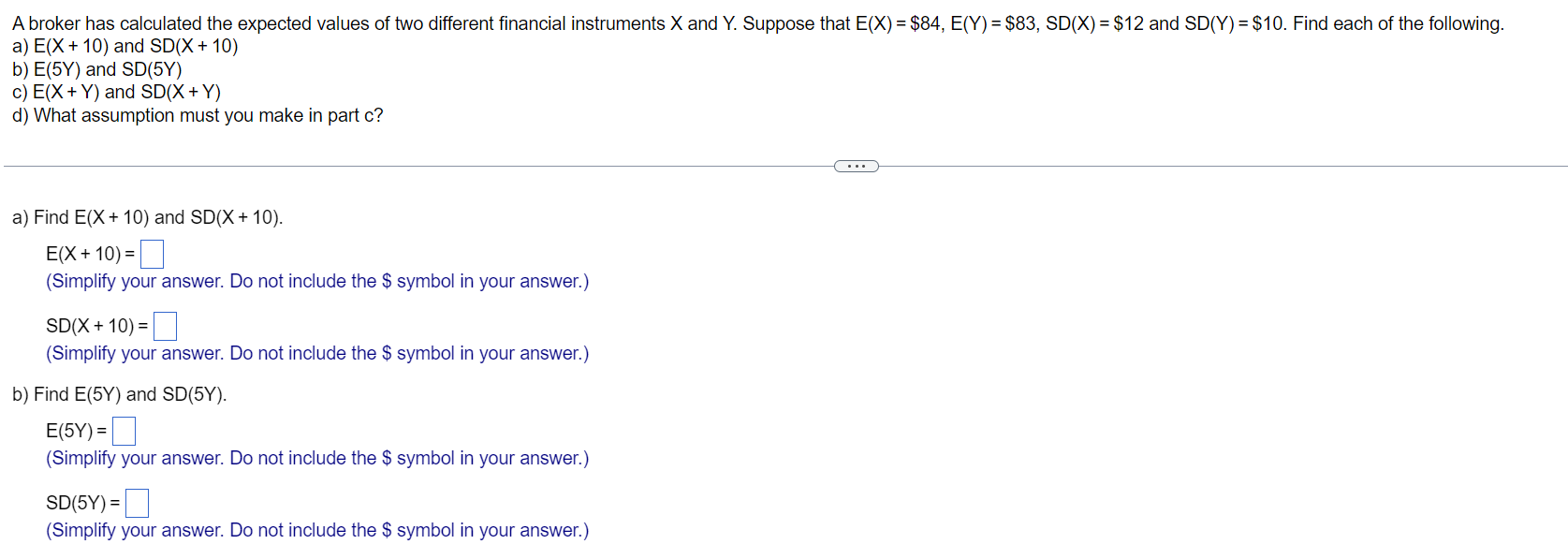
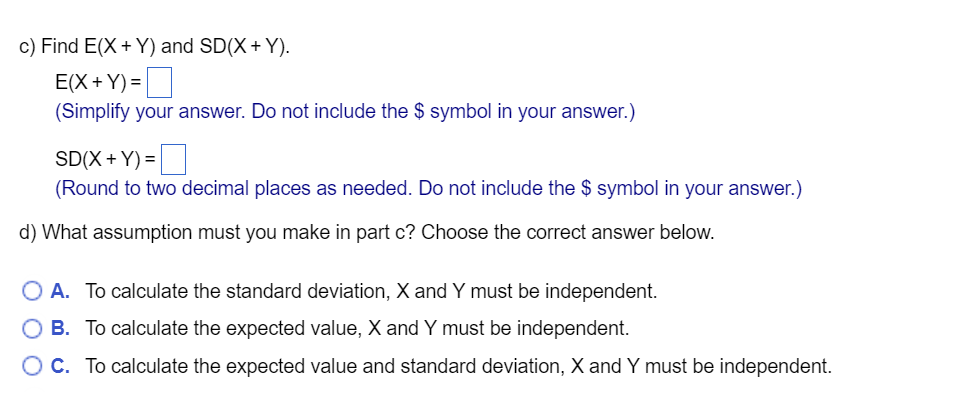
A broker has calculated the expected values of two different nancial instruments X and Y. Suppose that E(X) = $84, E(Y) =$83, SD(X) = $12 and SD(Y)= $10. Find each of the following. a) E(X + 10) and SD(X +10) b) E(5Y) and SD(5Y) c) E(X + Y) and SD(X +Y) d) What assumption must you make in part c? a) Find E(X+ 10) and so(x+ 10). E(X + 10) = (Simplify your answer. Do not include the $ symbol in your answer.) SD(X + 10) = (Simplify your answer. Do not include the $ symbol in your answer.) b) Find E(5Y) and SD(5Y). E(5Y) = (Simplify your answer. Do not include the $ symbol in your answer.) SD(5Y) = D (Simplify your answer. Do not include the $ symbol in your answer.) c) Find E(X + Y) and soot: + Y). E(X + Y) = (Simplify your answer. Do not include the $ symbol in your answer.) SD(X + Y) = (Round to two decimal places as needed. Do not include the $ symbol in your answer.) d) What assumption must you make in part c? Choose the correct answer below. 0 A. To calculate the standard deviation, X and Y must be independent. 0 B. To calculate the expected value, X and Y must be independent. O C. To calculate the expected value and standard deviation, X and Y must be independent
Step by Step Solution
There are 3 Steps involved in it

Get step-by-step solutions from verified subject matter experts
 Study Help