







Question: A building ( say 2 5 m 2 5 m plan dimensions ) , supported by spread footing shallow foundations, has to be constructed on
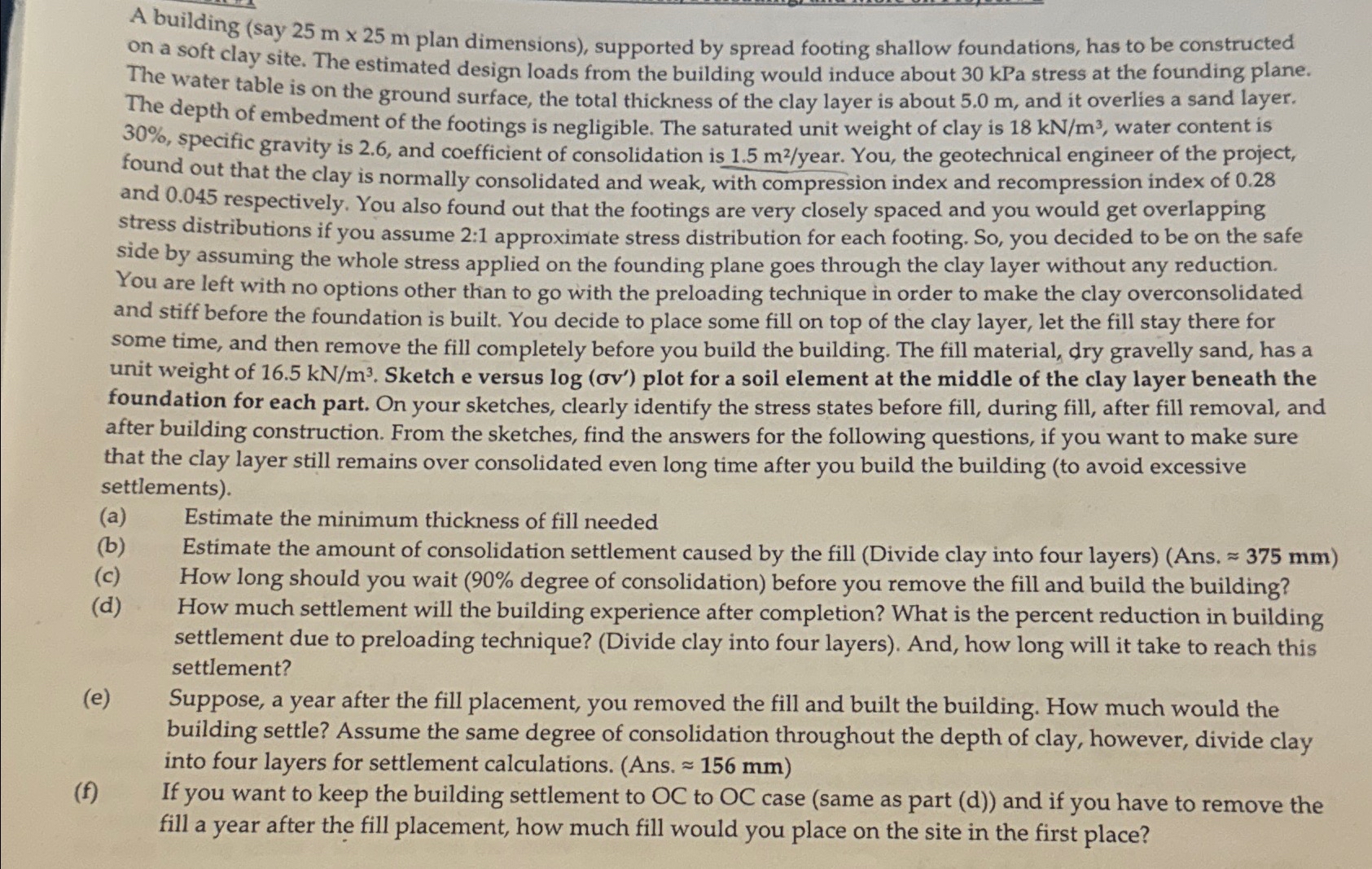
A building say plan dimensions supported by spread footing shallow foundations, has to be constructed on a soft clay site. The estimated design loads from the building would induce about kPa stress at the founding plane. The water table is on the ground surface, the total thickness of the clay layer is about and it overlies a sand layer. The depth of embedment of the footings is negligible. The saturated unit weight of clay is water content is specific gravity is and coefficient of consolidation is year. You, the geotechnical engineer of the project, found out that the clay is normally consolidated and weak, with compression index and recompression index of and respectively. You also found out that the footings are very closely spaced and you would get overlapping stress distributions if you assume : approximate stress distribution for each footing. So you decided to be on the safe side by assuming the whole stress applied on the founding plane goes through the clay layer without any reduction. You are left with no options other than to go with the preloading technique in order to make the clay overconsolidated and stiff before the foundation is built. You decide to place some fill on top of the clay layer, let the fill stay there for some time, and then remove the fill completely before you build the building. The fill material, dry gravelly sand, has a unit weight of Sketch e versus plot for a soil element at the middle of the clay layer beneath the foundation for each part. On your sketches, clearly identify the stress states before fill, during fill, after fill removal, and after building construction. From the sketches, find the answers for the following questions, if you want to make sure that the clay layer still remains over consolidated even long time after you build the building to avoid excessive settlements
a Estimate the minimum thickness of fill needed
b Estimate the amount of consolidation settlement caused by the fill Divide clay into four layersAns ~~
c How long should you wait degree of consolidation before you remove the fill and build the building?
d How much settlement will the building experience after completion? What is the percent reduction in building settlement due to preloading technique? Divide clay into four layers And, how long will it take to reach this settlement?
e Suppose, a year after the fill placement, you removed the fill and built the building. How much would the building settle? Assume the same degree of consolidation throughout the depth of clay, however, divide clay into four layers for settlement calculations. Ans ~~
f If you want to keep the building settlement to OC to OC case same as part d and if you have to remove the fill a year after the fill placement, how much fill would you place on the site in the first place?
Step by Step Solution
There are 3 Steps involved in it
1 Expert Approved Answer
Step: 1 Unlock

Question Has Been Solved by an Expert!
Get step-by-step solutions from verified subject matter experts
Step: 2 Unlock
Step: 3 Unlock
 Study Help