Question: (a) (c) and (d) 2. In each part, apply the GramSchmidt process to the given subset S of the inner product space V to obtain

(a) (c) and (d)
(a) (c) and (d) 2. In each part, apply the(a) (c) and (d) 2. In each part, apply the
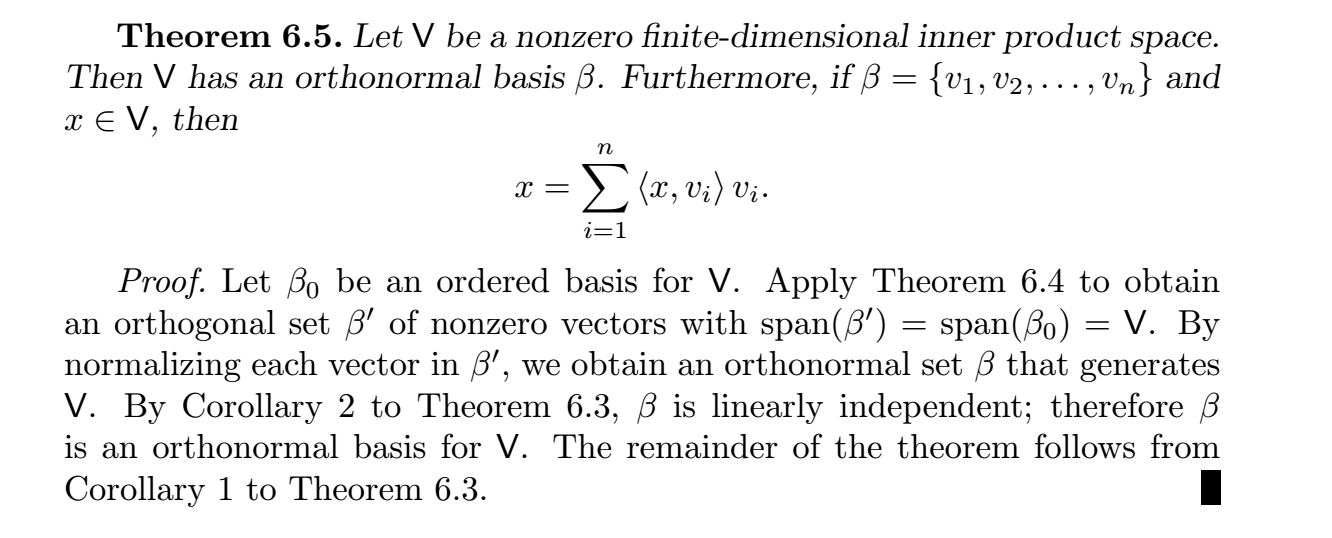
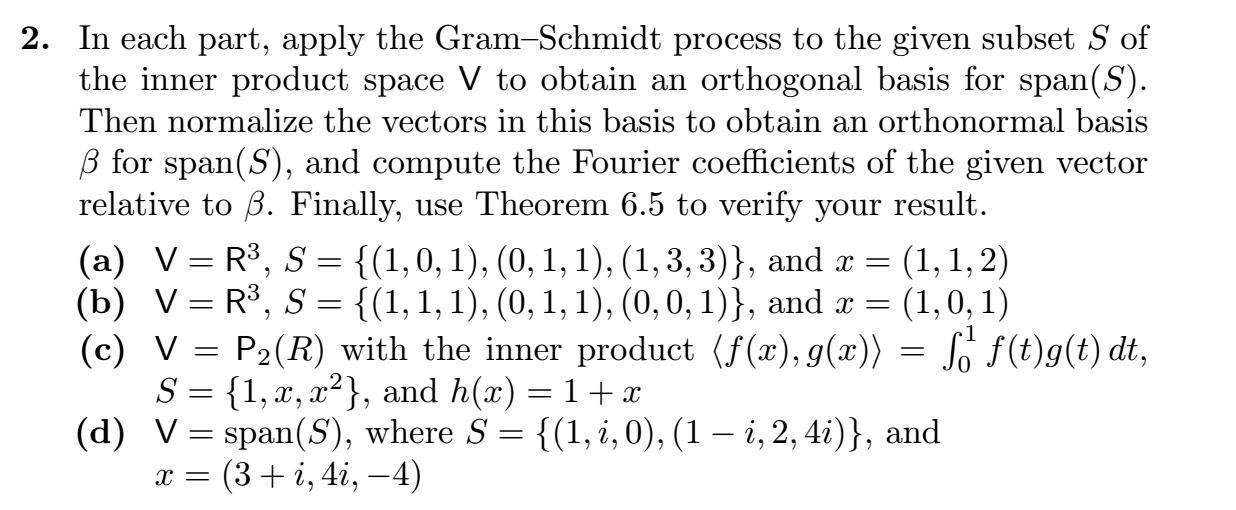
2. In each part, apply the GramSchmidt process to the given subset S of the inner product space V to obtain an orthogonal basis for span(S). Then normalize the vectors in this basis to obtain an orthonormal basis for span(S), and compute the Fourier coefcients of the given vector relative to 8. Finally, use Theorem 6.5 to verify your result. (a) v = R3, 8 = {(1,0,1),(0,1,1),(1,3,3)}, and x = (1,1,2) (b) v = R3, 8 = {(1,1,1),(0,1,1),(0,0,1)}, and a: = (1,0,1) (c) v = P2(R) with the inner product (f(a:),g(m)) = f01f(t)g(t)dt, S : {1,w,:r2}, and h(a;) : 1 + a: (d) V = span(S), where S = {(1,i,0), (1 2', 2,40}, and a: = (3 + 2',47, 4) Theorem 6.5. Let V be a nonzero nite-dimensional inner product space. Then V has an orthonormal basis 5. Furthermore, if B = {'01, v2, . . . ,vn} and a: 6 V, then 11. a: = 2 (any) vi. :1 Proof. Let 50 be an ordered basis for V. Apply Theorem 6.4 to obtain an orthogonal set E of nonzero vectors with span(') = span(g) = V. By normalizing each vector in 5" , we obtain an orthonormal set 5 that generates V. By Corollary 2 to Theorem 6.3, 5 is linearly independent; therefore 3 is an orthonormal basis for V. The remainder of the theorem follows from Corollary 1 to Theorem 6.3

Step by Step Solution

There are 3 Steps involved in it

1 Expert Approved Answer
Step: 1 Unlock blur-text-image

Question Has Been Solved by an Expert!

Get step-by-step solutions from verified subject matter experts

Step: 2 Unlock
Step: 3 Unlock

Students Have Also Explored These Related Mathematics Questions!