







Question: A cafeteria serving line has a coffee urn from which customers serve themselves. Arrivals at the urn follow a Poisson distribution at the rate of
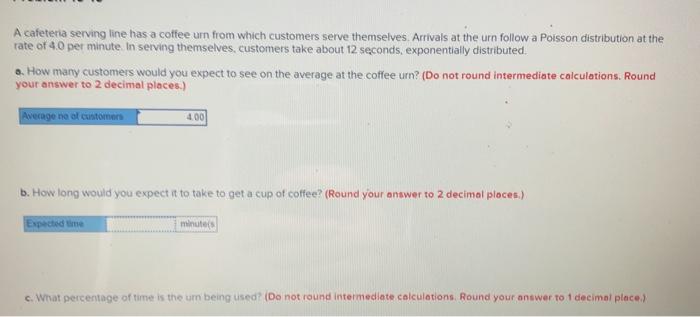
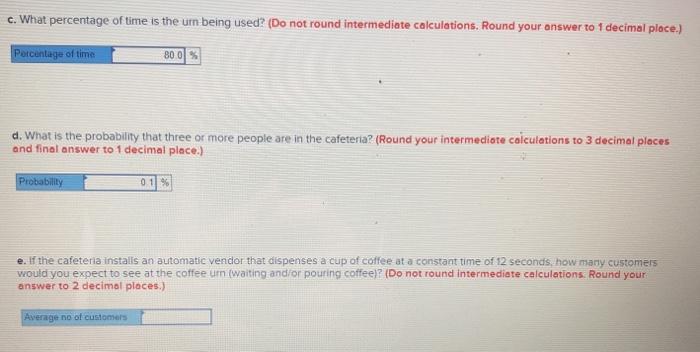
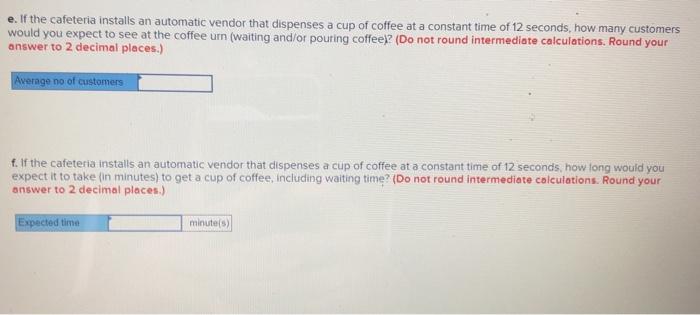
A cafeteria serving line has a coffee urn from which customers serve themselves. Arrivals at the urn follow a Poisson distribution at the rate of 4.0 per minute in serving themselves, customers take about 12 seconds, exponentially distributed, . How many customers would you expect to see on the average at the coffee urn? (Do not round intermediate calculations. Round your answer to 2 decimal places.) Average ne of customer 400 b. How long would you expect it to take to get a cup of coffee? (Round your answer to 2 decimal places.) Expected time minute c. what percentage of time is the um being used? (Do not round intermediate calculations. Round your answer to 1 decimal place c. What percentage of time is the urn being used? (Do not round intermediate calculations. Round your answer to 1 decimal place.) Porcentage of time 80 0% d. What is the probability that three or more people are in the cafeteria? (Round your intermediate calculations to 3 decimal places and final answer to 1 decimal place.) Probability 0 11% e. If the cafeteria installs an automatic vendor that dispenses a cup of coffee at a constant time of 12 seconds how many customers would you expect to see at the coffee ur (waiting and/or pouring coffee)? (Do not round intermediate calculations. Round your answer to 2 decimal places.) Average no of customers e. If the cafeteria installs an automatic vendor that dispenses a cup of coffee at a constant time of 12 seconds, how many customers would you expect to see at the coffee urn (waiting and/or pouring coffeel? (Do not round intermediate calculations. Round your answer to 2 decimal places.) Average no of customers f. If the cafeteria installs an automatic vendor that dispenses a cup of coffee at a constant time of 12 seconds, how long would you expect it to take in minutes) to get a cup of coffee, including waiting time? (Do not round intermediate calculations. Round your answer to 2 decimal places) Expected time minute(s)
Step by Step Solution
There are 3 Steps involved in it

Get step-by-step solutions from verified subject matter experts
 Study Help