







Question: A cam - driven pump is needed to simulate human aortic pressure to serve as a consistent repeatable pseudo - human input to a hospital
A camdriven pump is needed to simulate human aortic pressure to serve as a consistent
repeatable pseudohuman input to a hospitals operating room monitoring equipment to test the
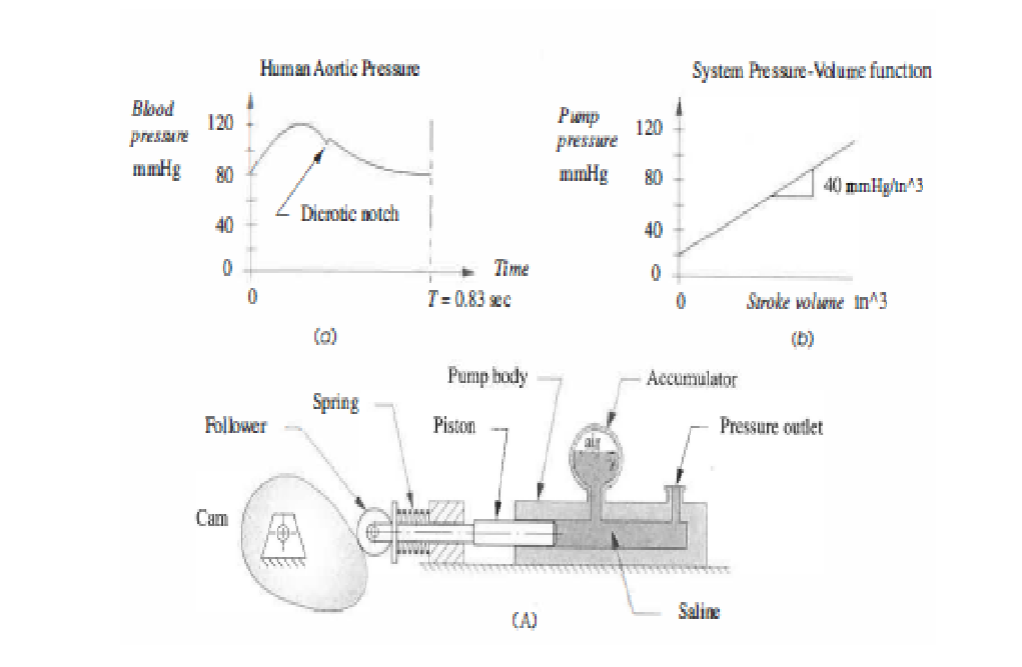
equipment daily. Figure below shows the Human Aortic characteristic pressure curve and the
proposed system pressurevolume function curve. Design a cam to drive the piston and give as
close as possible an approximation the aortic pressure curve that can be obtained without
violating the fundamental laws of cams. Simulate the dicrotic notch as best as you can.
Deliverables:
Design Concept & Kinematic Analysis:
Explanation of the cam design approach for simulating human aortic pressure.
Kinematic analysis of motion displacement velocity, acceleration and jerk for the cam,
ensuring the motion follows the pressurevolume curve for the aortic system.
Cam Profile Design:
Detailed cam profile that approximates the aortic pressure curve. This includes graphical
representations of the cam profile and the calculated displacement function.
Pressure Angle Calculations:
Calculation of the pressure angle throughout the cam's motion, ensuring that it stays
within acceptable limits to avoid excessive wear or cam malfunction.
Radius of Curvature Calculations:
Calculation of the radius of curvature at key points of the cam profile and an explanation
of how this impacts the camfollower interaction, minimizing undesirable friction.
Simulation of Dicrotic Notch:
Explanation and kinematic simulation of the dicrotic notch in the pressure curve as best
as possible within the cam design. This includes any special techniques used to model the
notch.
System Schematic:
Schematic diagram showing the camfollower system, including the cam profile, piston,
and actuating components.
Step by Step Solution
There are 3 Steps involved in it
1 Expert Approved Answer
Step: 1 Unlock

Question Has Been Solved by an Expert!
Get step-by-step solutions from verified subject matter experts
Step: 2 Unlock
Step: 3 Unlock
 Study Help