







Question: A Case Study for a Stakeholder Analysis New hope for the incomplete shopping mall project... plan being proposed for converting it into an outlet mall,
A Case Study for a Stakeholder Analysis
New hope for the incomplete shopping mall project... plan being proposed for converting it into an outlet mall, headlines appeared on air and in print media in March 2014 regarding the proposed resumption of the discontinued Redville shopping mall.
It all became possible when the city acquired the services of the project management expert consultant Tufan Consulting, LLC, to investigate the original shopping mall project failure and suggest viable solutions.
Background
The small city of Redville was incorporated in 1998 and did not have any other shopping mall for the local community. In September 2006, the City of Redville, California, unveiled a plan to build a premium shopping mall in the outskirts of the city on the east side of Highway 5 near Exit 282.
Russ Williams, the mayor of the city, was upbeat during the groundbreaking ceremony of the project in March 2007. The mall was expected to open by October 2009. However, the construction on the project halted in 2009 when Akomo Builders, LLC, developer for this proposed 1.6 million square-foot mall project, declared Chapter 11 bankruptcy.
Why Did the Original Project Fail? Experts reported two major reasons for the project discontinuation.
First, the bad economy forced many stores to close their doors, which derailed many new construction commercial projects.
The second reason was the stakeholders.
When the news of the opening of the new shopping mall broke, the residents of the City of Redville were not happy. They protested against the opening of this huge mall in the vicinity of their small town. They argued that the mall would bring a lot of traffic and crime to the city and would disrupt their peaceful life. But the builder kept lobbying the city manager Jason Roth and the mayor Russ Williams to pursue this project.
The city officially eventually decided to go ahead by bypassing the community protest and approved the mega project. The idea of building a huge shopping mall was originally conceived by the city council back in 2000. However, the city officials did not include the community in the decision-making process. No community member was consulted and no town hall meetings were held.
The Redville community was outraged when the project was officially started. Immense opposition and regular protests by the community slowed the project significantly.
The project came to a halt when the community leaders filed a legal action against the city and obtained a stay order.
New Approach
Recently, with the help of the project management expert consultant on board, the city decided to thoroughly analyze the root causes of the original mall project closure issue. The objective was to explore the possibility of resuming the project again per original plans or per brand-new plans but this time with the new approach based on lessons learned from the previous failure including but not limited to proper stakeholder analysis.
Conclusion
The project management team, the project manager, along with public relations, communications, development, and planning staff from the city office, came together to conduct a formal stakeholder analysis and to develop an effective community outreach strategy.
The end result was the proposal to initiate a new project to build an outlet shopping mall, a new hope for the original incomplete shopping mall.
The following steps were performed to achieve the wanted outcome:
1. Identify the citys mall development goals and strategies
2. Identify relevant decision-makers for each development goal
3. Identify effects on the community of achieving goals
4. Identify all groups and individuals with a stake in the project.
5. Brainstorm on the following questions to identify all the groups and individuals who have a stake in the project community:
Who would benefit if the project goals are achieved for the project?
Who would be hurt, or might believe that they could be hurt, by the project?
Who could shape public opinion about the project, even if it might not directly affect them?
Who has the authority to make decisions affecting the program?
The following is the list of the stakeholders identified during the brainstorming: City (tax and tourism revenue)
City Officials (possess authority to make decisions)
Community at-large (convenient shopping, dining, socializing opportunities, movies, kids fun activities, and such)
Management consulting firms (can coach city officials on how to shape public opinion about the project)
Community at-large (increased traffic, potential for increased crime)
Goals | Strategies | Decision Makers |
Ensure appropriate development, management, and restoration of the city infrastructure to bring reputable convenience and enjoyment for the community | Improve communication with the community and involve community representatives in the decision making | City Mayor- City managers Community representatives |
Prevent traffic hours caused by commercial development | Request the state to add buses to the freeway along the new mall | City planning staff |
6. Prioritize stakeholders.
Practical restraints on time and resources usually make it infeasible to develop strategies for working with all stakeholders in a community, so it is necessary to set some priorities.
Priority stakeholders should be identified based on their relative potential to impact your ability to meet your goals, whether positively or negatively.
7. Analyze high-priority stakeholders
Analyze high-priority stakeholders to begin to develop strategies for working with them.
As a summary
Key Decisions: The developer made several key decisions that helped to transform the project into a successful outlet mall. These decisions included:
- Target Market: The developer decided to target families and budget-conscious shoppers.
- Tenant Mix: The developer signed leases with a mix of national and regional outlet retailers.
- Location: The developer chose a location that was easily accessible to major highways and tourist destinations.
Results: The outlet mall has been a success since its opening. It has attracted a large number of shoppers and has generated significant revenue for the developer.
Here are some of the benefits of converting a shopping mall project into an outlet mall project:
Outlet malls are typically more profitable than traditional shopping malls. This is because outlet retailers offer discounts on merchandise that is discontinued, overstocked, or past season.
Outlet malls are more attractive to budget-conscious shoppers. This is a growing segment of the retail market, as more and more people are looking for ways to save money.
Outlet malls are typically located in areas with high traffic. This makes them easily accessible to shoppers and helps to drive foot traffic.
Of course, there are also some challenges associated with converting a shopping mall project into an outlet mall project. These challenges include:
Finding the right tenants. Outlet retailers are typically more selective about the locations they choose. This can make it difficult to find a mix of tenants that will appeal to shoppers.
Repositioning the project. The developer will need to reposition the project as an outlet mall. This includes changing the marketing materials and signage, and updating the website.
Managing expectations. The developer will need to manage expectations and explain the benefits of outlet malls.
Overall, converting a shopping mall project into an outlet mall project can be a successful strategy. However, it is important to carefully consider the challenges involved before making a decision
Questions to answer
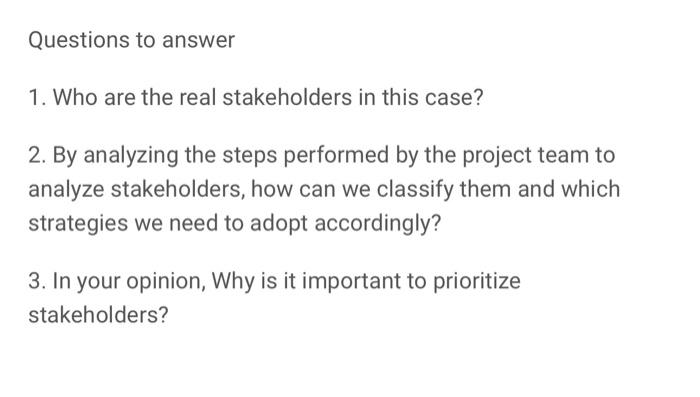
1. Who are the real stakeholders in this case?
2. By analyzing the steps performed by the project team to analyze stakeholders, how can we classify them and which strategies we need to adopt accordingly?
3. In your opinion, Why is it important to prioritize stakeholders?
1. Who are the real stakeholders in this case? 2. By analyzing the steps performed by the project team to analyze stakeholders, how can we classify them and which strategies we need to adopt accordingly? 3. In your opinion, Why is it important to prioritize stakeholders
Step by Step Solution
There are 3 Steps involved in it

Get step-by-step solutions from verified subject matter experts
 Study Help